
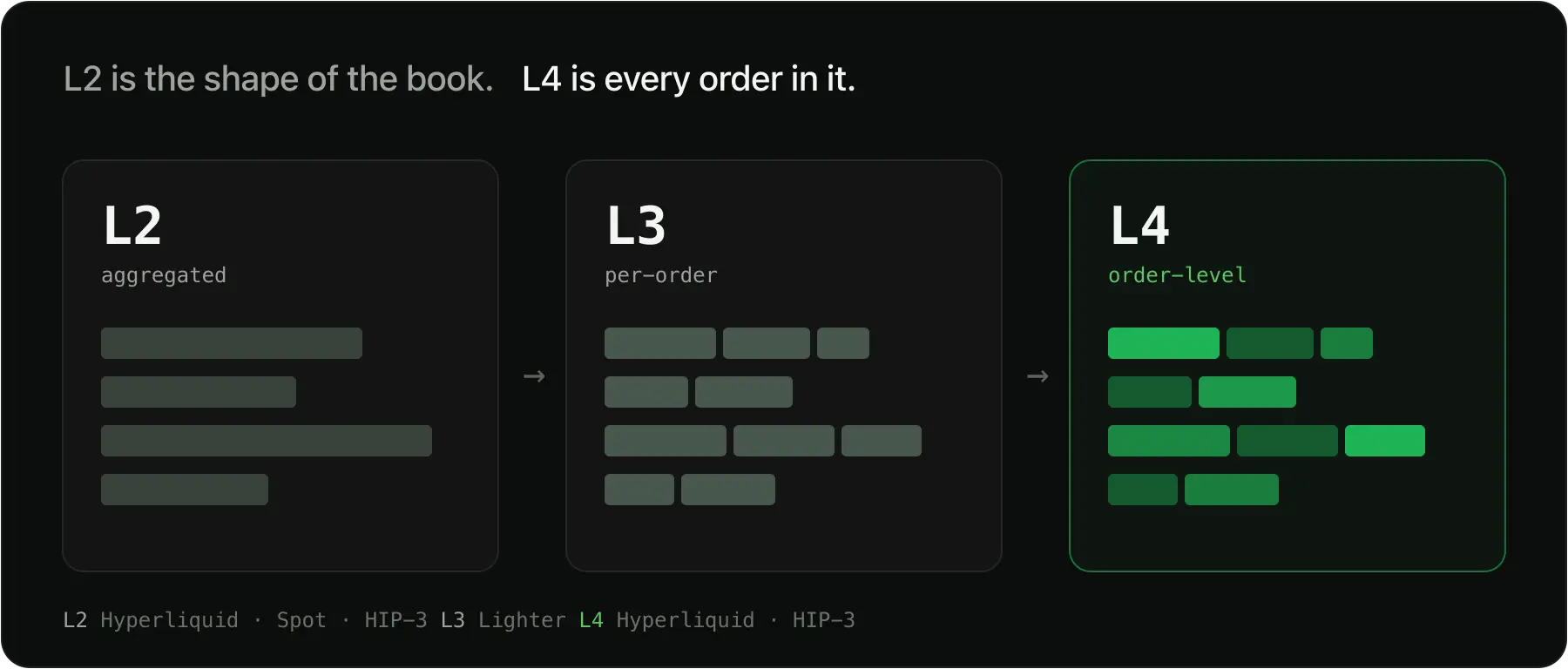
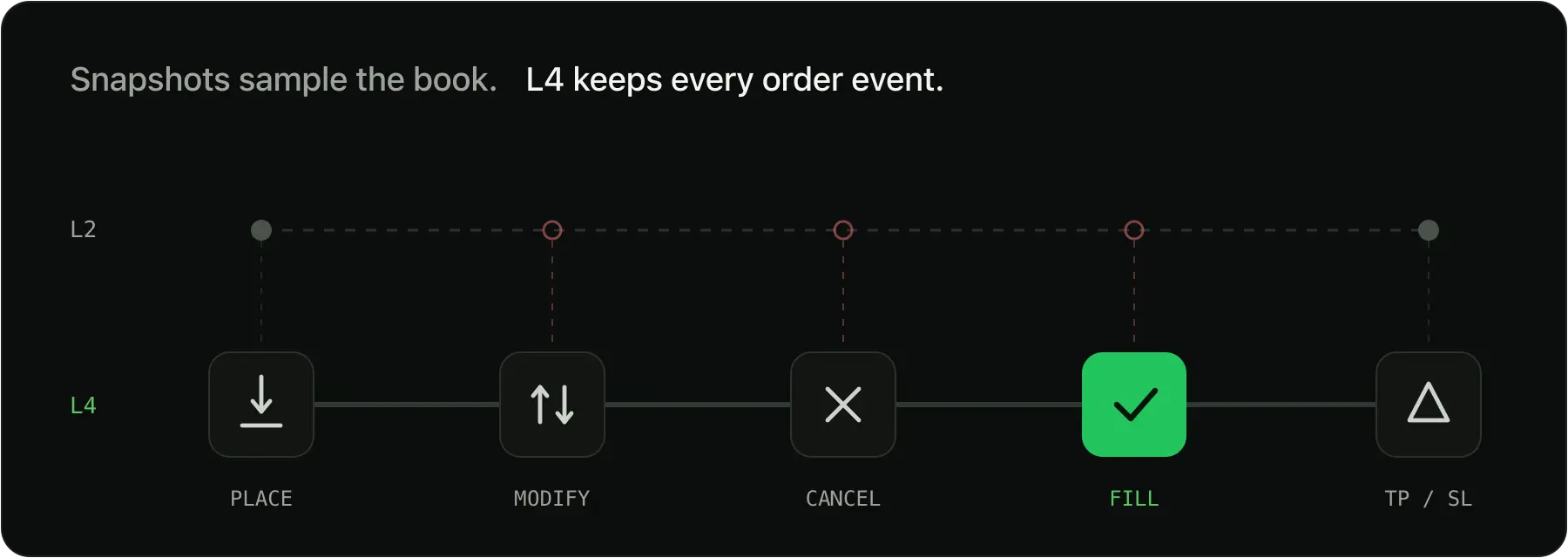
Hyperliquid order-book data has three useful grains: aggregated price levels, resting order-level depth, and order-event lifecycle records. Pick the grain that matches the question. A spread study needs L2. A queue or reconstruction study needs a resting L4 book. A placement, cancel, or trigger study needs l4_orders history.
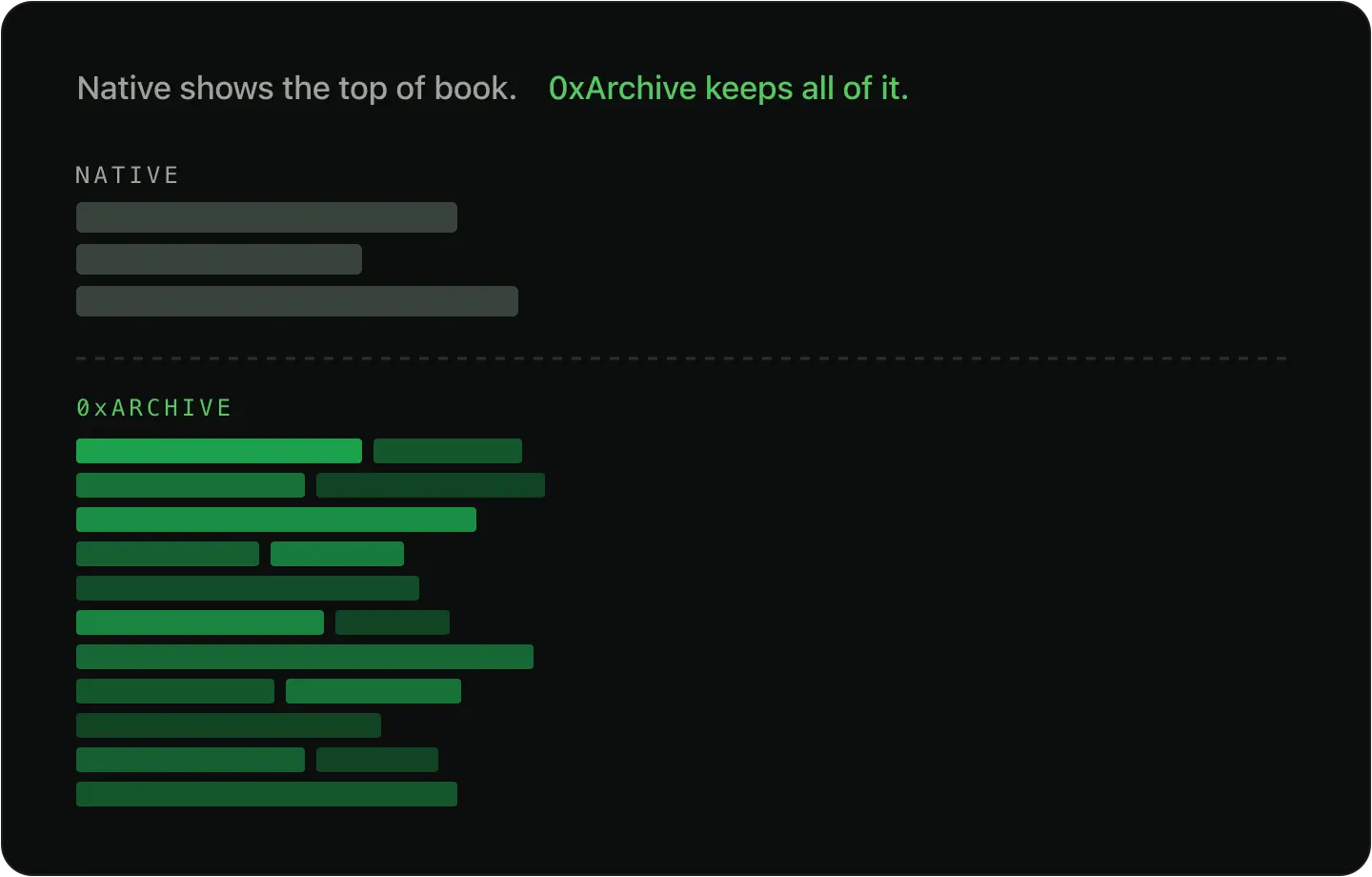
Short answer: native
l2Bookreturns aggregated price-level snapshots at its documented depth. 0xArchive adds historical L2, all-level aggregation derived from L4, resting-order L4, ordered diffs, lifecycle history, and export paths. Those are related data products, not interchangeable names.
Run one bounded snapshot
curl "https://api.0xarchive.io/v1/hyperliquid/orderbook/BTC?timestamp=1767225600000&depth=20" \
  -H "X-API-Key: $OXARCHIVE_API_KEY"
The timestamp is Unix milliseconds. Keep the symbol, timestamp, depth, response envelope, and meta.request_id with the snapshot.
What native l2Book means
Hyperliquid's native l2Book info response is an aggregated snapshot. Each side contains price levels with price, size, and order count. It is not only the best bid and ask, and it is not a per-order event stream. The native response is the venue's own response. 0xArchive's L2 routes retain aggregated levels for historical queries and deeper bounded reads.
Read the official info endpoint reference for native request semantics. Use the 0xArchive order-book routes for the archive contract.
Depth matrix
Every level from the best bid to the wallet, shown on one order book, is in level 1 vs level 2 vs level 3 market data.
| Surface | Grain | Use it for |
|---|---|---|
Native l2Book | Aggregated price levels in a venue response | Current or bounded native depth inspection |
| 0xArchive L2 | Aggregated levels with size and order count | Historical spread, depth, and slippage studies |
| 0xArchive L4 order book | Resting orders with oid and user_address | Queue detail, wallet attribution, and reconstruction |
l4_orders and /tpsl | Order-event lifecycle rows | Placed, canceled, triggered, and status changes |
/trigger-levels | Pending trigger-order size bucketed around price | TP/SL concentration before a trigger fires |
| Trades | Resulting executions | Confirm what actually filled after a trigger or resting order |
Resting L4 depth describes the book state. l4_orders and /tpsl describe lifecycle events. /trigger-levels describes pending concentration. A resulting trade is the execution record.
Download the fixed Parquet sample and verify its published size and SHA-256 in the sample manifest.
Choose the route
- Current or timestamped depth:
/v1/hyperliquid/orderbook/{symbol}. - Historical L2 snapshots:
/v1/hyperliquid/orderbook/{symbol}/history. - Resting L4 history:
/v1/hyperliquid/orderbook/{symbol}/l4/history. - Order lifecycle:
/v1/hyperliquid/orders/{symbol}/historyand/v1/hyperliquid/orders/{symbol}/tpsl. - Pending trigger concentrations:
/v1/hyperliquid/orders/{symbol}/trigger-levels. - Resulting fills:
/v1/hyperliquid/trades/{symbol}.
An empty result applies only to the selected venue family, symbol, route, and window. Check the catalog and status before concluding that data is unavailable more broadly.
Workflows
| Question | Start with | Keep beside the result |
|---|---|---|
| How much liquidity was displayed? | L2 snapshot or history | Timestamp, depth, spread, and request ID |
| Which resting orders formed the level? | L4 snapshot or diffs | Order ID, wallet, side, price, and size |
| Which orders changed state? | l4_orders history | Status, event timestamp, order type, and cursor |
| Where are pending triggers concentrated? | /trigger-levels | As-of time, bucket price, and side totals |
| Did a trigger produce a fill? | Join lifecycle rows to trades | Trigger time, trade time, price, and size |
Related routes
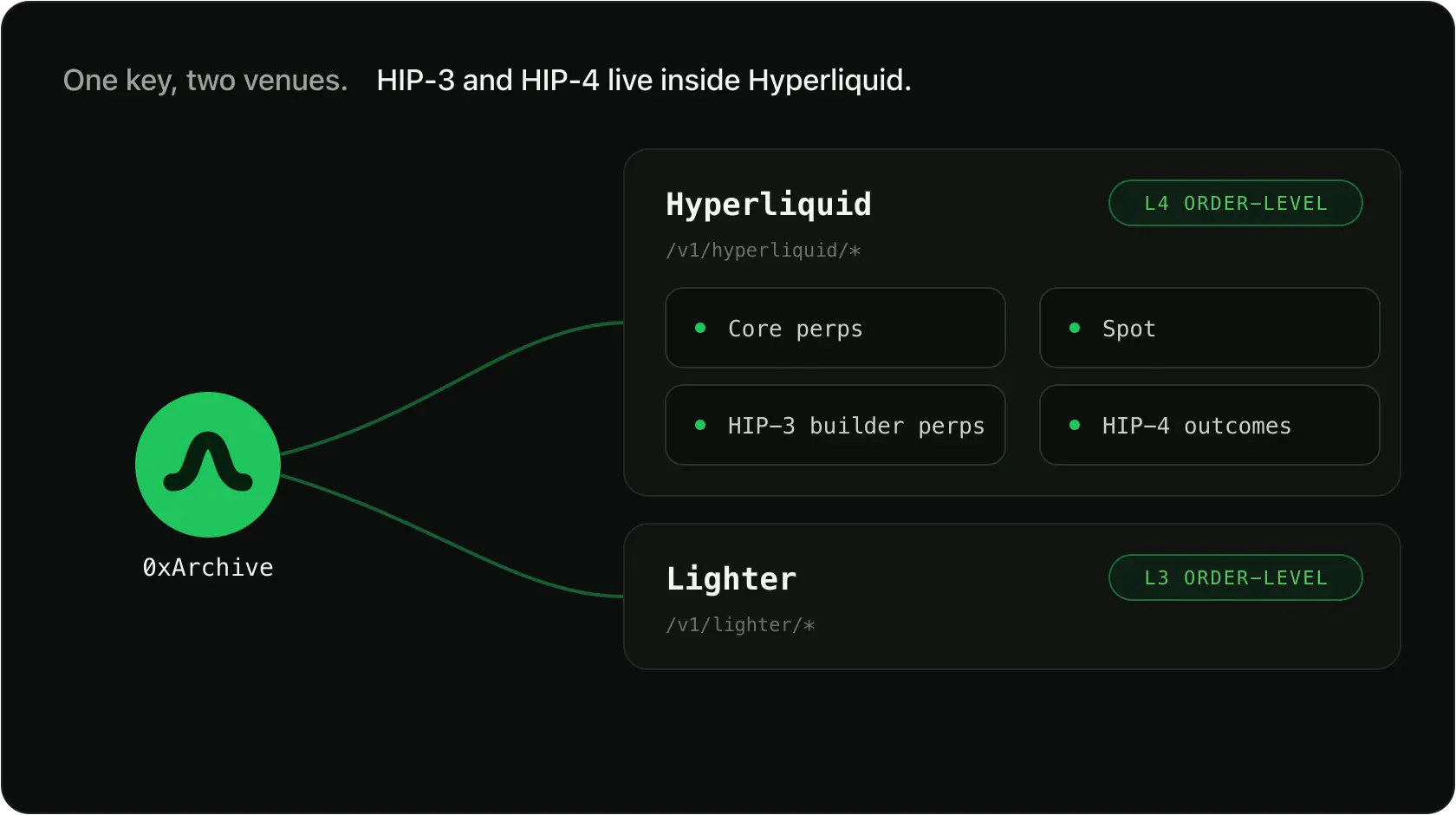
Use the HIP-3 L4 and TP/SL release for HIP-3 order-level data. Use the backtesting guide when depth becomes an execution-model input.
The exact contracts are in the Hyperliquid Order Book Data API, L4 order-book reference, Order history, TP/SL, and Order flow pages. Compare the Hyperliquid data API, pricing, and status for current delivery details.