
You cannot buy Anthropic on any stock exchange. On August 19, Entropy opened a perp for it on Hyperliquid anyway. The book started empty. 0xArchive recorded every second of what happened next. This is the first week of evidence.
Trading started before the announcement: first fill August 19 at 10:59 UTC, five days before RedStone's launch post, including a 4.0% move on $224,072 of volume on August 21.
The announcement multiplied everything: daily volume went from $369,081 on day one to $11,619,926 in the first sixteen hours of August 26; open interest grew 4.6x in exactly 48 hours.
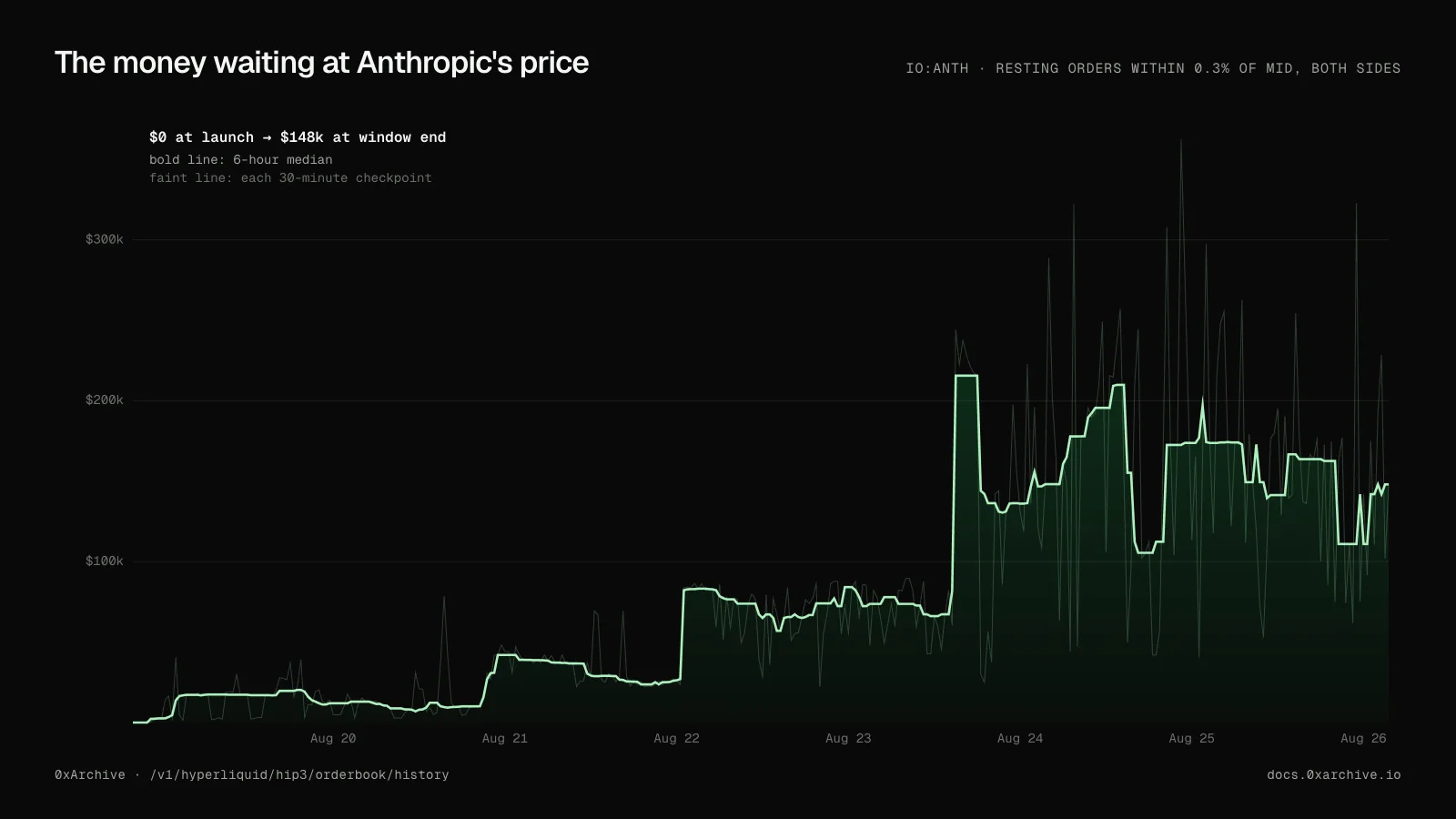
The book got cheaper to trade, not just busier: the bid–ask gap tightened from about 50 cents to about 10 cents on a $2,000 price, and money resting within 2% of the price grew about 6x.
Funding leaned long the whole way: the perp traded above its reference in 30 of 34 complete four-hour windows; the largest premium hit during the quiet period, not the announcement.
Verdict, bounded to one week: price discovery is working; durability is the open question the ongoing recording will answer.
Pricing a company with no public market
Anthropic has no ticker. No exchange session, no closing auction. What it has is a scattering of reference points: funding rounds, tenders, secondaries. Marks that arrive weeks apart, each negotiated in private.
Entropy built a market for it anyway: a perp on Hyperliquid, deployed via HIP-3 under the io namespace. Per RedStone's launch post, the mark blends an outside reference with Entropy's own book. And because Anthropic has no public price, the book carries more of the weight. That makes this market a live experiment: if the company trades nowhere else, where does the right price come from?
The published answer: the book earns influence when it holds real orders, on both sides, close enough to actually fill against. You do not have to take that on faith. It is a state you can measure. This book has been recorded at one-second resolution since before anyone placed a single order.
The four measurements this study uses
Spread: the gap between best bid and best ask. On a $2,000 price, tight here means about 10 cents.
Depth: how much money rests within reach of the price, counted here within 2% of it.
Two-sidedness: the smaller of the two sides, because a wall of bids with nothing offered against it is not a market.
The three prices: the mid, where the book meets; the mark, what the protocol settles on; the oracle, the outside anchor.
One boundary holds throughout. Nothing here reconstructs Entropy's internal oracle weights. The study measures the state the mechanism is described as responding to. What the book held, not what the oracle believed.
The first snapshots, at 08:56 UTC on August 19, show a market with zero bids and zero asks. The contract existed; the price did not.
Anthropic's launch week: volume, trades, and open interest
The data splits the launch into two chapters on its own. Trading began August 19, five days before RedStone's launch post. First recorded fill: 10:59:43 UTC. Through August 23 it traded like the soft launch it presumably was. $296,746 to $612,957 a day.
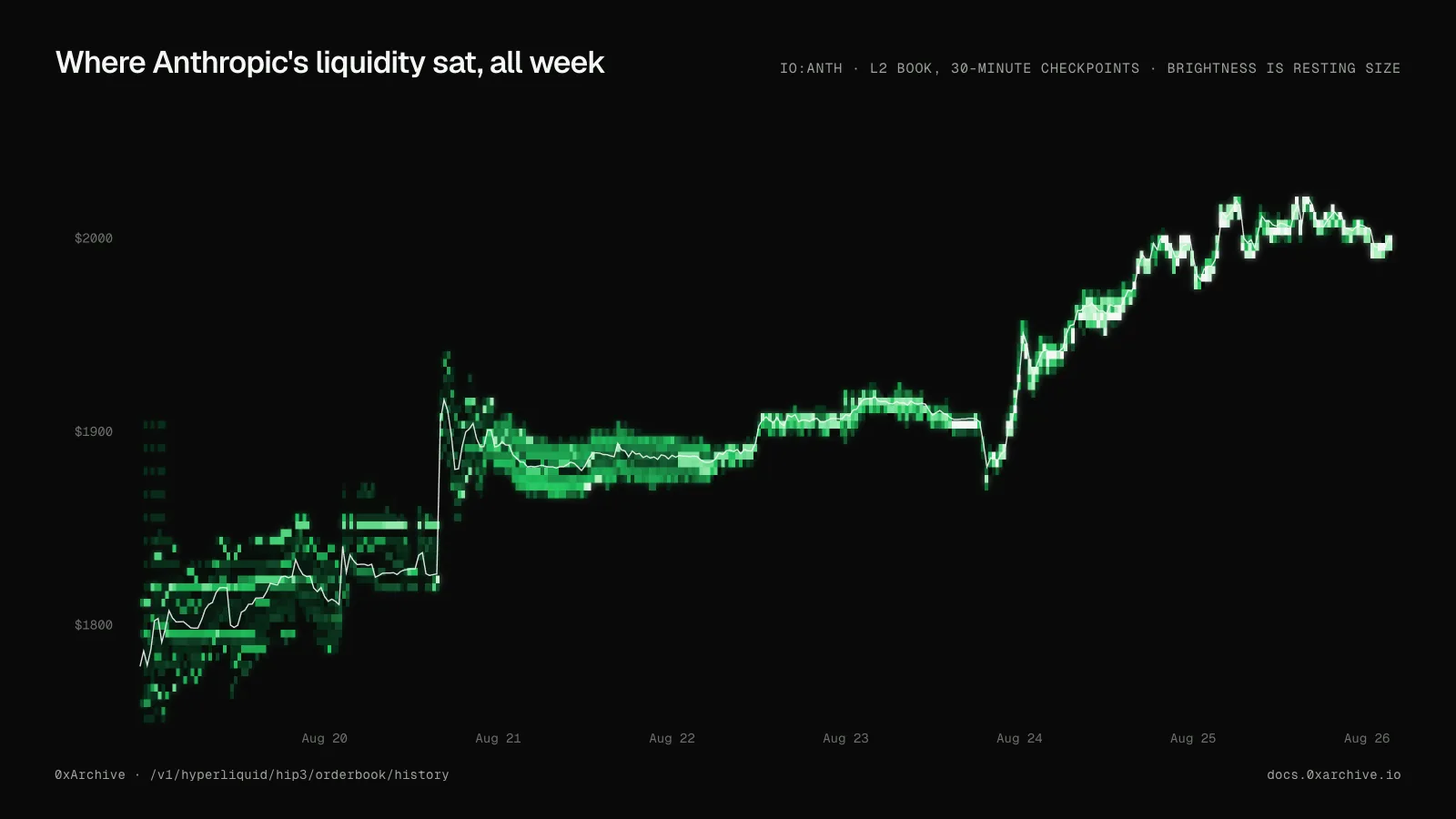
Price discovery did not wait for the audience. The book opened at $1,796.8 and sat near $1,912 by announcement day. The sharpest move came August 21: up 4.0% in four hours on $224,072 of volume. Whoever traded the quiet market moved it with very little money.
Then the announcement landed. The table tells it day by day. One wrinkle worth seeing: open interest dipped through announcement-day morning, 350.7 to 292.2 contracts, as early holders de-risked into the attention. Then it ran.
Day (UTC) | Traded | Fills | Open interest at 00:00 |
|---|---|---|---|
Aug 19 (from 09:00) | $369,081 | 8,279 | n/a |
Aug 20 | $444,466 | 5,826 | n/a |
Aug 21 | $612,957 | 6,375 | 199.8 |
Aug 22 | $296,746 | 2,680 | 290.6 |
Aug 23 | $468,424 | 3,683 | 306.6 |
Aug 24, announcement | $2,616,448 | 10,718 | 350.7 |
Aug 25 | $8,699,023 | 71,776 | 1,026.5 |
Aug 26 (to 16:00) | $11,619,926 | 110,702 | 1,609.3 |
From 0xArchive 4h candles and open interest history for io:ANTH. Aug 26 covers complete buckets to 16:00 UTC.
The tell is the timing. Spreads started tightening the morning of August 24, before the post went out. That fits market makers arriving early, not reacting.
Spreads and depth in Entropy's Anthropic market
Volume is participation. Depth is credibility. This market's whole premise is that the book earns pricing influence when real money rests close to the price, so this is the section that matters. Sampled at matching timestamps: the gap between best bid and best ask went from about 50 cents to about 10 cents on a $2,000 price, and the money you could actually fill against grew about 6x. The early book was thin exactly where it mattered. A market that can print a price is not yet a market that can absorb one.
Snapshot (UTC) | Bid–ask gap | Asks within 2% | Bids within 2% |
|---|---|---|---|
Aug 20, 12:00:27 | ≈50¢ | $82,934 | $46,577 |
Aug 22, 12:00:22 | ≈50¢ | $121,047 | $167,529 |
Aug 24, 06:00:21 | ≈20¢ | $177,269 | $323,555 |
Aug 25, 12:00:10 | ≈10¢ | $334,462 | $279,705 |
Aug 26, 12:00:49 | ≈10¢ | $424,765 | $434,763 |
Exact values are from single named snapshots, not medians; the full one-second series is the underlying record. Bid-ask gaps at the five snapshots were 2.75, 2.65, 1.05, 0.50 and 0.50 bps.
Three windows selected for order-level replay
Three windows, picked by rule rather than by eye. The August 21 repricing, up 4.0% on $224,072. Announcement-day morning, when open interest fell while volume rose. And the sharpest one-minute move after real liquidity arrived.
How the three prices and funding behaved
The three prices stayed close all week. Mark and oracle tracked tightly, the mark a touch above, gaps mostly 50 cents to two dollars on a $1,900 to $2,010 contract. The book's own mid sat almost exactly on the mark. The market and its references told the same story.
The perp held a small, stubborn premium. Longs leaning the whole way, never violently. And the largest premium did not come from the announcement crowd. It hit during the quiet-period repricing, three days before the launch post.
Funding premium | Value | When |
|---|---|---|
Windows above reference | 30 of 34 | complete 4h windows, mostly +0.03% to +0.08% |
Largest premium | +0.17% | Aug 21, 04:00 UTC, during the quiet repricing |
Late push | +0.13% | near midnight Aug 26, post-announcement bid |
Below reference | 4 windows | all in the Aug 21–22 lull |
One week in, Anthropic price discovery on Entropy is working
For five days io:ANTH was a listed contract with a thin book. A few hundred thousand dollars could move it several percent. After August 24 the book thickened, spreads tightened 5.5x, and price action turned continuous and crowded.
The chicken-and-egg problem every synthetic market faces is visible in this data. And it resolved fast, once real liquidity showed up.
The open questions now are about durability. Does the deep book hold. How many hands supply it. What it does through its first real shock, a funding round headline or a big model release.
The experiment is bigger than Anthropic. Pre-IPO equity. Real-world assets with stale references. Anything that rarely prints. The bet is that a book with real money on both sides can be the place the price gets made, not a shadow of one. That bet now has recorded, replayable evidence building under it, one second at a time.
Common questions
Does Anthropic have a stock price?
No public one. Anthropic is a private company with no ticker and no exchange listing. Its reference points are funding rounds, tenders and secondaries. Entropy's io:ANTH perpetual on Hyperliquid trades its implied valuation continuously.
What is Entropy?
Entropy deploys pre-IPO and real-world-asset perpetual markets on Hyperliquid via HIP-3. Its launch was announced on 24 August 2026 with an Anthropic market (io:ANTH) and a SanDisk market (io:SNDK), with price anchoring described by RedStone.
What is io:ANTH?
io:ANTH is Entropy's HIP-3 builder perpetual on Hyperliquid tracking Anthropic's implied valuation. The first recorded fill was 19 August 2026 at 10:59 UTC, five days before the public launch post. The io namespace is part of the market's identity.
Can you buy Anthropic stock?
Not on any stock exchange. Exposure to Anthropic exists through private secondary transactions or through synthetic markets such as Entropy's io:ANTH perpetual. This article studies how that market priced Anthropic in its first week; it is research, not investment advice.
Reproduce the analysis
Market identity is io:ANTH; the builder namespace is part of the identity, so do not flatten it to a generic ANTH. Window: 2026-08-19T08:00Z to 2026-08-26T16:00Z, all timestamps UTC, complete 4h buckets only: 44 of 44 expected candle buckets and 34 of 34 open-interest and funding buckets from their first record onward. No values were interpolated. A trailing partial bucket was excluded: the API returns each bucket aggregated over its full four hours, so a mid-bucket snapshot cannot be reproduced by a later pull. Underlying coverage, verified before analysis: order book complete at one-second median cadence with no gaps; fills complete apart from three August 23 gaps at 03:25–03:57, 17:25–18:02 and 18:32–19:28 UTC.
Trade counts use the candle series' trade_count. The trades endpoint returns two records per execution, one per side sharing a tradeId, so counting its rows without deduplicating doubles every figure.
The fixed UTC window, linked API routes, source timestamps, and tradeId deduplication rule define the reproduction contract. Use the ANTH-USD catalog page and linked endpoints to reproduce the pull. This article does not republish the raw archive.
Run this analysis from an agent
Every number in this article came from public endpoints an agent can call. 0xArchive ships an MCP server, so Claude and other AI agents can query the same io:ANTH order book, funding, and open interest surfaces in plain language; the earliest pulls behind this article ran through it. There is a Claude Code skill for terminal workflows and an agentic gateway for bounded data requests. Start with the agent surfaces overview or the guide to replayable market data for MCP, CLI and agent workflows.
Sources
RedStone, “RedStone Live powers Entropy pre-IPO and RWA markets on Hyperliquid,” 24 August 2026: blog.redstone.finance.
Alea Research, “Entropy: pricing private markets,” 25 August 2026 (secondary source): alearesearch.substack.com.
0xArchive historical data documentation: docs.0xarchive.io.