

Lighter L3 provides order-level snapshots of up to 250 resting orders per side, with owner attribution. Where L2 shows how much size sits at a price, L3 disaggregates the served depth into individual resting-order rows: its order ID, the account that placed it, the side, the price, and how much of it is left. 0xArchive serves this for Lighter over REST and WebSocket across 200+ markets, with L3 history going back to March 2026. Use L3 to reconstruct queue position and attribute orders to accounts.
L2 vs L3: what actually changes
Most order-book data is L2. L2 is aggregated by price level. Every resting order at 1567.79 gets summed into a single number, and you see one row: price, total size, and an order count. That is enough to draw a depth chart. It is not enough to know what happens to your order when you join that price.
L3 is the disaggregated book. Each served resting order is its own row. Two traders resting 2 ETH each at the same price show up as two records, not one 4-ETH level. This is the data shape quants call market-by-order: each order carries a stable ID, and you can follow it while it remains inside the served, bounded view. Disappearance alone does not prove that it filled or canceled.
Every level from the best bid to the wallet, shown on one order book, is in level 1 vs level 2 vs level 3 market data.
Here is the same price level in both views.
| L2 (aggregated) | L3 (per order) |
|---|---|
{ px: "1567.79", sz: "3.807", n: 3 } |
{ price: 1567.79, remaining_size: 1.500, owner_account_index: 476270 }{ price: 1567.79, remaining_size: 1.807, owner_account_index: 708287 }{ price: 1567.79, remaining_size: 0.500, owner_account_index: 713041 }
|
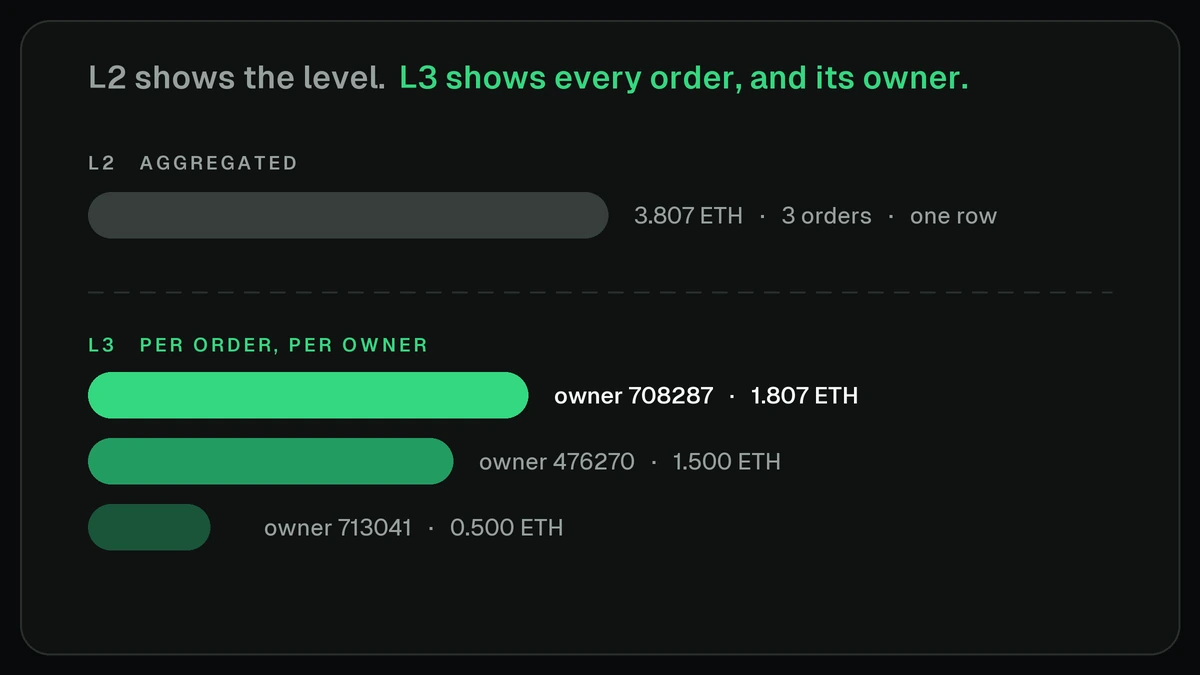
The L2 row tells you 3.807 ETH is bid at that price across 3 orders. The L3 rows tell you which 3 accounts, in what sizes, and in what order they arrived. That last part is the whole point. The difference between L2 and L3 is the difference between a histogram and a ledger.
What L3 carries on Lighter
Lighter is the only venue on 0xArchive that exposes L3. Hyperliquid exposes L4 resting-order book data, while order-lifecycle records are available through separate order routes. On Lighter, an L3 snapshot returns an array of resting orders, each with the fields below, plus book-level counts.
| Field | What it is |
|---|---|
order_index | Stable identifier for the resting order. Track it across snapshots to follow a single order's life. |
owner_account_index | The account index that placed the order. This is the attribution key. |
side | bid or ask. |
price | Limit price of the order. |
remaining_size | Size still resting. Falls as the order gets partially filled. |
original_size | Size the order was placed with. Compare to remaining_size to see fill progress. |
The response also carries bid_count and ask_count (orders per side), totals, mid price, and spread. A real ETH snapshot looks like this:
{
  "data": {
    "coin": "ETH",
    "timestamp": "2026-06-28T21:07:16.492Z",
    "mid_price": "1571.12",
    "spread": "0.14",
    "bid_count": 250,
    "ask_count": 250,
    "orders": [
      { "order_index": 562947490139185, "owner_account_index": 476270, "side": "bid",
        "price": 1568.36, "remaining_size": 0.485, "original_size": 0.485 },
      { "order_index": 562947490009211, "owner_account_index": 708287, "side": "bid",
        "price": 1570.85, "remaining_size": 0.400, "original_size": 0.400 },
      { "order_index": 281477344539214, "owner_account_index": 713041, "side": "ask",
        "price": 1573.27, "remaining_size": 3.2233, "original_size": 3.2233 }
    ]
  }
}
Coverage you can build on today: Lighter trades from the observed global floor of January 17, 2025, with exact starts varying by market; native L2 tick order book since January 2026; and L3 order-level since March 2026, across 200+ markets. Every one of those orders is keyed to the account that placed it, which is what turns the archive from a price series into a behavioral dataset.
Download the fixed Parquet sample and verify its published size and SHA-256 in the sample manifest.
What you can do with it
Reconstruct queue position
On L2 you can never answer "where am I in line at this price?" because the level is one number. On L3 the orders at a price arrive in sequence, and a stable order_index lets you place yourself relative to everyone else resting there. Queue position decides whether a passive order fills or gets skipped, so this is the input most order-book backtests are missing.
Attribute behavior to Lighter accounts
Each served resting order carries its owner_account_index. Group by owner and the book stops being anonymous. You can see which accounts post the tightest quotes, who pulls liquidity right before prints, who only ever rests on one side, and which handful of accounts actually set the top of book. This is the join key for market-participant studies, flow-toxicity models, and account-level analysis. The numeric account index is not a wallet address.
Separate makers from takers
Cross L3 resting orders against the trades feed by order and account. An order that rested and then shrank as a trade printed against it was the maker. The account that lifted it was the taker. Doing this per account, over time, gives you a maker/taker profile per account instead of only a venue-wide ratio.
Spot concentrated accounts and replenishment
Because you have original_size and remaining_size per order, refills become visible. An order that keeps reappearing at the same price in similar size after observed fills is a potential replenishment pattern that aggregated data can hide. Repetition alone does not prove hidden-size intent. The same fields let you size real resting interest from a single account and flag the orders large enough to move the book.
Build reproducible backtests
L3 history plus the trades feed is enough to replay the book event by event and simulate passive fills with queue priority. The archived records are repeatable. Simulated fills still depend on queue and execution-model assumptions.
Worked example: who is really at the top of book
Take the ETH snapshot above. The best bid sits at 1570.85 from owner 708287 for 0.4 ETH. Pull a few minutes of L3 snapshots and follow that order_index. If it stays put while price drifts, that account is a patient maker. If it cancels and reposts a tick higher every time someone joins, it is jockeying for queue priority. Now group every bid by owner_account_index across the window: if three accounts account for most of the size inside two ticks of mid, the book is thinner than the depth chart suggests, because L2 would have shown you the summed size and hidden the concentration. That is a signal you can only get from per-order rows with an owner attached.
How to pull it
Authenticate with the X-API-Key header. L3 is available on every tier, including Free. Start with a single snapshot:
curl -H "X-API-Key: $OXARCHIVE_API_KEY" \
  "https://api.0xarchive.io/v1/lighter/l3orderbook/ETH?depth=50"
For comparison, the L2 book is the aggregated route, and trades are their own feed:
# L2 aggregated book: bids/asks of { px, sz, n }
curl -H "X-API-Key: $OXARCHIVE_API_KEY" \
  "https://api.0xarchive.io/v1/lighter/orderbook/ETH?depth=50"

# Trades: price, size, side, account
curl -H "X-API-Key: $OXARCHIVE_API_KEY" \
  "https://api.0xarchive.io/v1/lighter/trades/ETH"
To study behavior over time, walk snapshots and index orders by owner. A short Python loop:
import os, time, requests
from collections import defaultdict

HEADERS = {"X-API-Key": os.environ["OXARCHIVE_API_KEY"]}
URL = "https://api.0xarchive.io/v1/lighter/l3orderbook/ETH"

size_by_owner = defaultdict(float)

for _ in range(20):                      # 20 snapshots
    r = requests.get(URL, headers=HEADERS, params={"depth": 50})
    book = r.json()["data"]
    for o in book["orders"]:
        if o["side"] == "bid":
            size_by_owner[o["owner_account_index"]] += o["remaining_size"]
    time.sleep(1)

# accounts resting the most bid size across the window
top = sorted(size_by_owner.items(), key=lambda kv: kv[1], reverse=True)[:5]
for owner, size in top:
    print(f"owner {owner}: {size:.2f} ETH cumulative bid size")
For continuous data, subscribe to the lighter_l3_orderbook WebSocket channel instead of polling, and reconcile against periodic REST snapshots. For history, the L3 archive goes back to March 2026, so you can rerun the same logic against the same archived records. Results still depend on your code and model assumptions.
Where to get Lighter L3
0xArchive carries Lighter L3 across 200+ markets over REST and WebSocket. Each resting order is keyed to the account that placed it, with order-level history since March 2026, alongside L2 tick data since January 2026 and trades from the observed global floor of January 17, 2025, with exact starts varying by market.
FAQ
What is the difference between L2 and L3 on Lighter?
L2 is aggregated: one row per price level with total size and an order count. L3 is per order: one row per resting order with its ID, owner, price, and remaining size. L3 lets you reconstruct queue position and attribute orders to accounts; L2 cannot do either.
Does Lighter L3 identify the account that placed each order?
Yes. Each order carries a numeric owner_account_index for the Lighter account that placed it. It is not a wallet address. Use it for account-level maker/taker and flow analysis.
How far back does Lighter L3 history go?
L3 order-level data goes back to March 2026. Native L2 tick order book goes back to January 2026. The observed global trade floor is January 17, 2025, with exact starts varying by market; funding and open-interest coverage must be checked separately by market.
Is L3 available for Hyperliquid?
No. L3 is Lighter only. Hyperliquid exposes L4 resting-order book data; separate order routes provide lifecycle records. If you need per-order owner data on Lighter, that is L3.
Which plan do I need for L3?
L3 is available on every tier, including Free. Every plan gets full venue and depth coverage; plans differ on limits like credits, rate, WebSocket subscriptions, replay, export, and history window: Free covers the most recent rolling 30 days with a maximum 30-day span per request, and Build and above keep the full retained archive. See pricing for current limits.
Can I use L3 for reproducible backtests?
Yes, with a stated model. The archived L3 records and trades are repeatable, but simulated fills depend on queue, latency, and execution assumptions. Record those assumptions beside the result.
REST or WebSocket?
Use REST (/v1/lighter/l3orderbook/{symbol}) for snapshots and historical pulls. Use the lighter_l3_orderbook WebSocket channel for continuous updates, reconciled against REST snapshots.
For current Lighter data, start with the Lighter live and historical data API, then use the overview and REST reference below for implementation details.
Start here
Pull one ETH snapshot, group the bids by owner_account_index, and see how few accounts hold the top of book. From there you can reconstruct queue position, profile makers and takers, and run backtests against the same historical window. Read the Lighter historical data overview, the Lighter REST reference, and check pricing for the plan that fits your usage.