
How to migrate your Hyperliquid node's peering to 0xArchive
Move a Hyperliquid non-validating node from public seeds or another provider to 0xArchive's allowlisted Tokyo peer: what to check first, the config change, and how to confirm it worked.
Practical methods for using market data.
Move a Hyperliquid non-validating node from public seeds or another provider to 0xArchive's allowlisted Tokyo peer: what to check first, the config change, and how to confirm it worked.
Hyperliquid historical data comes from four places: Hyperliquid's S3 buckets, the info API, a node you run, or a data provider. How far back each one goes and what each one misses.
TradeXYZ lists stocks, indices, commodities and FX as perpetual futures on Hyperliquid. How it works, how its prices hold up on weekends, what it costs, and what traded in September 2026.
Tick data is every trade and every order book change, one row each. What candles throw away, and why a backtest on them guesses which fill came first.
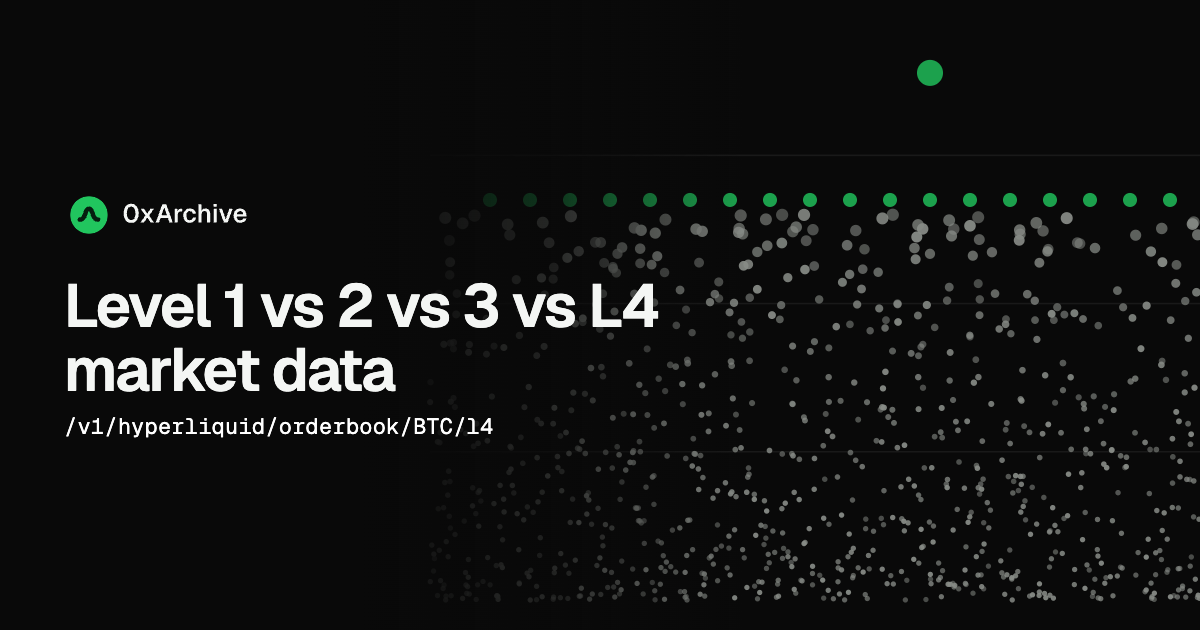
Level 1 is the best bid and ask, level 2 every price, level 3 every order, and L4 every order with its wallet. One illustrated BTC order book shows what each level keeps.

Test whether a HIP-3 wallet classification is stable on rerun by pulling one historical window twice and comparing the buckets.
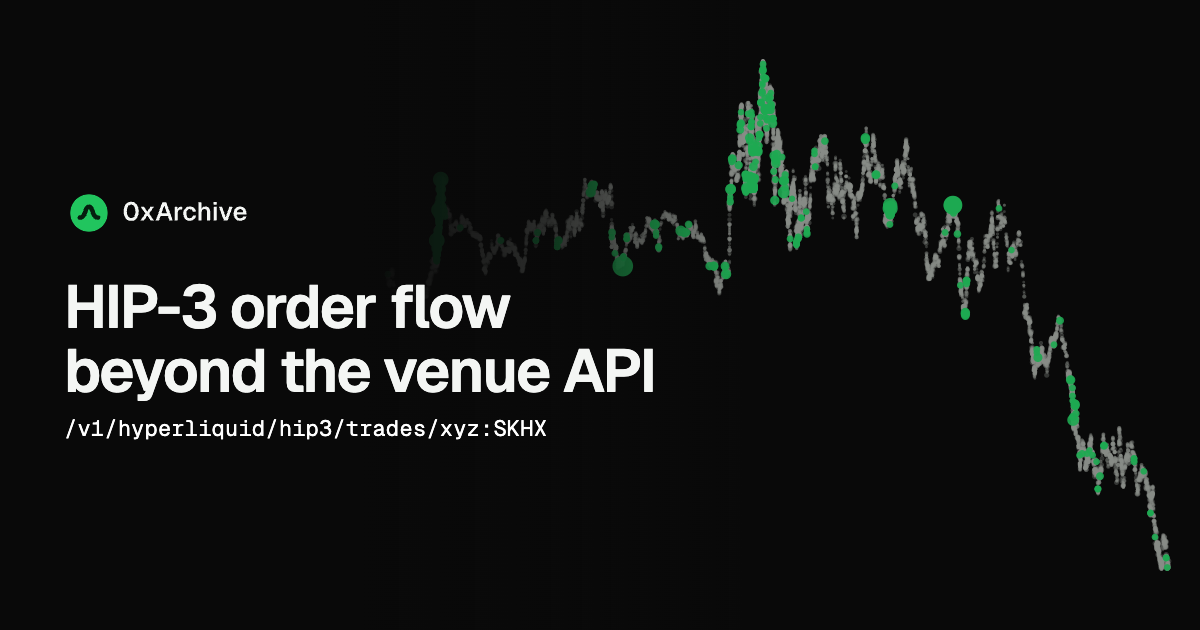
Venue APIs are excellent for narrow checks. The gap opens when the same HIP-3 reconstruction keeps getting rebuilt for a larger study.
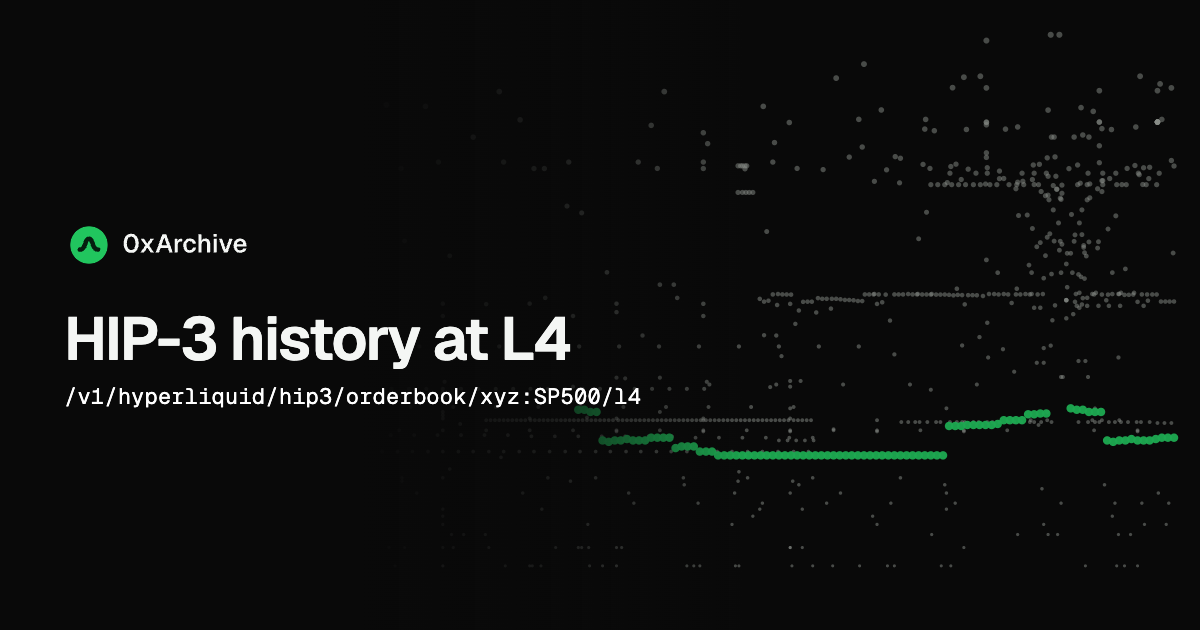
Inspect route-specific HIP-3 L4 book and lifecycle history, including orders, cancels, fills, and wallet attribution where served.
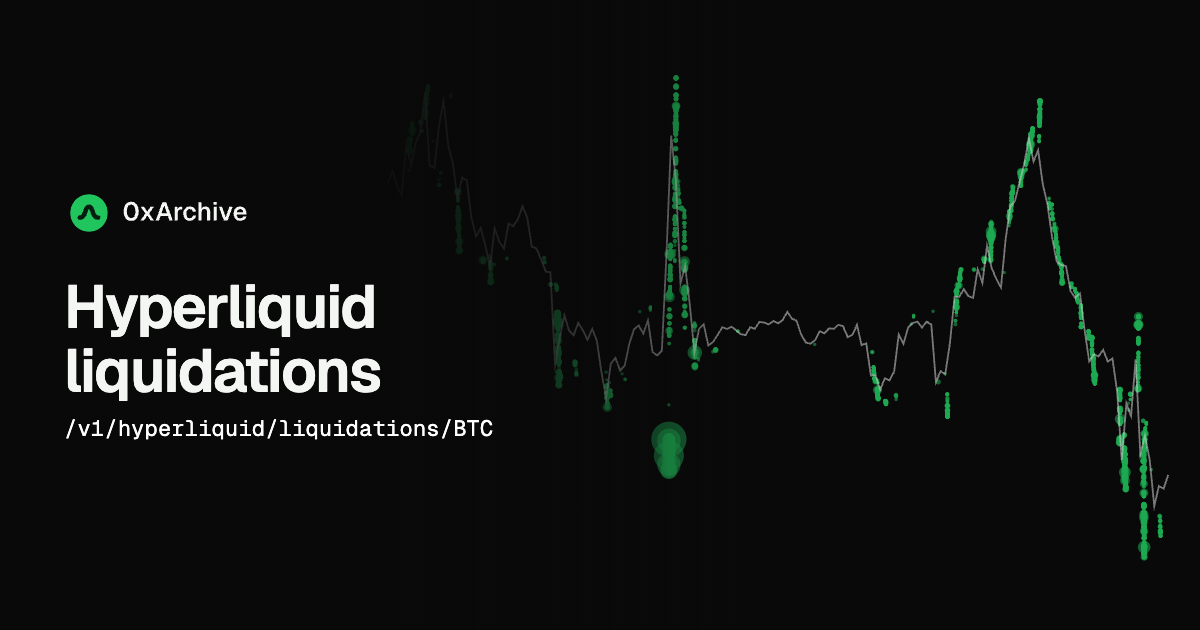
Read completed Hyperliquid liquidation events by symbol, then separate projected forced levels from pending TP/SL trigger concentrations.
On Hyperliquid's HIP-4 prediction markets the order-book price is an implied probability, not USD. How to read it, analyze it, and pull it from 0xArchive.
Lighter L3 returns up to 250 resting orders per side with owner attribution. Reconstruct queue position, attribute flow, and run backtests with historical order and trade data.
Query Hyperliquid native L2, all-level L2 derived from L4, and resting-order L4 history with route-specific depth and symbol coverage.
A question-first framework for deciding when checkpoint history is enough, when full L4 and order-level routes matter, and how to test the threshold on one Hyperliquid event window.
Why repeated Hyperliquid agent workflows benefit from typed tools, replayable history, and coverage-aware reruns once raw API pulls stop being enough.
A practical Hyperliquid evaluator playbook for comparing native venue pulls with managed history on one symbol, one window, and one rerunnable study.
Select, pull, normalize, and validate bounded Hyperliquid data before testing on an untouched holdout window.
Compare BTC funding rates across Hyperliquid and Lighter with an open-source notebook that normalizes rates and detects arbitrage windows.
Use an open-source notebook to visualize BTC liquidation events on Hyperliquid, including cascades and long-short imbalance analysis.
Start with Market data guides for integration and dataset-selection walkthroughs, and Research for analyses with a stated method and sample. Product updates explain changes, while the developer docs carry the current API and delivery contracts.