
- 5.3×Lower cost to hedge the spread on Hyperliquid than on Binance, and 7.4× lower than on Lighter.
- 3–5×More hedge volume on days that finish near the strikes than on days that drift away.
- $42KThe maker's loss. Hedging through the afternoon would have cut it to $6K to $17K.
- 17%More volume through Hyperliquid from a mixed hedge, at about half the cost.
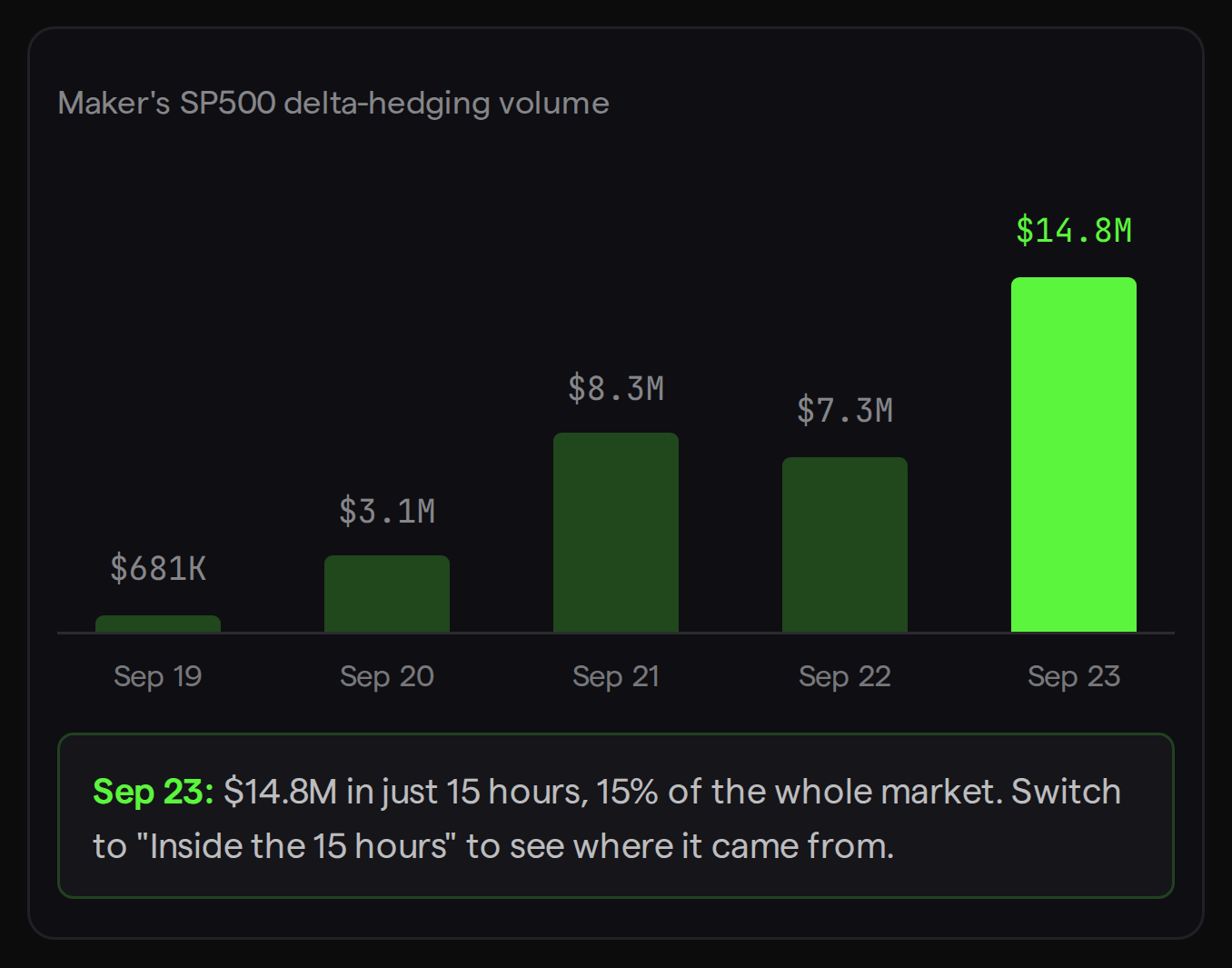
On September 23, one market maker on Hypercall traded 15% of all S&P 500 perp volume on Hyperliquid in 15 hours. That's $14.8 million.
It wasn't a whale taking a view. It was the maker cleaning up after a single options trade. Here's what happened, why one small option creates this much trading, and why that matters for Hyperliquid.
The trade
A trader thought the S&P 500 would drop before the close. Instead of shorting it, they bought a same-day put spread. Two legs:
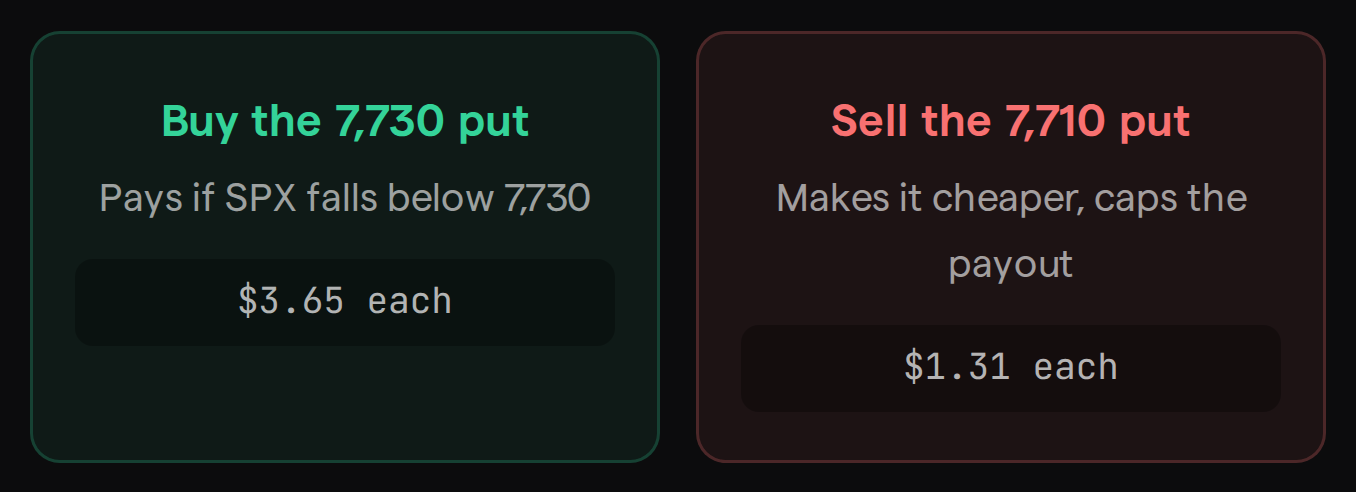
Both expired at 4:00 PM ET the same day. The trader paid $7,100 for about 3,000 spreads. Best case: $60,700. Here's the payoff at expiry. Hover to try any closing price:
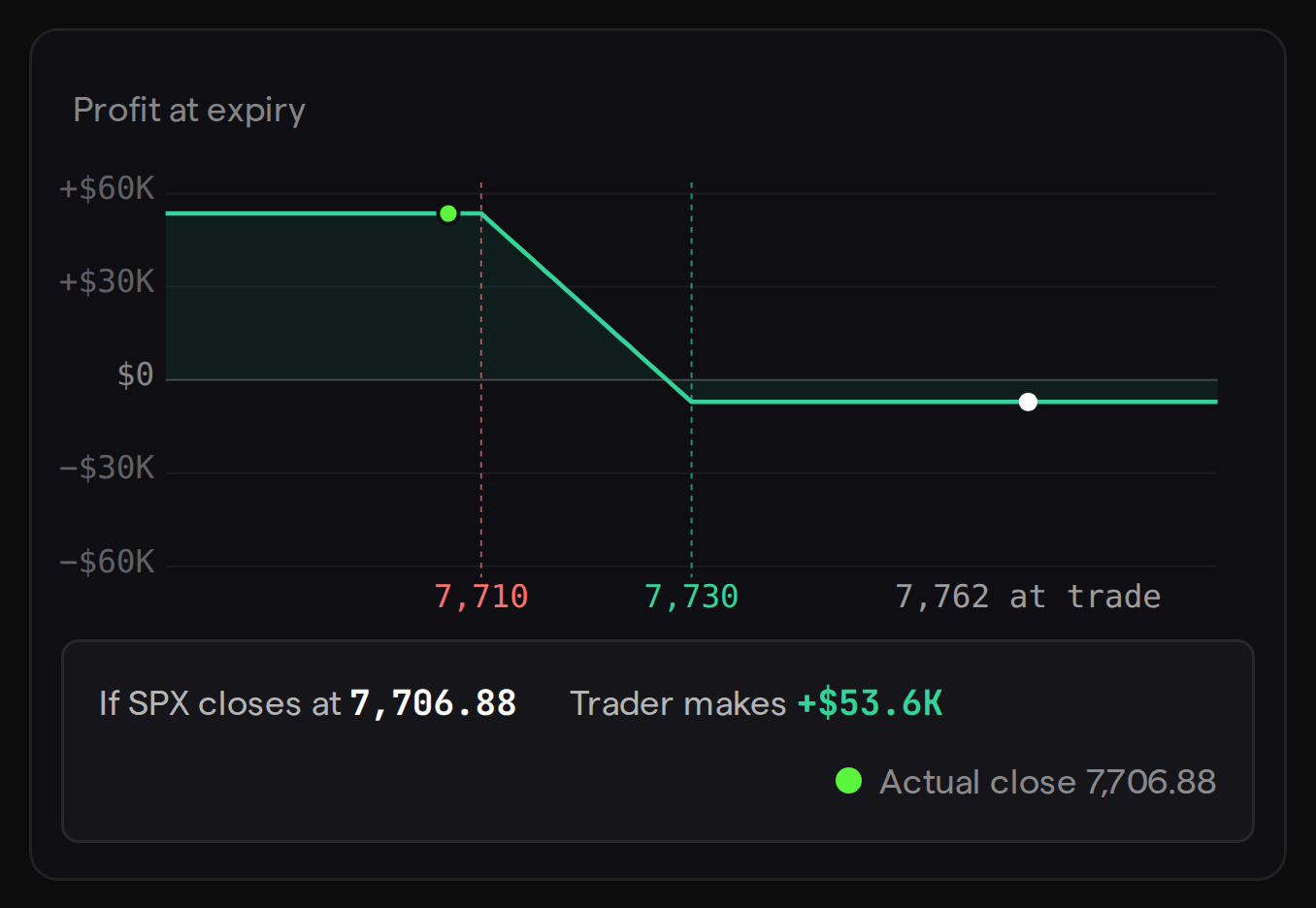
It worked. SPX closed at 7,706.88, just under the lower strike. The spread paid in full and the trader made $53,600 on $7,100.
Flip the chart to the maker's side. It's the mirror image, and it's the risk the maker had to hedge.
What was the taker thinking?
This wallet is a volatility trader. Its day job is selling options and earning the spread, about a thousand trades in five days. On SP500 it did the other thing vol traders do: buy cheap, short-dated protection when the price looks wrong.
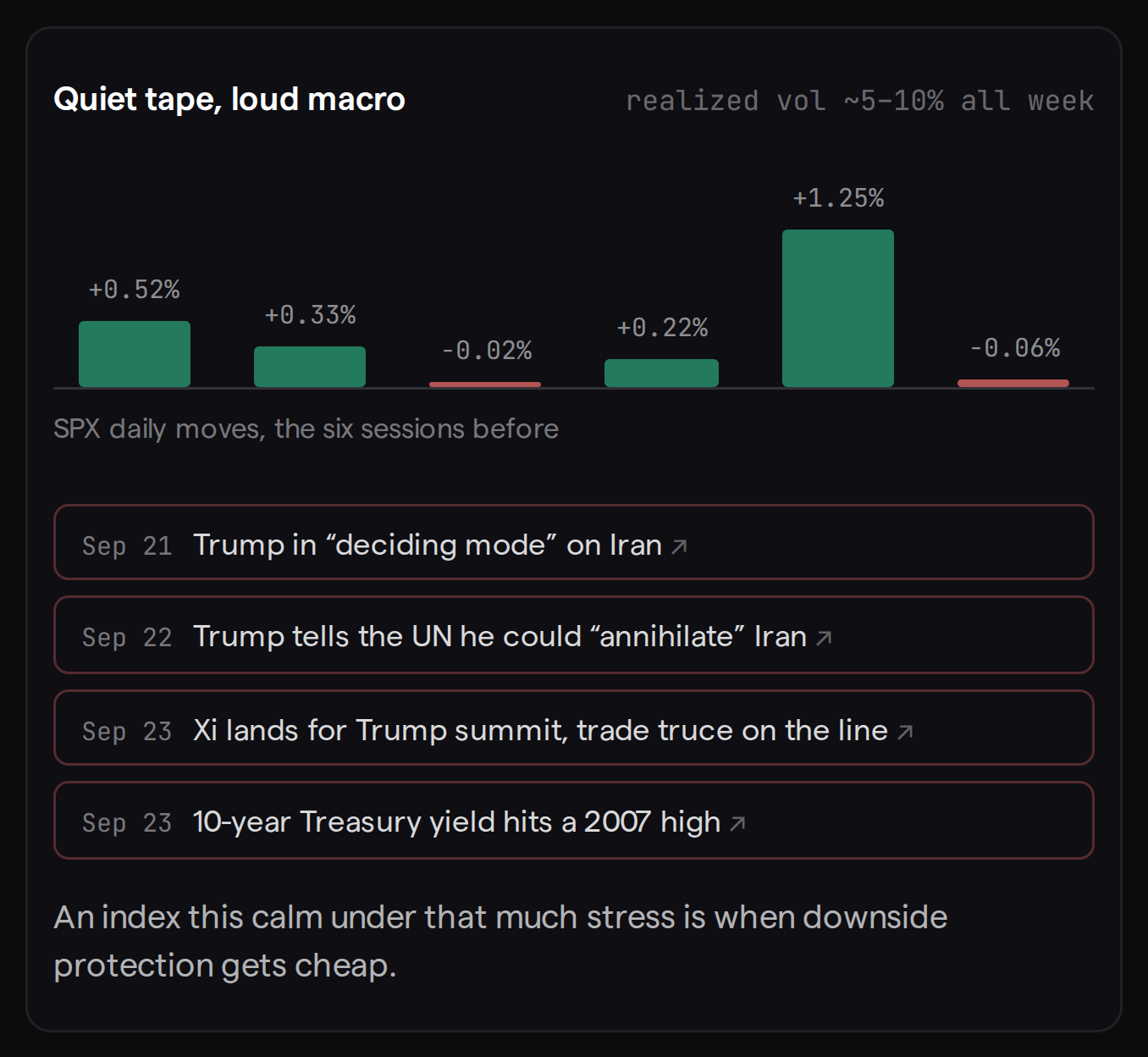
Linked headlines: Trump in “deciding mode” on Iran; Trump tells the UN he could “annihilate” Iran; Xi lands for Trump summit, trade truce on the line; 10-year Treasury yield hits a 2007 high.
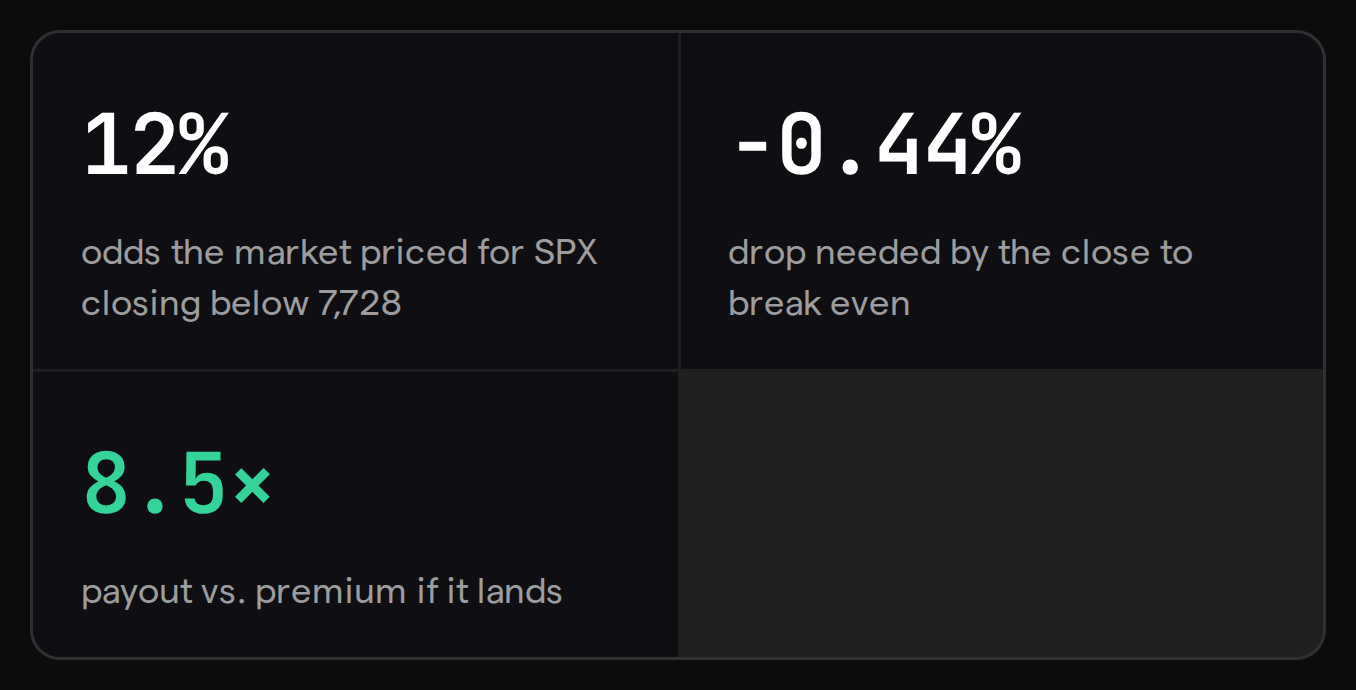
Sept 23 delivered −0.66% on a 1.1% range. And for $7,100 the trader owned the gamma into the close without ever trading it: the model hedge grew from about 8 units per SPX point at the trade to 13 by 15:00.
It also wasn't a lucky first shot. The same trader had bought SP500 put spreads the two days before and lost both:
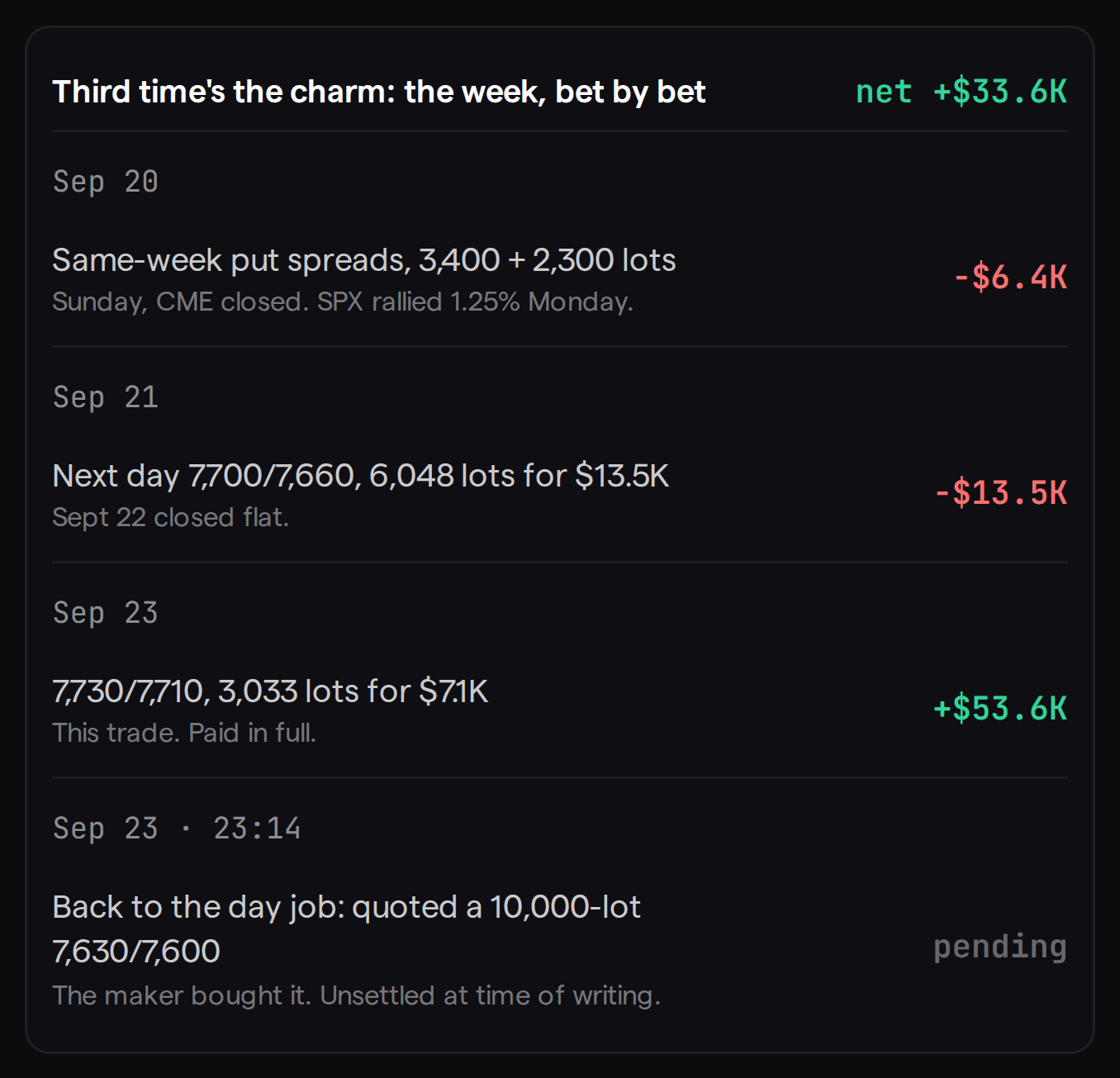
Net, the trader is up $33,600 on the week.
Why do the same two wallets keep meeting?
Hypercall's SP500 options book is still young, and this maker quoted six of the seven SP500 option prints across Sept 22–23. In a market that thin, the same few professionals end up on opposite sides again and again. The settlements went both ways: the maker collected about $20K on the first two bets, then paid the trader $60,700 on the third.
All of this is read from public settlement receipts. The wallet may hold positions elsewhere, so a spread that looks like a view could also be hedging exposure we can't see.
Why did the maker start selling?
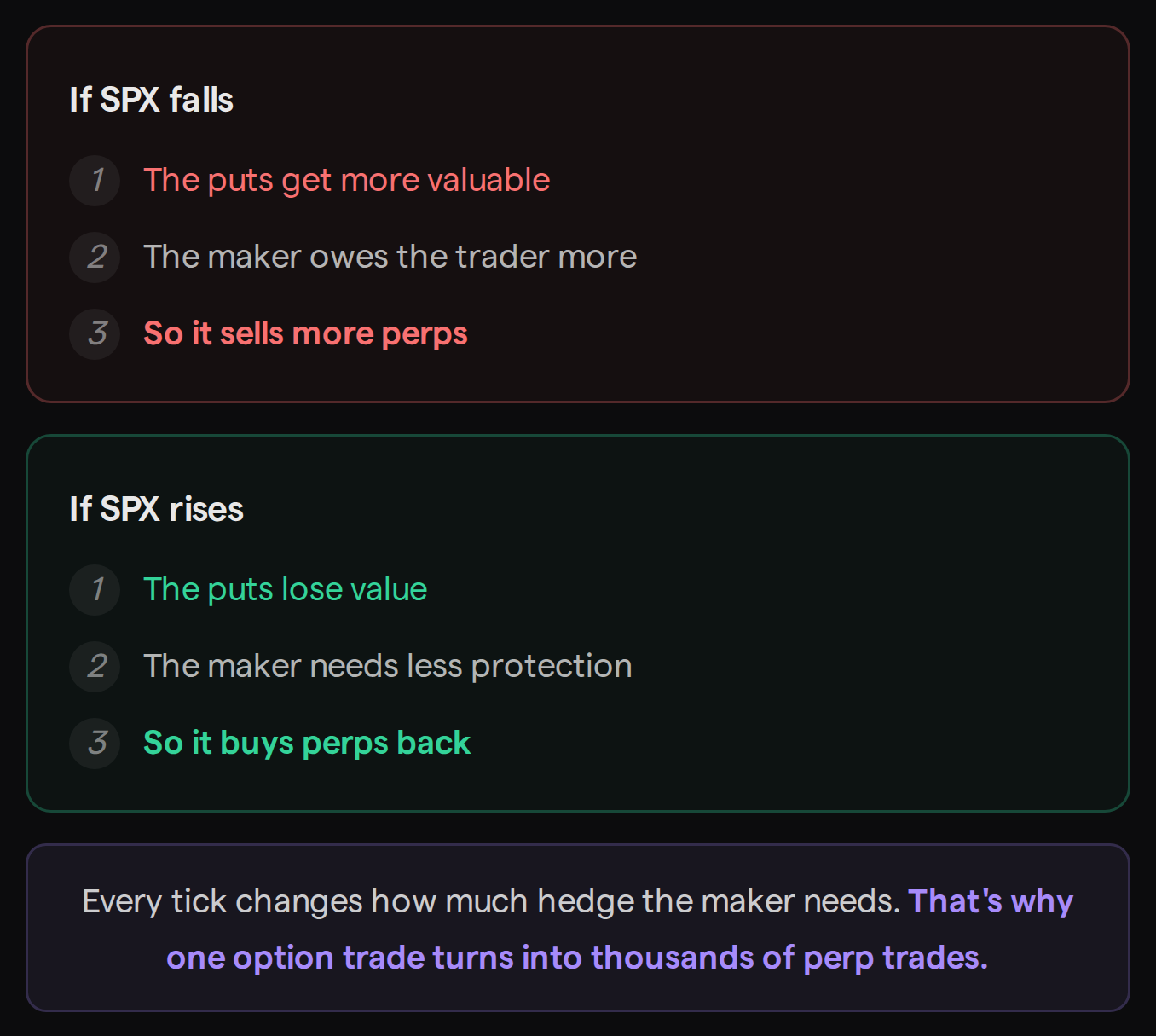
The maker sold the trader that put spread. So the maker now loses money if SPX falls. Market makers don't want that bet. They want to earn the spread and go home flat.
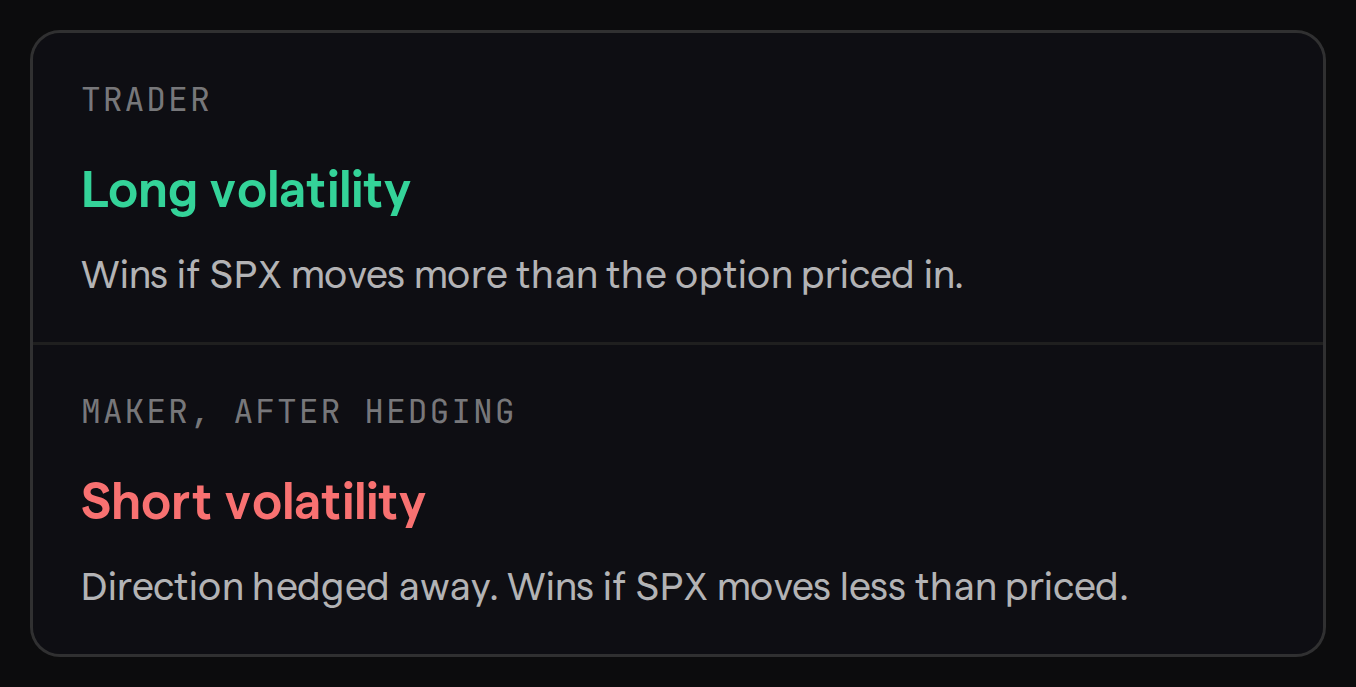
So neither side is really betting on direction. They're betting on how much SPX moves. The hedge strips out the direction and leaves the maker holding only that volatility bet.
So they offset it: short the S&P 500 perp. If the market drops, the short makes back what the options lose. The maker's first sale hit Hyperliquid 911 milliseconds after the option trade.
How big should the hedge be?
That number is called delta. Hit replay to watch it through the real day, or drag SPX and the clock yourself:
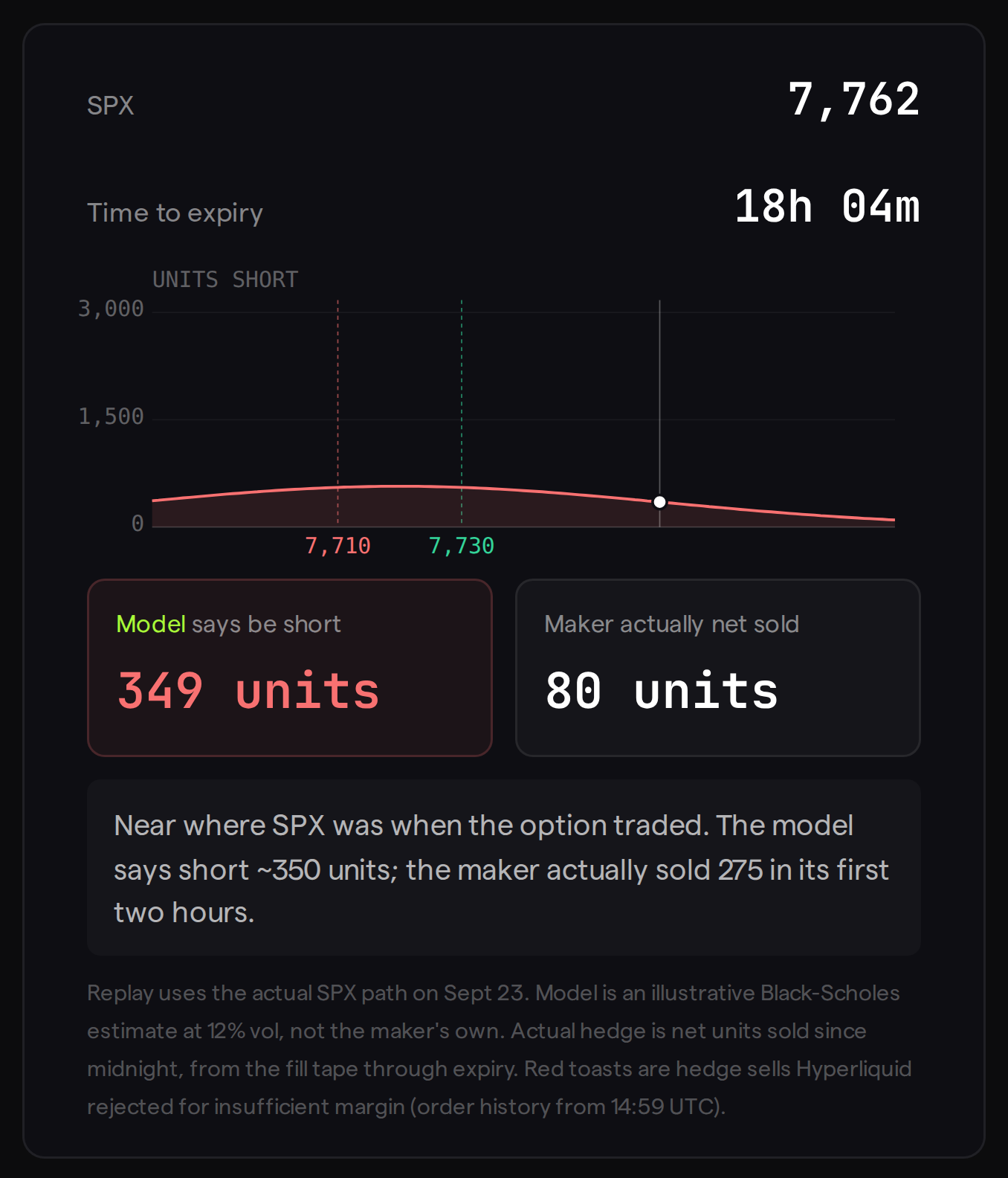
“Model” links to Hypercall's Black-Scholes reference.
Run the clock toward zero and the curve narrows into a spike between the strikes. That's gamma: late in the day, a few points of SPX can swing the hedge by hundreds of units. That's why the maker kept trading.
Why does real delta differ from target delta?
The model spits out a new target every tick, but trading to it isn't free. Every adjustment is a taker order: it crosses the spread and pays a fee, about 1.3 bps of turnover here. Chase the target exactly and those costs bleed the book. Let the hedge drift and you carry unhedged risk instead. Real engines pick a band and only trade when the gap gets too big:
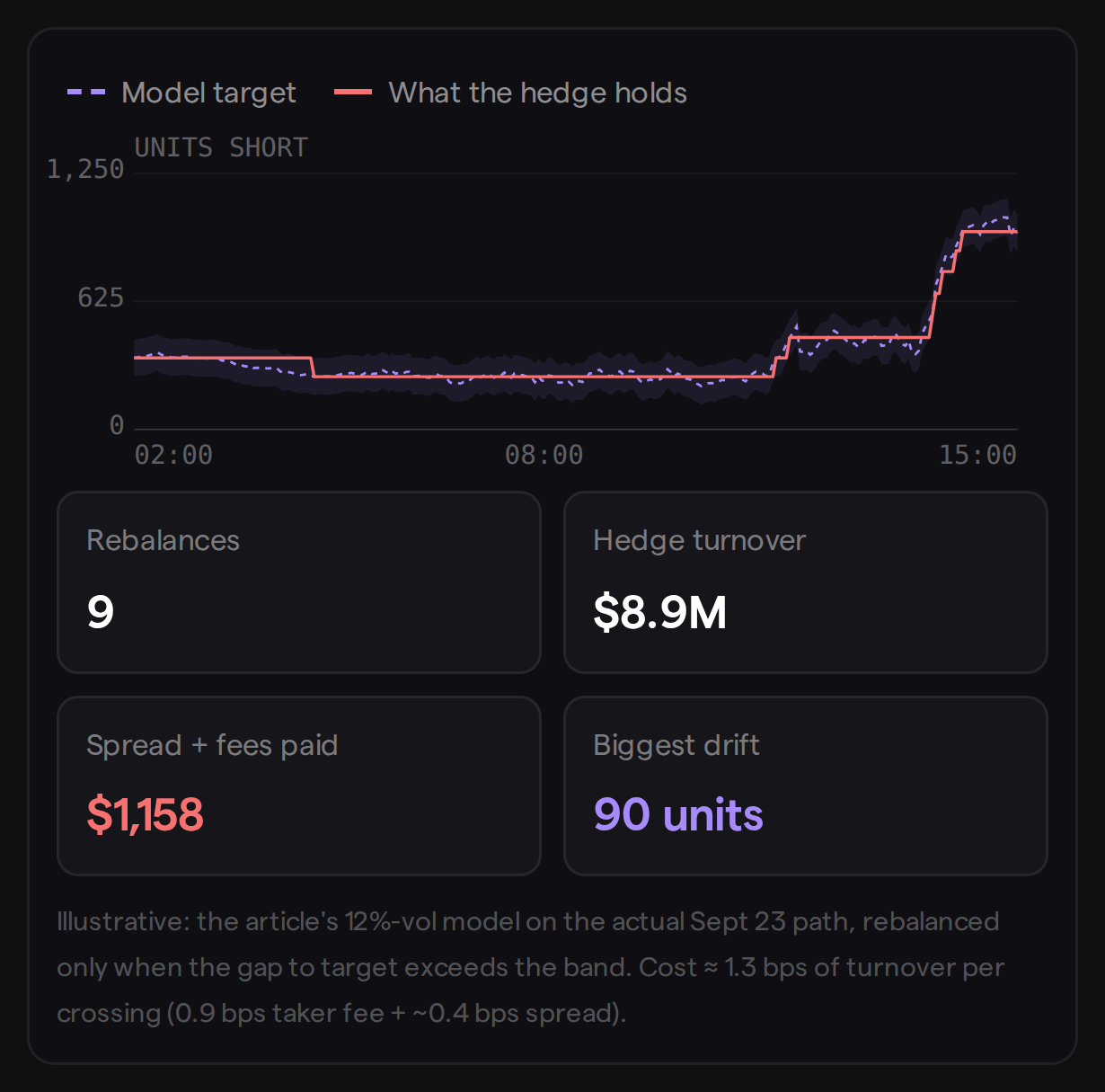
Chasing every tick roughly doubles the turnover and the spread-and-fee bill, for a hedge that's only slightly tighter. That trade-off, not sloppiness, is most of the gap between the model curve and what the maker actually held. The rest is the model itself: ours is a flat-vol guess at one spread, while the maker hedges its whole book with its own.
A day of hedging, trade to expiry
The maker sold 275 units in the first two hours. Then it spent the rest of the day buying and selling around that level as SPX drifted toward the strikes. Tap any hour:
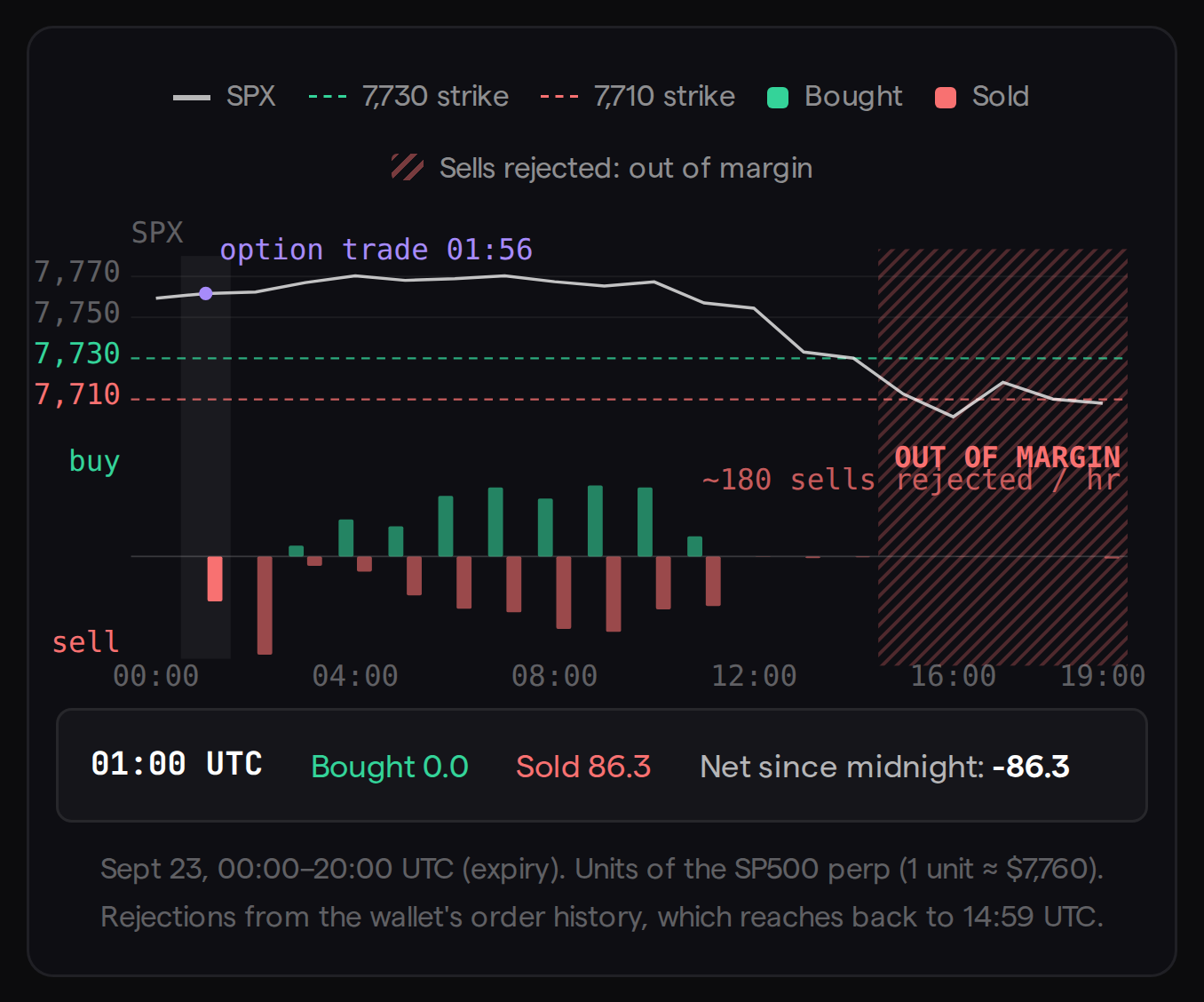
Look at the middle of the day. Big green and red bars, but the net barely moves. Most of that $14.8 million was the maker adjusting, not adding. Sell a little when SPX ticks down, buy a little when it ticks up, over and over.
Then the afternoon goes quiet, and not by choice. As SPX slid into the strikes, the model wanted the hedge to grow toward 1,000 units short and beyond. The maker's engine kept trying to sell, but from 15:00 to expiry Hyperliquid rejected about 180 of its sell orders an hour for insufficient margin, and the hedge stayed stuck near 275 units sold while the spread it was hedging paid out in full.
Why is a put spread trickier to hedge than a single put?
A single put is simple: the further SPX falls, the more hedge you need, until the hedge equals the whole position. A spread isn't. The maker is short the 7,730 put and long the 7,710 put, so the long leg starts cancelling the short one below 7,710:
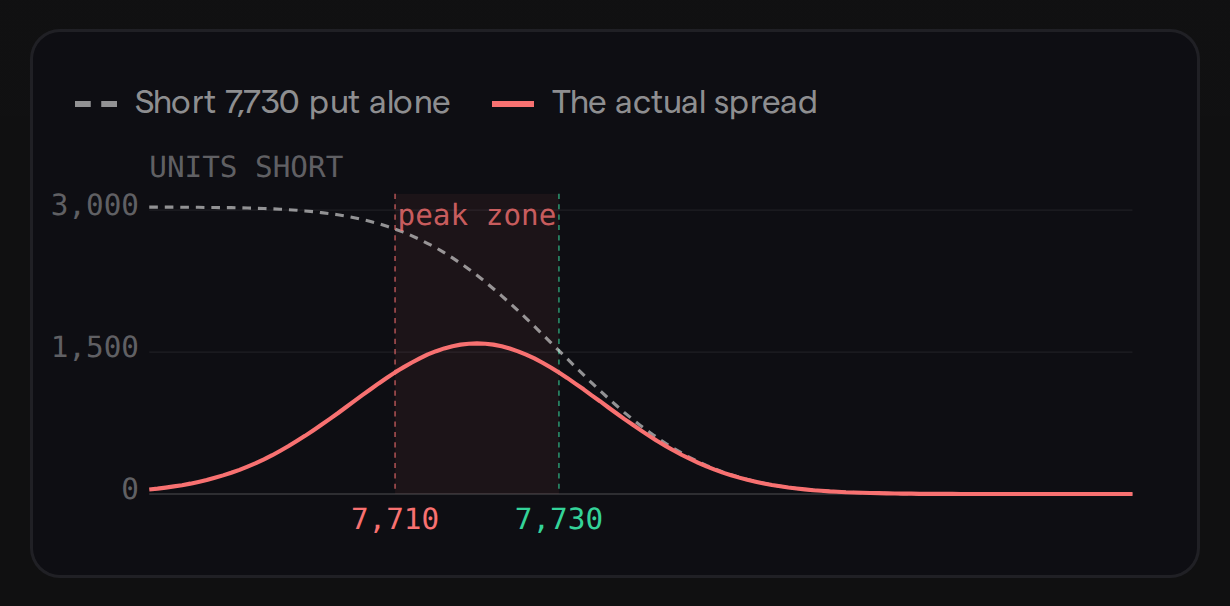
So the right hedge isn't "sell more as it falls." It rises, peaks between the strikes, then falls back. Near expiry that means SPX dropping through 7,710 tells the maker to buy back its hedge, the opposite of what you'd expect.
It's also why the closing price isn't the whole story. A smooth drift down and a choppy round trip can end at the same close but cost the maker very different amounts in hedging.
Capped structures like this are also the native shape of prediction and outcome markets like HIP-4, where every payoff has a hard ceiling by design, so the same hedging logic carries over (although pricing varies considerably).
How does $7,100 become $14.8 million?
Three things multiplied together: an option that expires the same day, an index that wouldn't sit still, and the strikes it kept wandering around.
1. Same-day options are cheap to buy and wild to hedge
A 0DTE option has hours left, so there's little time value: the spread cost $2.34 each. But with so little time, the hedge flips from "almost nothing" to "almost everything" over a few points of SPX.
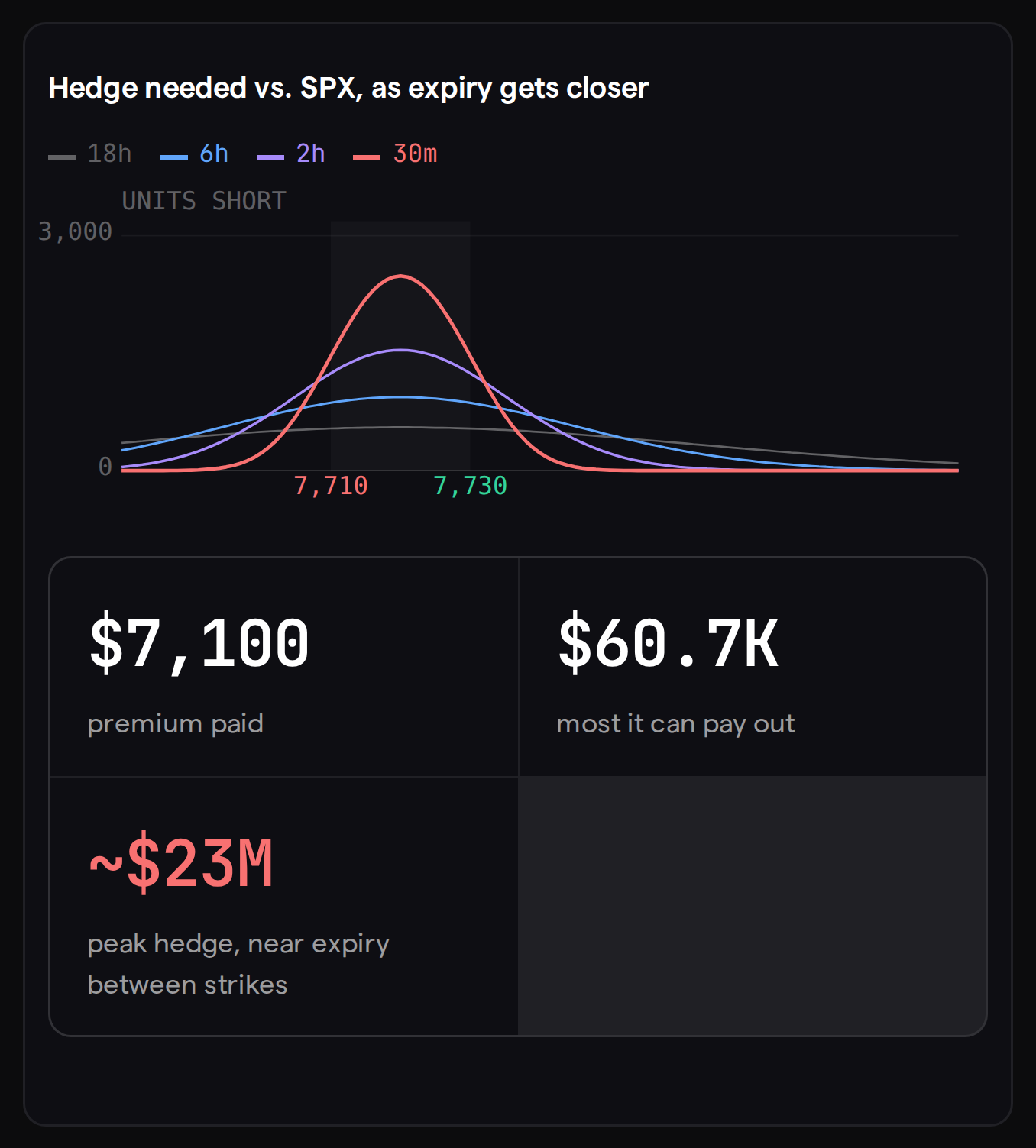
At the trade, 18 hours out, the hedge moved about 8 units per SPX point. By 15:00 it was 13. In the last half hour, sitting between the strikes, a 5-point move could swing it by more than 800 units.
2. SPX kept moving, and kept coming back
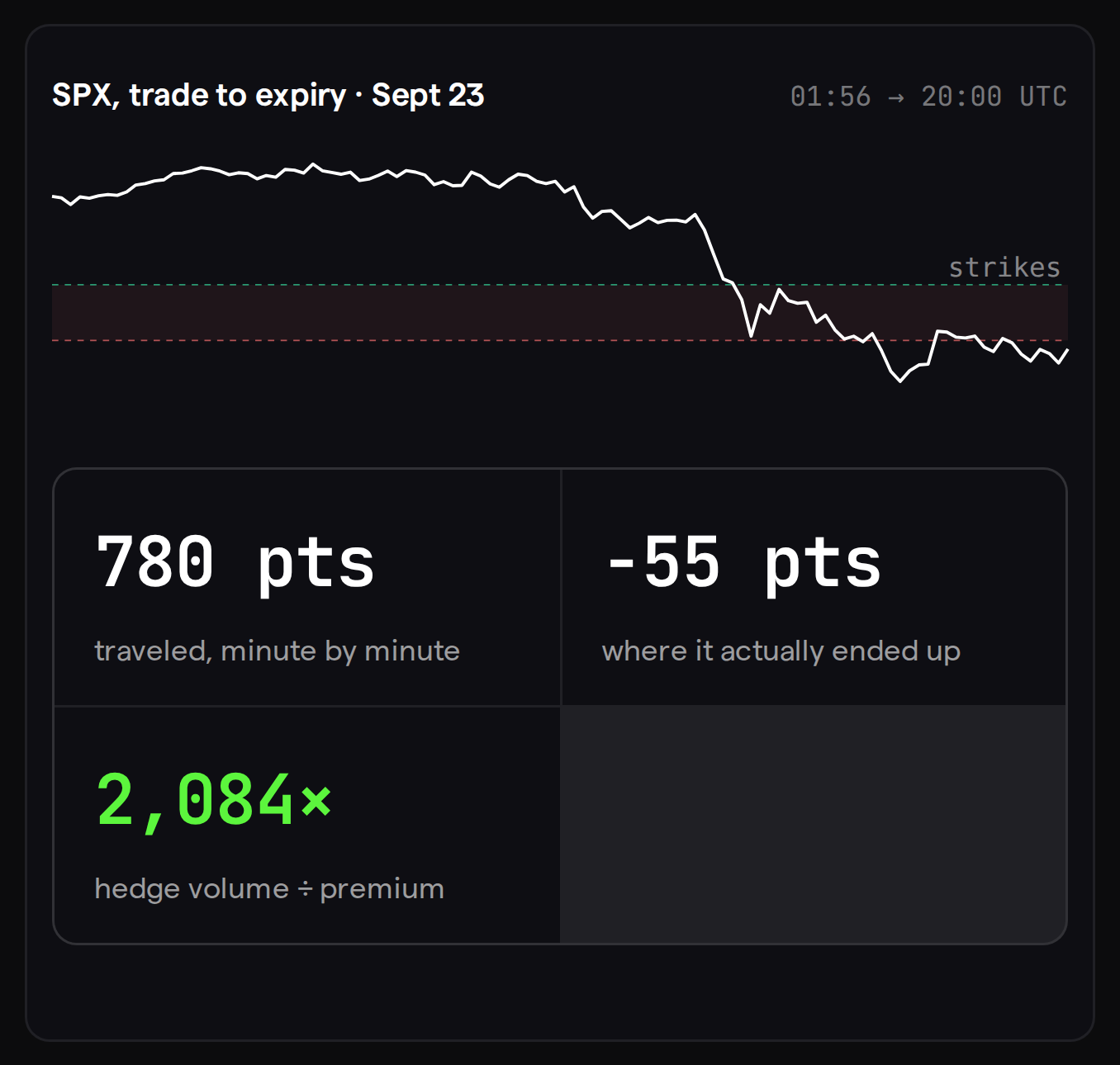
Every one of those wiggles changed the hedge a little, and the maker traded every change. Volume comes from the path, not the destination. SPX spent the afternoon sliding into the strike zone, right where the hedge moves most.
3. Different days, different volume
Same trade, different day. We simulated 80 days for each kind of market and hedged the spread through each one:
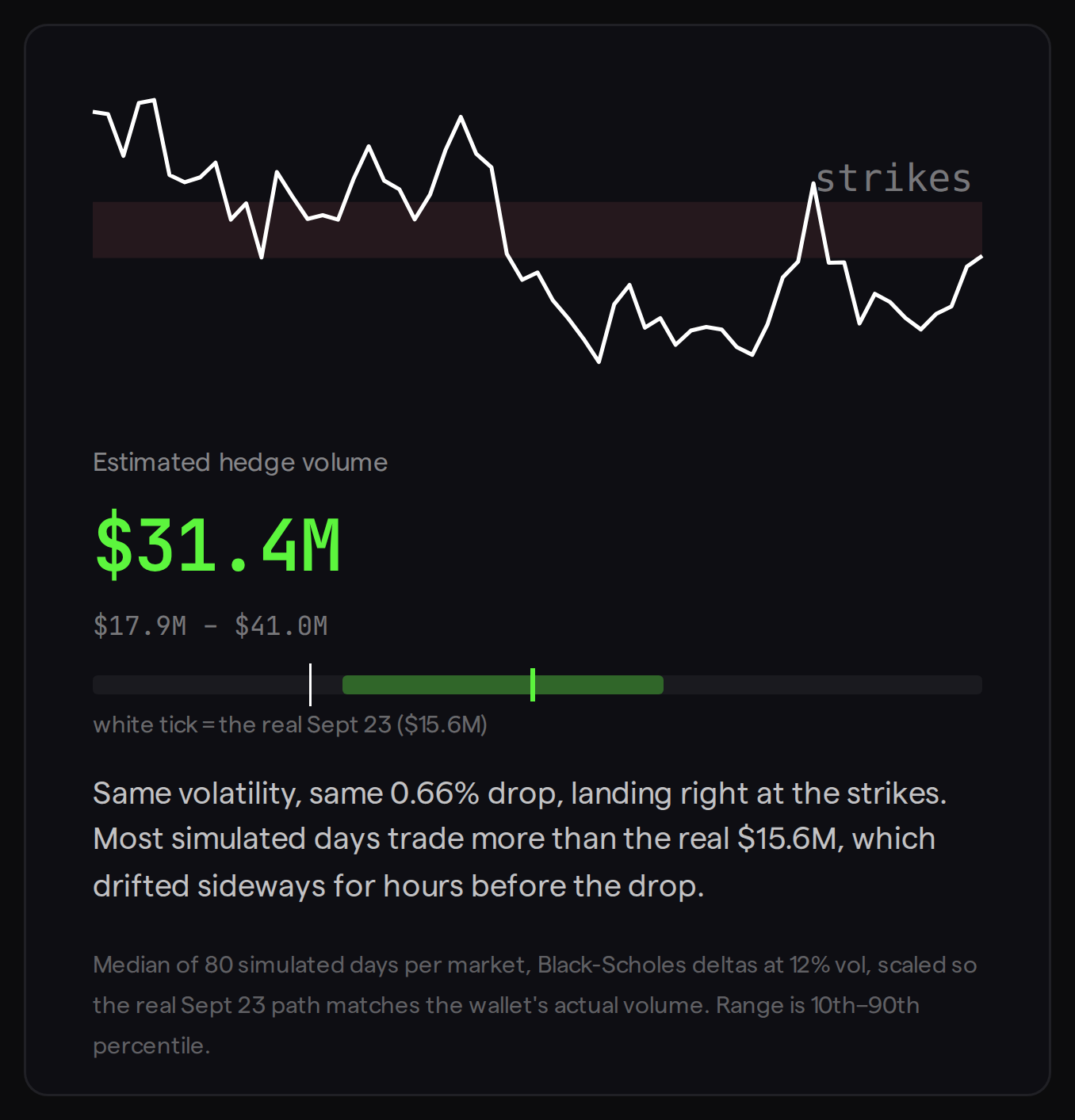
The pattern: where SPX ends up relative to the strikes matters more than how wild the day is. Days that finish near the strikes trade 3–5× more hedge volume than days that drift away. Doubling the volatility adds only about 15%.
What if the maker had kept hedging?
Here's the twist. The maker tracked the model closely until about 12:00 UTC, then stalled. Hedge volume fell from $1–2M an hour to almost nothing, right as SPX slid into the strikes and the hedge it needed kept growing. From 15:00 we can see why: Hyperliquid was rejecting its sell orders for insufficient margin, about 180 an hour.
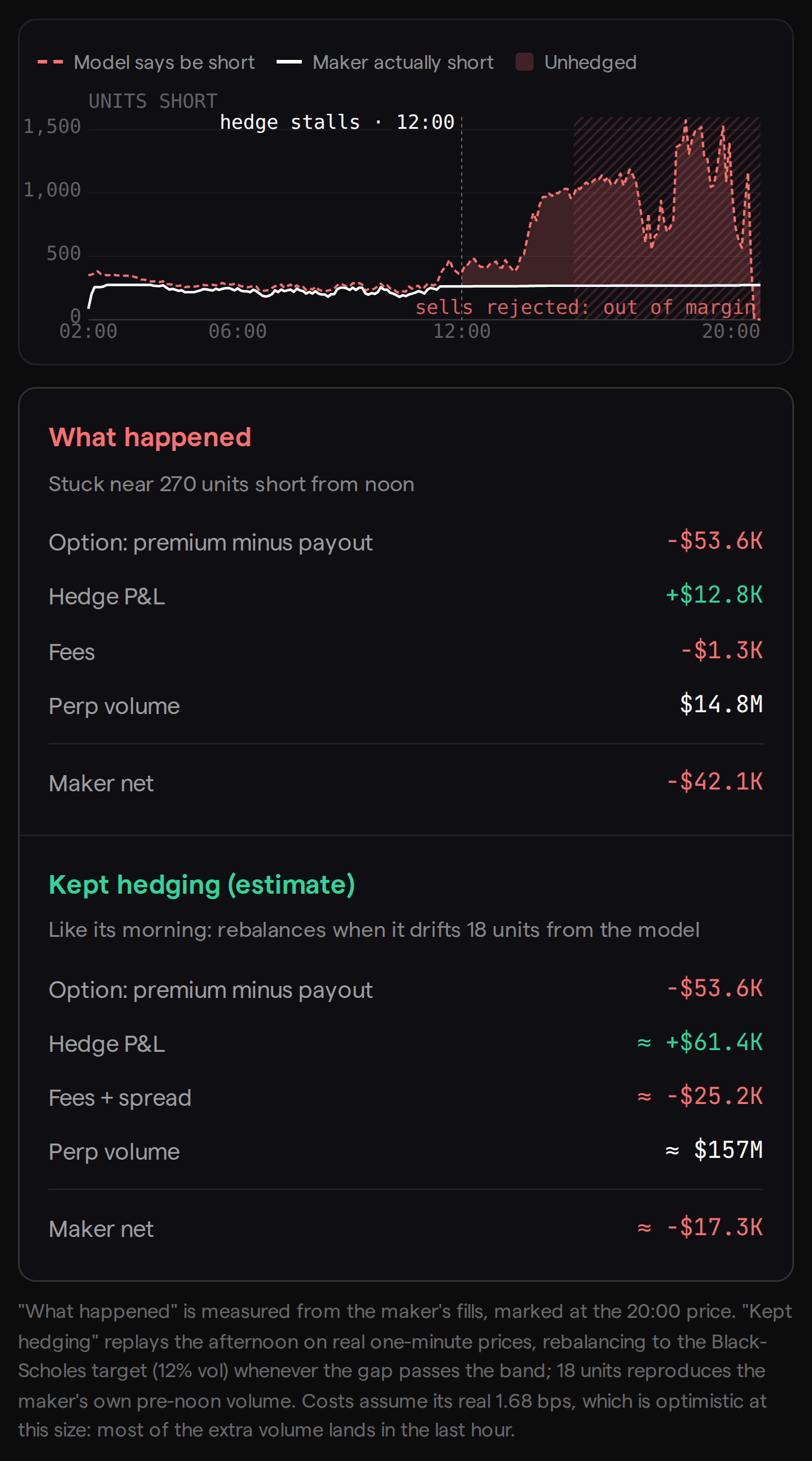
By 18:00 the model wanted about 1,500 units short. The maker held about 270. Then SPX closed below 7,710, the long put kicked in, and the hedge the model wanted collapsed to zero at the bell.
Hedging through the afternoon would have cut the maker's loss from about $42K to somewhere between $6K and $17K, depending on how tightly it tracked the model. It would also have traded many times more volume: $60M to $140M more, most of it in the last hour, when every point of SPX moved the hedge by hundreds of units. That is a large share of a day on which the whole market traded about $190M, so the real cost of pushing it through would have been higher than the 1.68 bps assumed here.
What did the hedge cost?
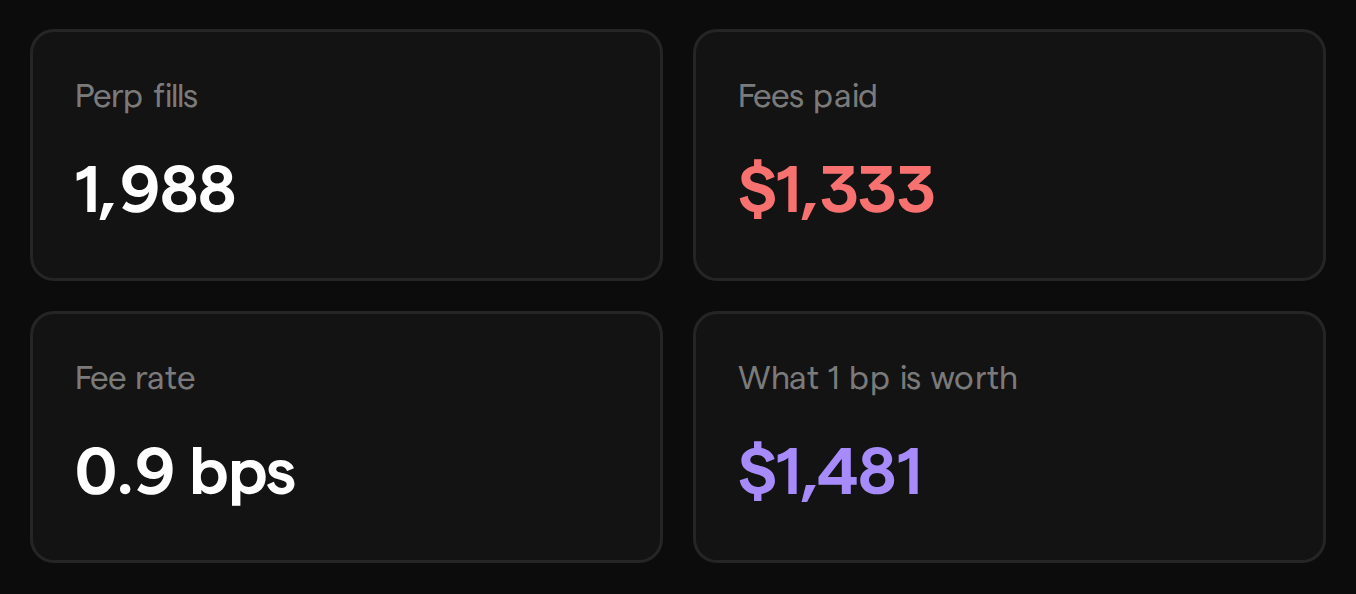
Every one of those fills was a taker order. The maker never waited; it always crossed the spread. At $14.8 million of turnover, every basis point saved is about $1,500.
Three ways to hedge
Every time delta moves, the maker has to trade back to flat. It can do that three ways, from patient to urgent. Pick one:
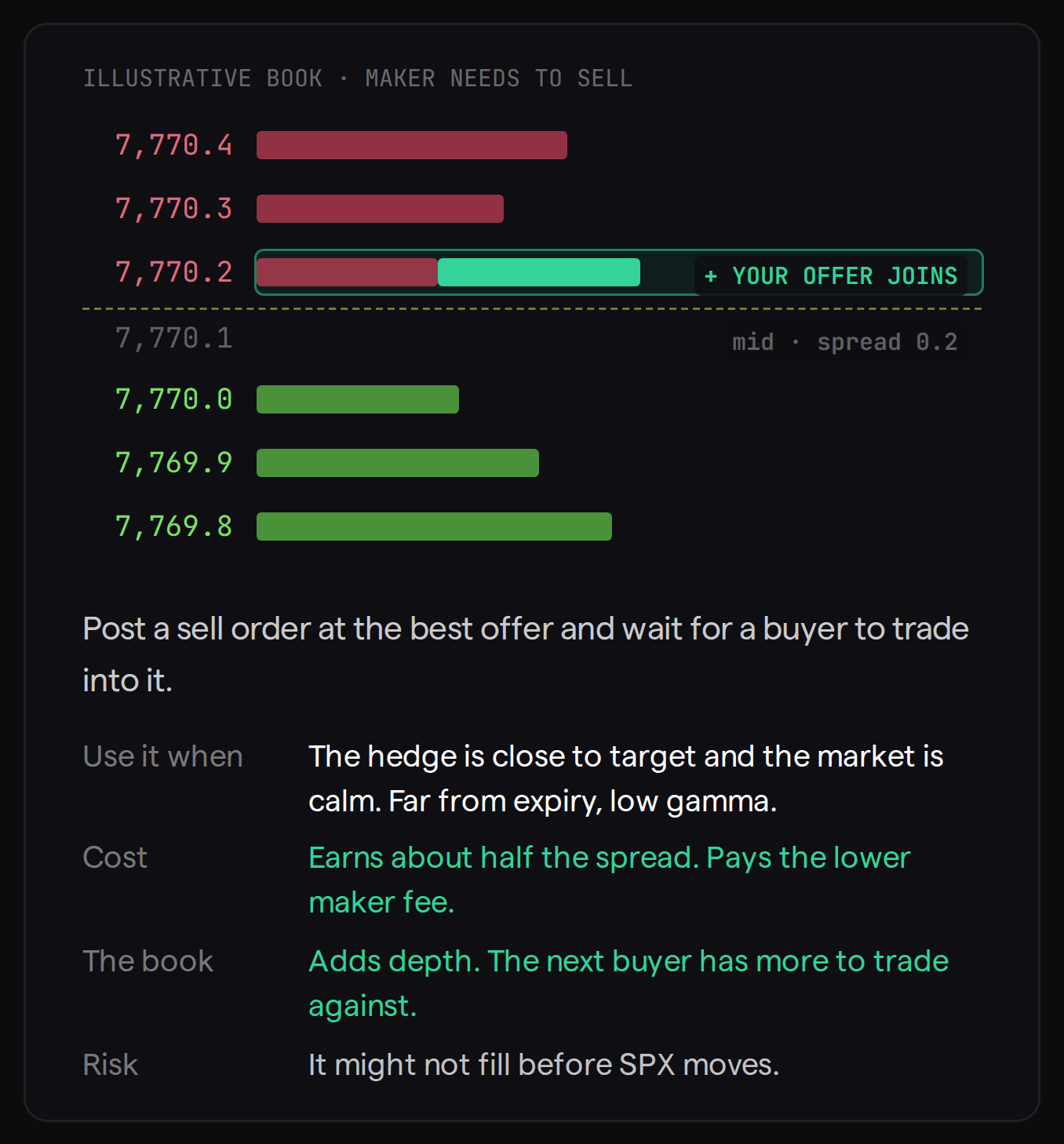
The most sophisticated hedging engines use all three. They rest orders while the hedge is close to target, tighten as it drifts, and cross only when the risk is too big to wait. So most options makers both add liquidity to the book and take it.
This wallet only did the third. Every order it sent was immediate-or-cancel, so every hedge trade crossed the spread. Here's what that looked like on the real book.
What the hedge did to the book
This is Hyperliquid's SP500 book on Sept 23, the day of the trade. Brighter bands are more resting orders; rings are the wallet's trades. It opens on If rested: the same hedge posted as resting orders, adding depth instead of taking it. Flip to Actual to see what it really took from the book. Open it full screen to replay every trade.
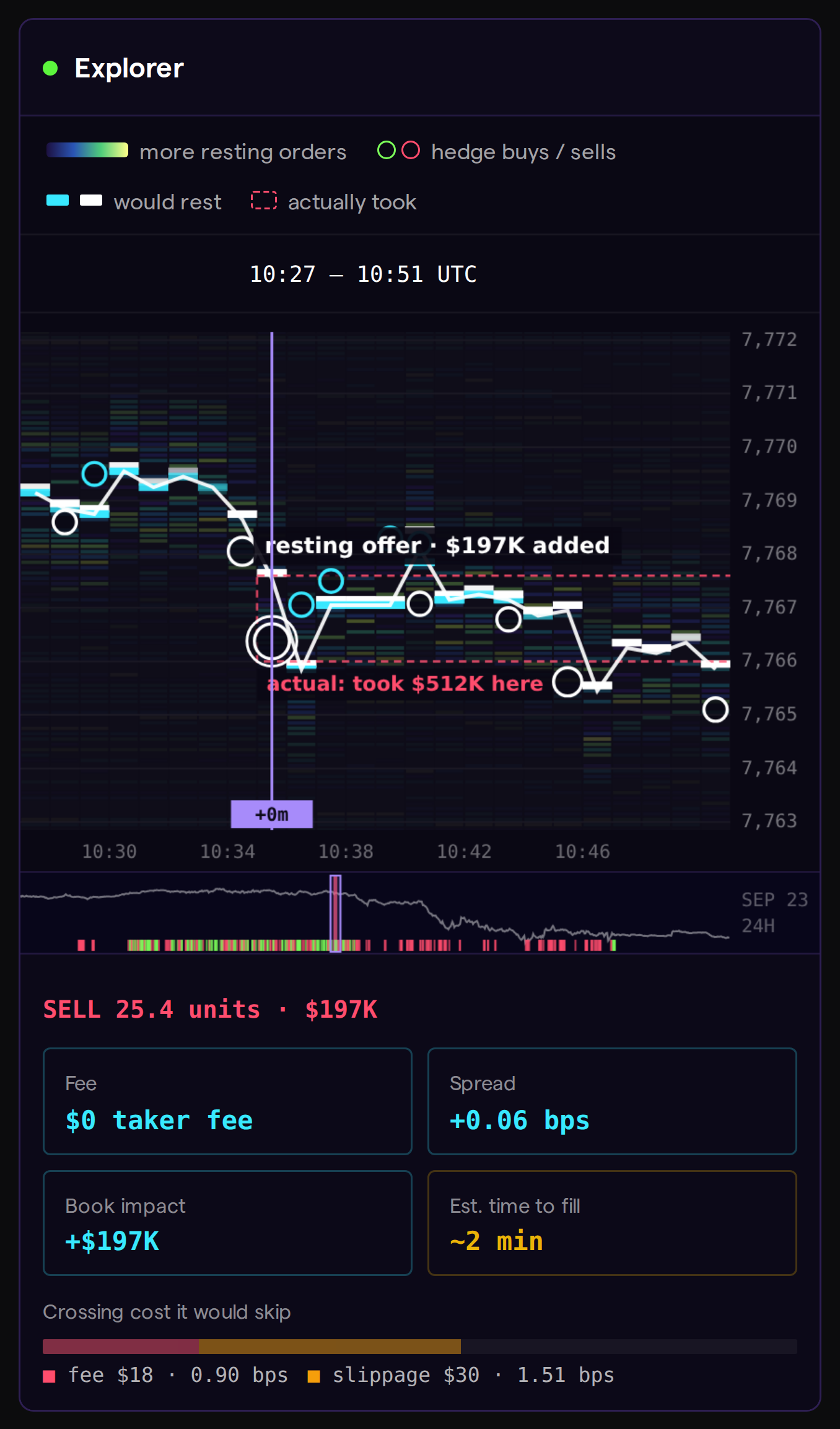
What if it hadn't only taken?
We re-ran the day's 359 hedge trades three ways, using the real book and the queue ahead at each price. Resting is cheaper, and it actually adds volume: while an order waits, delta keeps moving, so the maker ends up trading more to catch up.
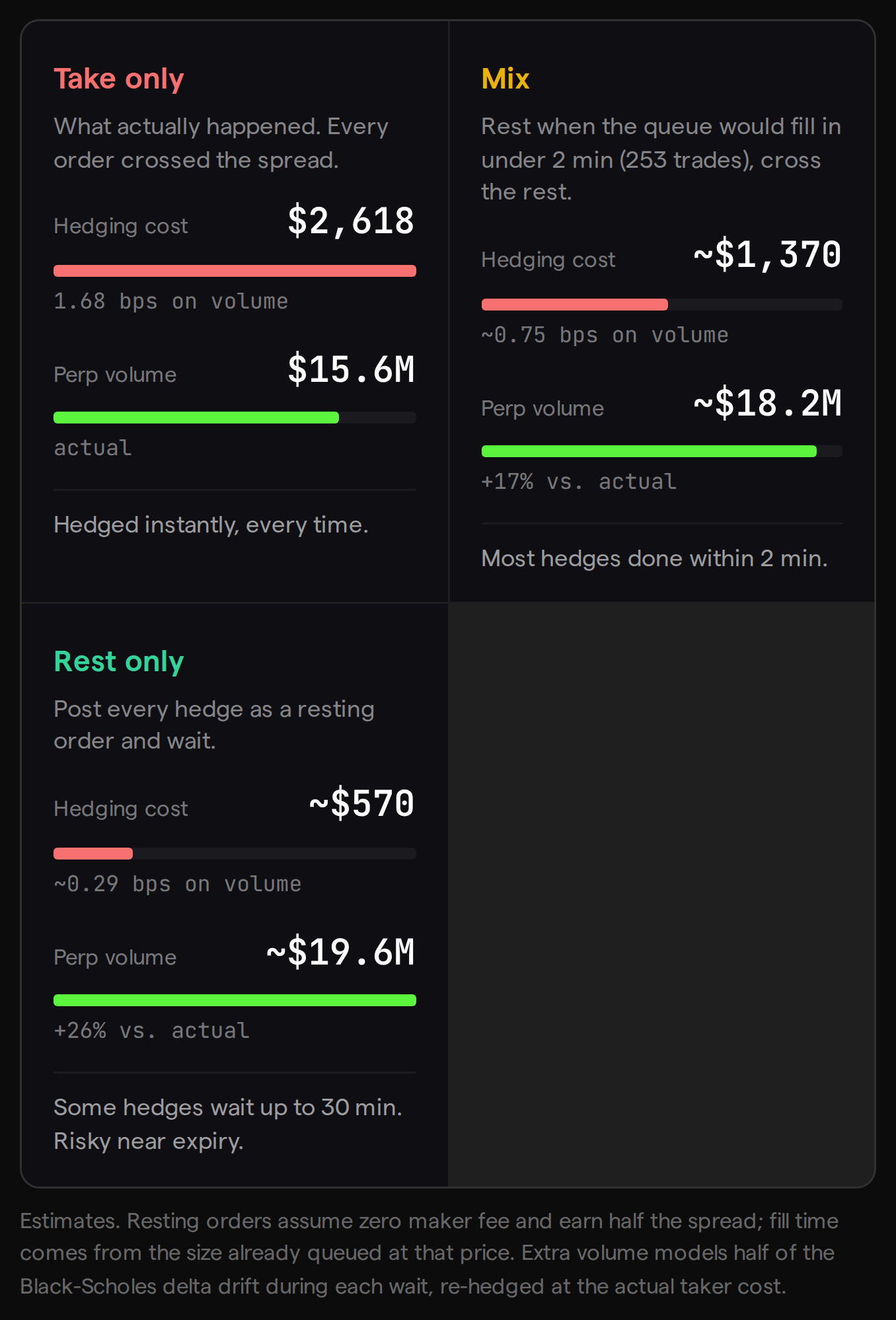
That's why the most sophisticated engines mix. A mixed hedge would have cost about half as much and put about 17% more volume through Hyperliquid, most of it as resting liquidity other traders could hit.
Why hedge on Hyperliquid?
Makers can hedge on other venues and post collateral on Hypercall, so why Hyperliquid? Below, a model hedge for this put spread (Black-Scholes delta, rebalanced all the way to expiry) trades into Hyperliquid, Binance and Lighter at once, each trade priced on that venue's full order book at that minute. Press play:
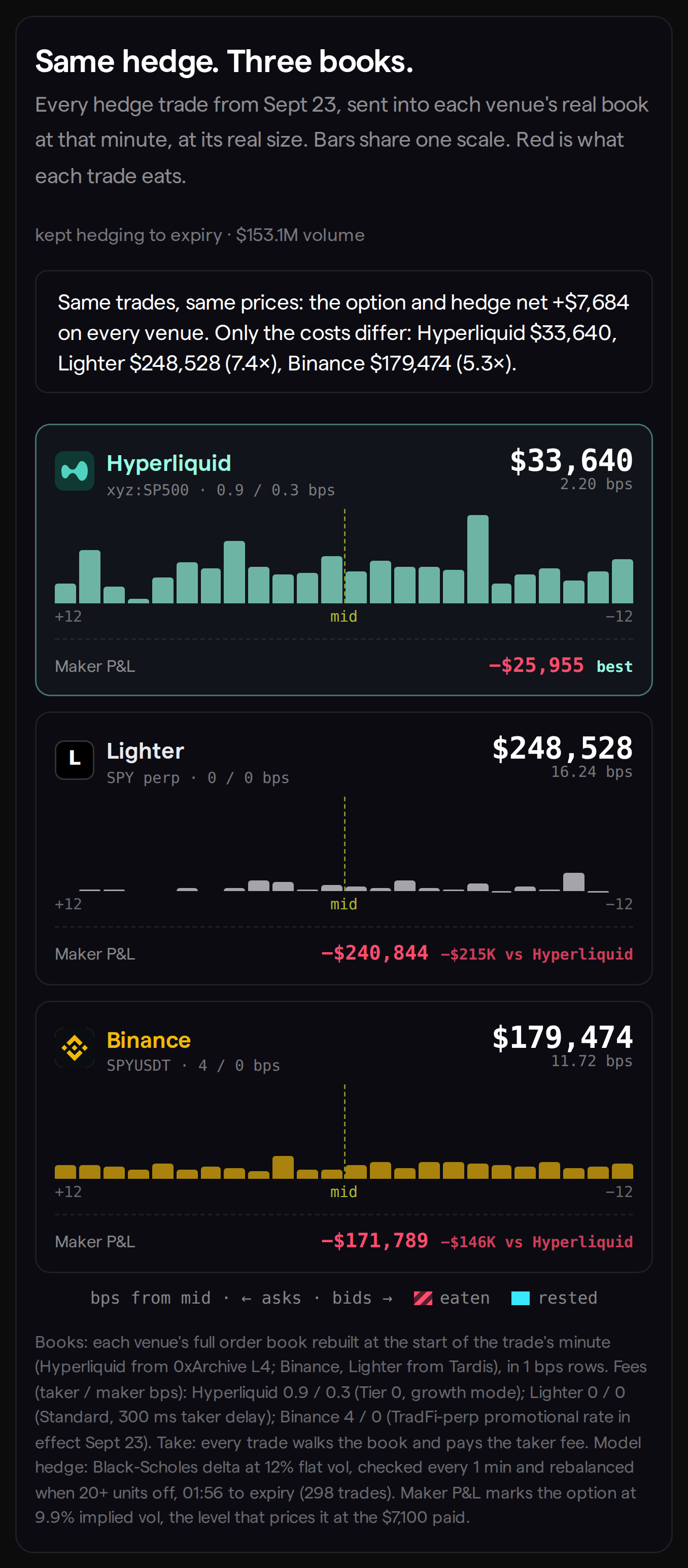
Books: each venue's full order book rebuilt at the start of the trade's minute (Hyperliquid from 0xArchive L4; Binance, Lighter from Tardis), in 1 bps rows.
Hedged to expiry, the spread costs about $34K to hedge on Hyperliquid: 5.3× less than Binance and 7.4× less than Lighter. Switch to Actual to replay the 359 trades the maker really made: about $1,760 on Hyperliquid, against $7,200 on Binance and $5,050 on Lighter. Watch the ladders: on Hyperliquid most trades barely dent the first basis point, while on Lighter they walk several ticks deep. Binance is tight at the very top but thins out fast, and charges a 4 bps taker fee.
Switch to Rest and Hyperliquid still comes out cheapest, 3.8× under Binance. A resting order only fills as fast as that venue's own traders show up, and Hyperliquid has by far the most of them: about $85M of taker flow each way over the day, against about $25M on Binance and under $2M on Lighter. For clips this size even Hyperliquid fills only part of each order within five minutes, so resting costs more than taking here. The gap between venues is what holds.
Under each venue, the maker's P&L makes the point directly: the option and the hedge are identical everywhere, so only the venue's costs separate the outcomes. The gear opens the assumptions: fee tiers, account types, how long to rest, and the volatility behind the model hedge, including Hypercall's own theo vol for these puts.
Dig into the three books: depth, cost curves and volume
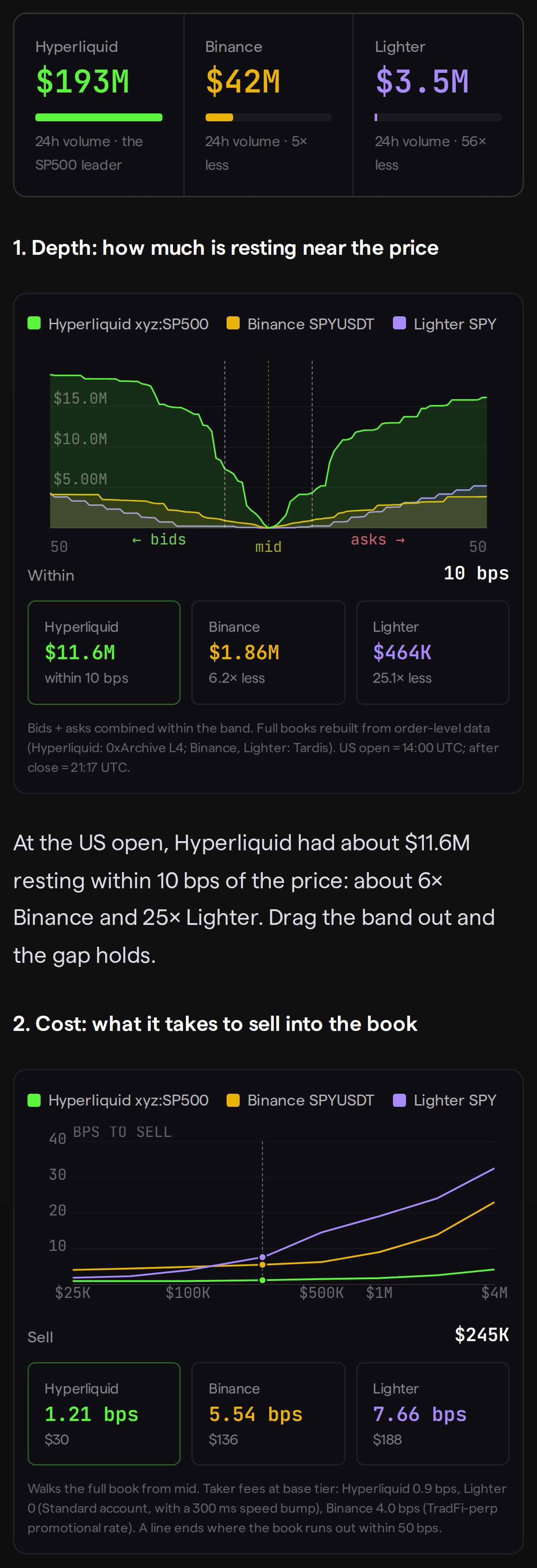
Bids + asks combined within the band. Full books rebuilt from order-level data (Hyperliquid: 0xArchive L4; Binance, Lighter: Tardis). US open = 14:00 UTC; after close = 21:17 UTC.
What are the other ways to hedge?
Selling perps is not the only way to flatten this risk. The maker has three other levers.
Buy the options back from other traders. The cleanest hedge is an offsetting option: if another Hypercall trader sells the same puts, or buys the maker's side of the spread, the book nets out and there is nothing left to delta-hedge. On a young options market that offsetting flow is scarce, which is exactly why the perp does the work today.
Buy options on another venue. The maker could also cover the short leg outright somewhere else. The details bite, though. American-style contracts like SPY options can be exercised early and settle physically into shares, both awkward for an onchain desk. European, cash-settled index options avoid early exercise and delivery risk, and SPX options happen to be exactly that, so the offset is doable here. But they live inside Cboe's session hours and a separate margin account, which re-imports the weekend and split-collateral problems from the CME note below. Covering off-venue matters most when the short option is naked; sold as a spread, the loss is capped, and the perp hedge alone can carry it.
Hide the execution. Silhouette runs shielded execution on top of Hyperliquid's book: orders fill against its liquidity without broadcasting their owner or intent while they work. If Hypercall routed hedge flow through an integration like that, bigger clips could execute without moving the touch, tightening effective spreads. Note what stays public: the option print on Hypercall. Hiding the child orders, not the position, keeps the flow legibly non-toxic.
Everyone can see it's a hedge
Normally, a big taker is scary. Market makers widen their quotes because whoever is hitting them might know something they don't. That's toxic flow.
This hedge is different. The option trade is public on Hypercall. The perp fills are public on Hyperliquid. And the hedge size follows mechanically from delta. Anyone watching can see it's rebalancing, not a view.
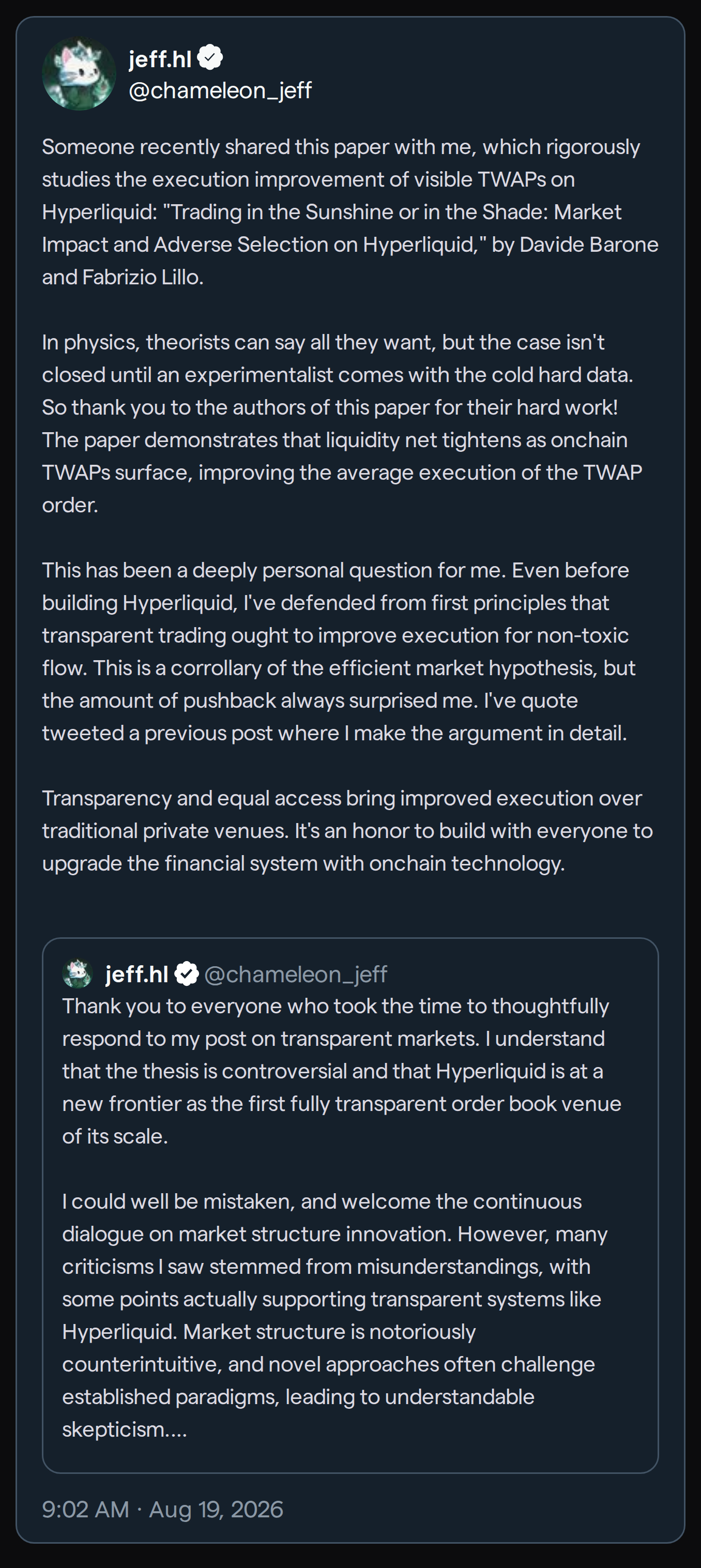
Post by jeff.hl (@chameleon_jeff) on X.
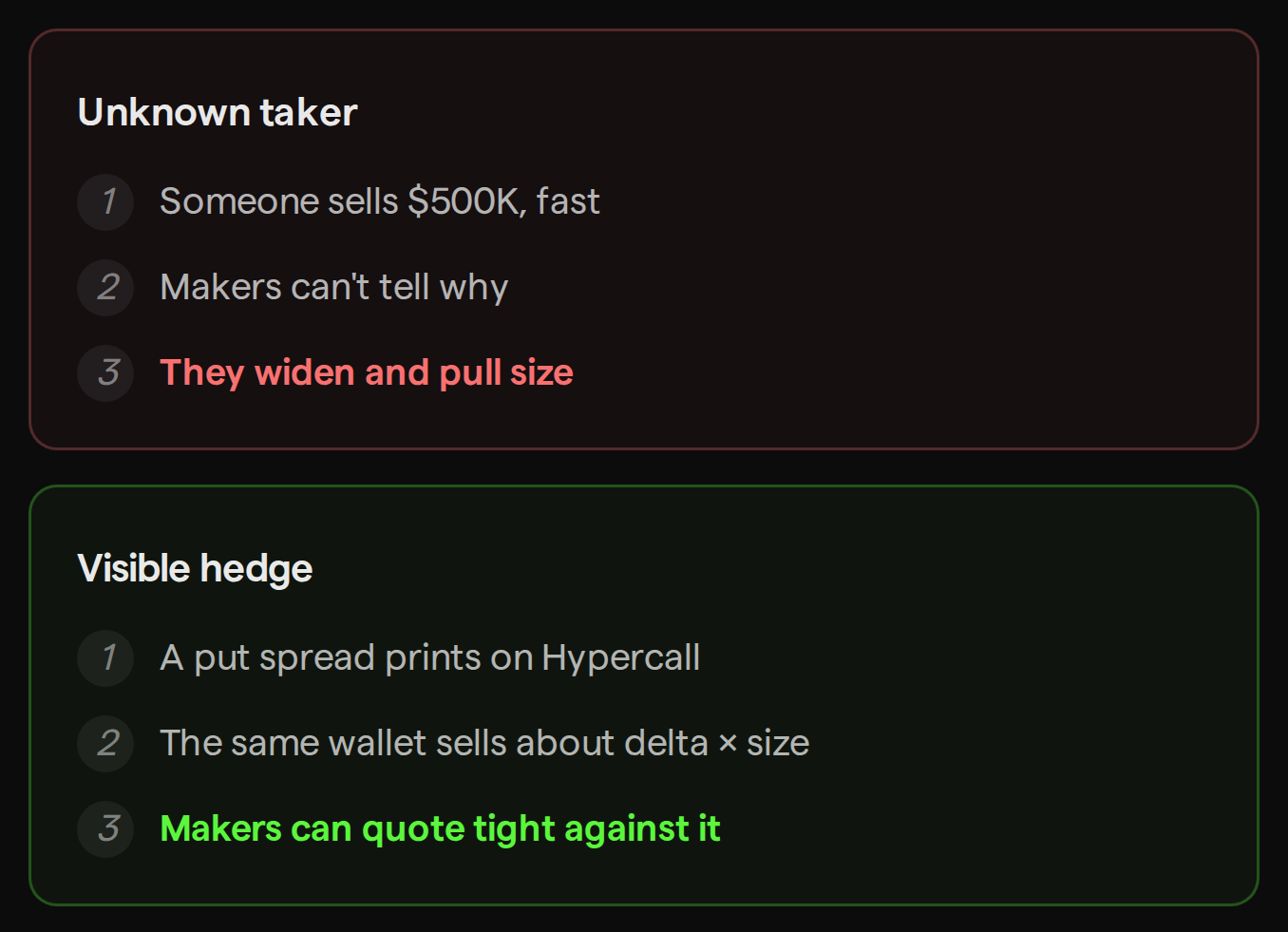
Flow that carries no information is cheap to fill. Research on flow toxicity makes the same point: makers who can tell informed from uninformed orders can quote the uninformed ones tighter. So even though this hedge takes liquidity, being visible should get it better prices over time.
Why not just hedge with CME futures?
A traditional desk would hedge SPX options with E-mini futures. That works great until the weekend. CME equity futures close Friday afternoon and reopen Sunday evening, with a break every day. Hypercall options trade 24/7.
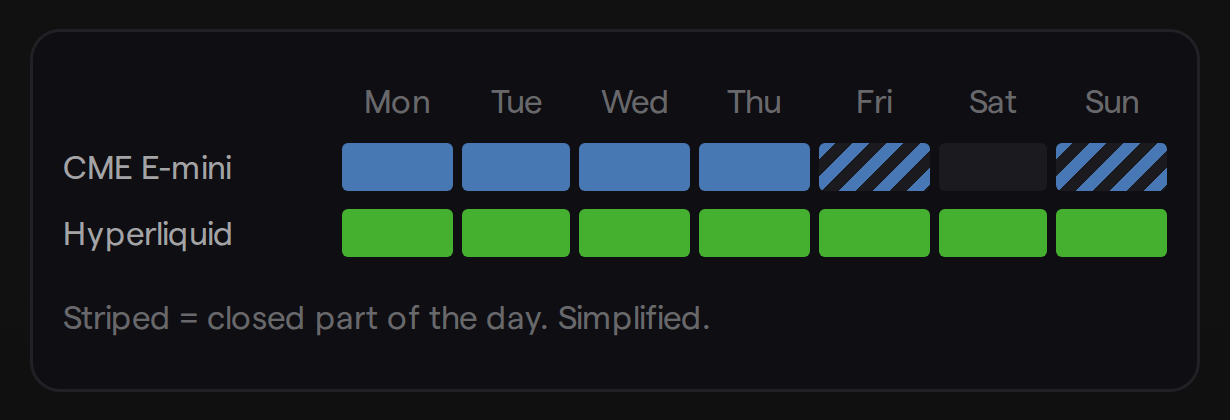
A Saturday option trade can't be hedged in a closed book. The maker has to hold the risk or quote wider.
The collateral is split up too. On a traditional stack, each piece of the book sits in its own account with its own margin. A gain in one can't pay for a loss in another without moving money, which takes time and often banking hours.
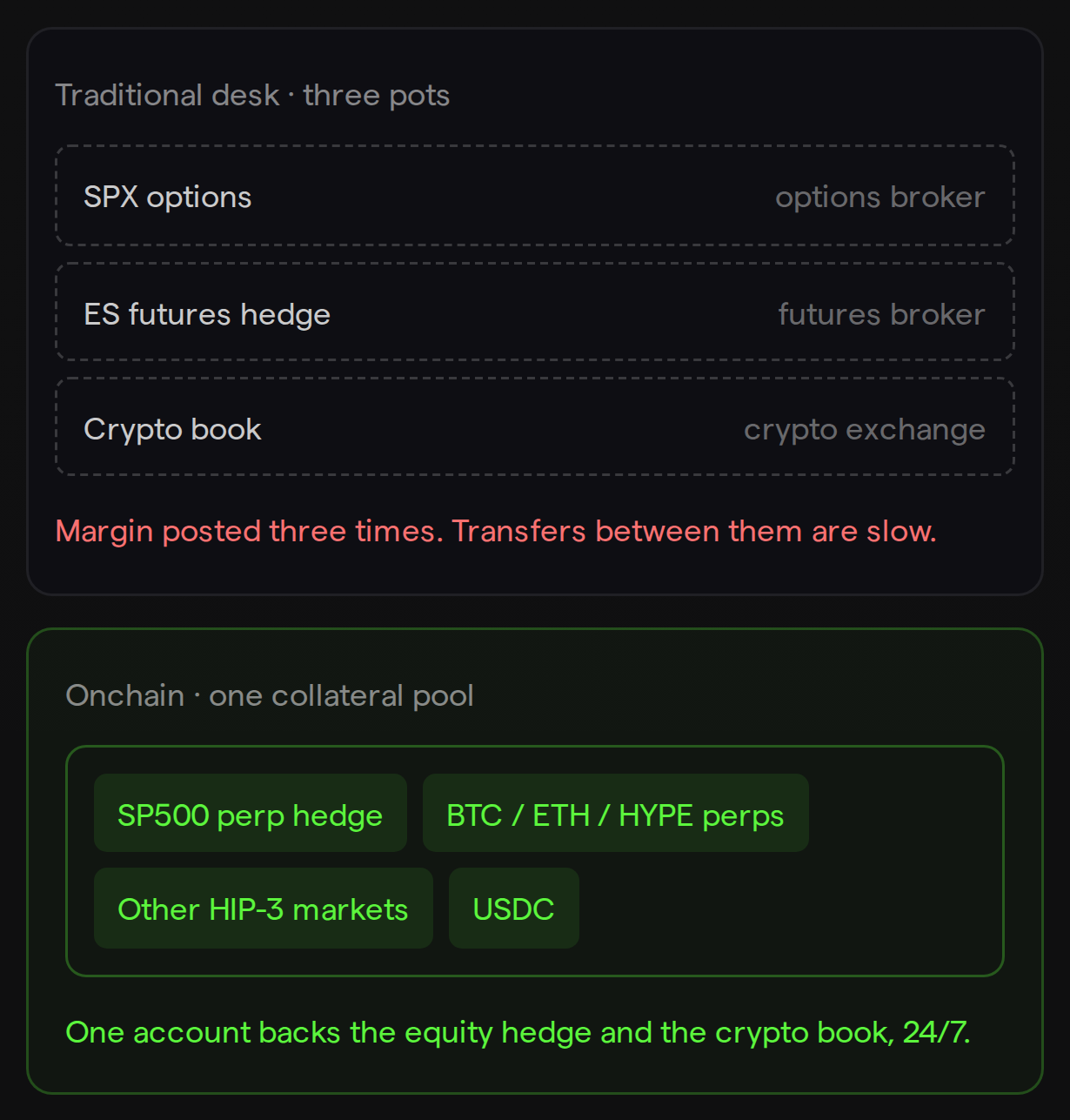
A maker running crypto options and equity options can hedge both from the same capital. A gain on its BTC hedge can back its SP500 hedge within seconds.
What this means
A $7,100 option became $14.8 million of perp volume. That's the multiplier. Every option on Hypercall has a hedge, and the hedge trades on Hyperliquid.
More strategies mean more hedging. Hedges that rest add bids and offers. Hedges that everyone can see get tighter quotes. All of it makes the book deeper, which makes options cheaper to quote, which brings more trades. We saw the same loop in our oil perps analysis.
Want to go deeper? See delta and gamma in our reference docs for how hedge ratios are calculated.
Sources
- 7,730 put purchase / 7,710 put sale: trade receipts
- Settlement receipts: payout and PnL
- Maker wallet on Hypurrscan: perp fills
- 0xArchive: order-level (L4) Hyperliquid order book, Sept 22–23
- Tardis: Binance SPYUSDT and Lighter SPY order books and trades, Sept 23
- Hydromancer Reservoir: historical fills and order books
- arXiv 2606.15715: flow toxicity
- Lighter trading fees / Binance TradFi perp fees / Lighter market specs / Hyperliquid order types
How did we measure this?
Market share = maker units ÷ total units traded on xyz:SP500, Sept 23 00:00–15:00 UTC (15.07%). Turnover sums buys and sells at fill price. The account may hold other positions, so not every fill is attributed to this spread.
Order book: 0xArchive's order-level history for xyz:SP500, replayed from a full-depth checkpoint through every per-block change, sampled at each minute and summed into price levels within ±30 bps of mid. The replay reproduces all 1,435 of Hydromancer Reservoir's independent Sept 22 top-20 snapshots exactly. Hedge counterparties are the resting orders that shrank by exactly the fill size, at the fill price, in the fill's block: all 2,127 Sept 23 fills matched. The same data shows the hedging wallet never had a resting order in the book across Sept 22–23; all 1,527 of its SP500 orders were immediate-or-cancel. "If it had rested" adds each minute's hedge size at the best bid (buys) or best ask (sells), decaying over five minutes, and assumes those orders fill, which isn't guaranteed.
This analysis is educational. Not financial advice. Options trading involves risk of loss.