
- $1.44BOnchain options notional over 30 days in mid-2026, with premium volume at all-time highs.
- $30BMonthly prediction market volume, up from about $2B a month 18 months earlier.
- $4.24MKalshi's daily average on BTC one-day binaries, 22 to 28 June 2026. Polymarket averaged $2.76M.
- $400KHyperliquid's daily average on the same BTC one-day binaries.
Published July 2026 · 95 pages · Tom Berry · Ankush Jha · Block Scholes
Data snapshot: July 2026. Figures are preserved from the published report; charts marked updated daily use live data.
“Options and prediction markets should not be treated so separately, as they are effectively different interfaces for the same underlying demand: priced conditional outcomes.”
The numbers that matter
- 4x+ Options contracts relative to futures in 2024
- 15.2B U.S.-listed options contracts traded in 2025
- $36B Approximate U.S. options premium traded daily
- $1T+ Peak daily notional in same-day SPX options
- 59% 0DTE share of SPX options volume in 2025
- $27.6B IBIT options open interest cited in the report
Executive Summary
A new group of order-book, AMM, perpetual-option and binary-market venues is rebuilding onchain options after the DOV cycle. Co-authored with Block Scholes, the report maps those products, compares one-day BTC binary markets and uses BTC and ETH volatility surfaces to examine how options and prediction markets price conditional outcomes.
Key findings
- Exchange-traded options volume exceeded futures by more than four times in 2024, while U.S.-listed options reached about 15.2 billion contracts in 2025.
- Onchain product design has expanded beyond DOVs into order books, AMMs, perpetual options, short-dated binaries and prediction markets.
- Across the 22 to 28 June 2026 BTC binary sample, Kalshi averaged $4.24 million in daily volume, Polymarket $2.76 million and Hyperliquid about $400,000.
Covered in the report
- Derive
- Rysk
- Aevo
- Paradex
- Panoptic
- GammaSwap
- Hyperliquid
- Polymarket
- Kalshi
- Block Scholes
Inside
- Executive Summary
- Options in Financial Markets
- The Crypto Options Ecosystem
- Vanilla, Exotic and Short-Dated Options
- Prediction Markets as Option-Like Instruments
- Comparing Binary Options Providers
- The State of BTC and ETH Volatility
- Where Onchain Volatility Markets Are Going
The Main Onchain Options Platforms in 2026
Onchain options did $1.44 billion of notional over 30 days in mid-2026, and premium volume hit all-time highs. Early designs failed on thin liquidity and passive LP pools (Opyn, Hegic, Ribbon, Lyra, Premia); today's venues use order books or RFQs with professional market makers, or package options as simple income products.
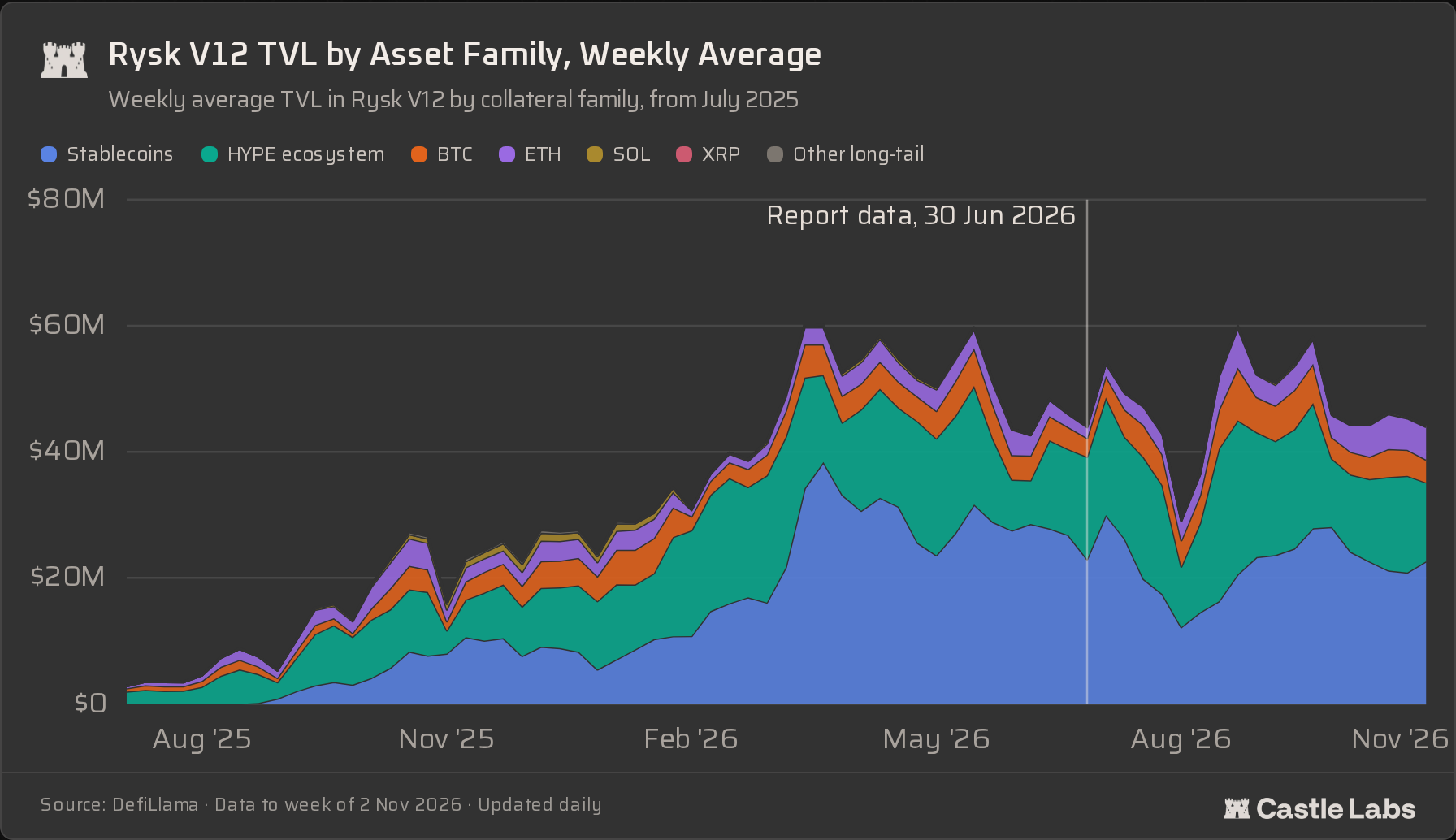
Now, week of 2 Nov 2026 Rysk TVL, last week: $44.19M · Stablecoin share: 51.2%
In the report, July 2026 Rysk is built on collateralised option selling, so TVL matters: sellers lock full collateral to earn premium. On Derive, by contrast, buyers can pay small premiums for large payouts.
Report page 23
Source: DefiLlama · Data to week of 2 Nov 2026 · Updated daily
Data as of November 15, 2026.
Onchain options venues, last 30 days to late June 2026
| Venue | Model | 30-day notional | 30-day premium | Who it serves |
|---|---|---|---|---|
| Derive (ex-Lyra) | Order book on its own OP Stack L2; options and perps cross-margined | $1.142B (79.2% of notional) | $44.3M (87.2% of premium) | Professional traders and market makers; volume supported by incentives |
| Rysk | RFQ; covered calls and cash-secured puts as income | $136.3M (9.5%) | $1.94M | Holders, treasuries and DAOs; Hyperion, a Nasdaq-listed HYPE treasury, runs strategies on it |
| Aevo (ex-Ribbon) | Order book on a custom L2; options beside perps and pre-launch markets | $45.1M (3.1%) | $2.52M | Active traders; live options OI only about $3.6M |
| Others | Paradex, Kyan, CallPut, Hypersurface, Ithaca, SOFA | Small and fragmented | Rising share of premium in 2026 | Varied, including stock options (CallPut) |
Source: Block Scholes data in Castle Labs, The Renaissance of Onchain Options (July 2026)
Rysk's monthly notional grew from $50 million in January to $182 million in May 2026, driven by HYPE holders earning yield on assets they already hold.
Are Prediction Markets Binary Options?
Yes, for price markets. A Polymarket "BTC Up or Down" contract pays $1 if a condition holds at expiry and $0 otherwise, exactly like a binary (digital) option. A binary can be built from two call options struck close together and scaled to pay $1, so by no-arbitrage its fair price is fixed by the vanilla options market: it equals the slope of the call-price curve at that strike.
That makes the options surface a benchmark for prediction-market odds. Comparing Polymarket's "Bitcoin above X on June 28" ladder with Block Scholes' composite surface, the two disagreed by strike: Polymarket was more bullish at some strikes and less at others.
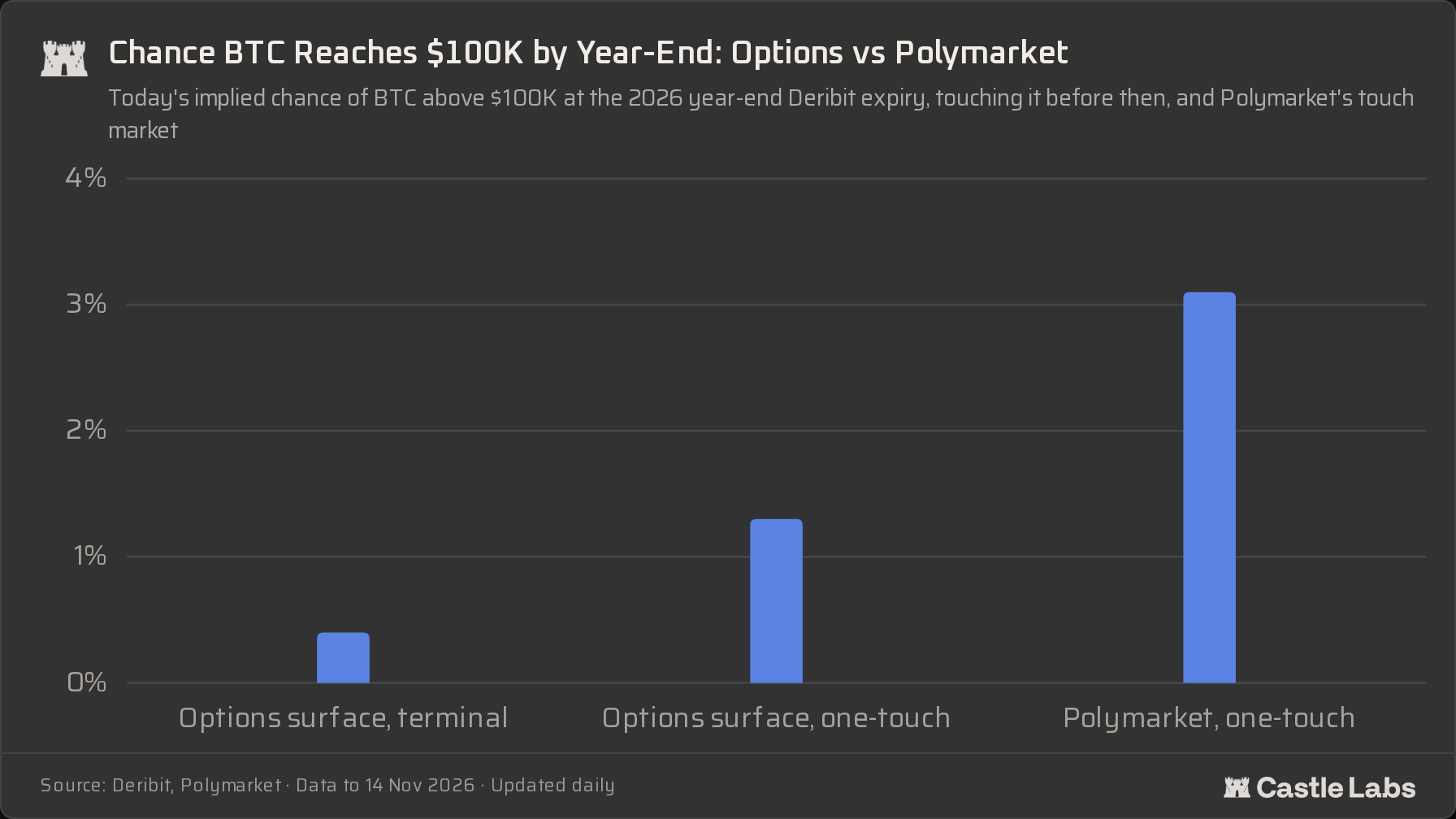
Now, 14 Nov 2026 Options, above $100K at year-end: 0.4% · Polymarket, touches $100K: 3.1%
In the report, July 2026 The options surface gives BTC a 3.9% chance of finishing above $100K and a 10.5% chance of touching it at any point. Polymarket's touch market priced 14.5%.
Report page 81
Source: Deribit, Polymarket · Data to 14 Nov 2026 · Updated daily
Data as of November 15, 2026.
Implied probability BTC closes above each strike, 28 June 2026 (about 2.2 days to expiry)
| Strike | Polymarket | Options surface (Block Scholes) |
|---|---|---|
| $54,000 | 98.2% | 96.1% |
| $56,000 | 93.0% | 91.8% |
| $58,000 | 73.9% | 80.1% |
| $60,000 | 41.2% | 42.5% |
| $62,000 | 10.5% | 9.0% |
| $64,000 | 2.4% | 1.6% |
Source: Polymarket and the Block Scholes composite volatility surface, aligned to 12:00 ET on 28 June 2026
Kalshi vs Polymarket vs Hyperliquid for BTC Binaries
Prediction markets grew from about $2 billion a month to about $30 billion a month in 18 months, with fees over $300 million in June 2026. Kalshi holds over 65% of volume. Hyperliquid's HIP-4 outcome markets went live in May 2026 and passed $150 million of volume; deployers stake 1 million HYPE.
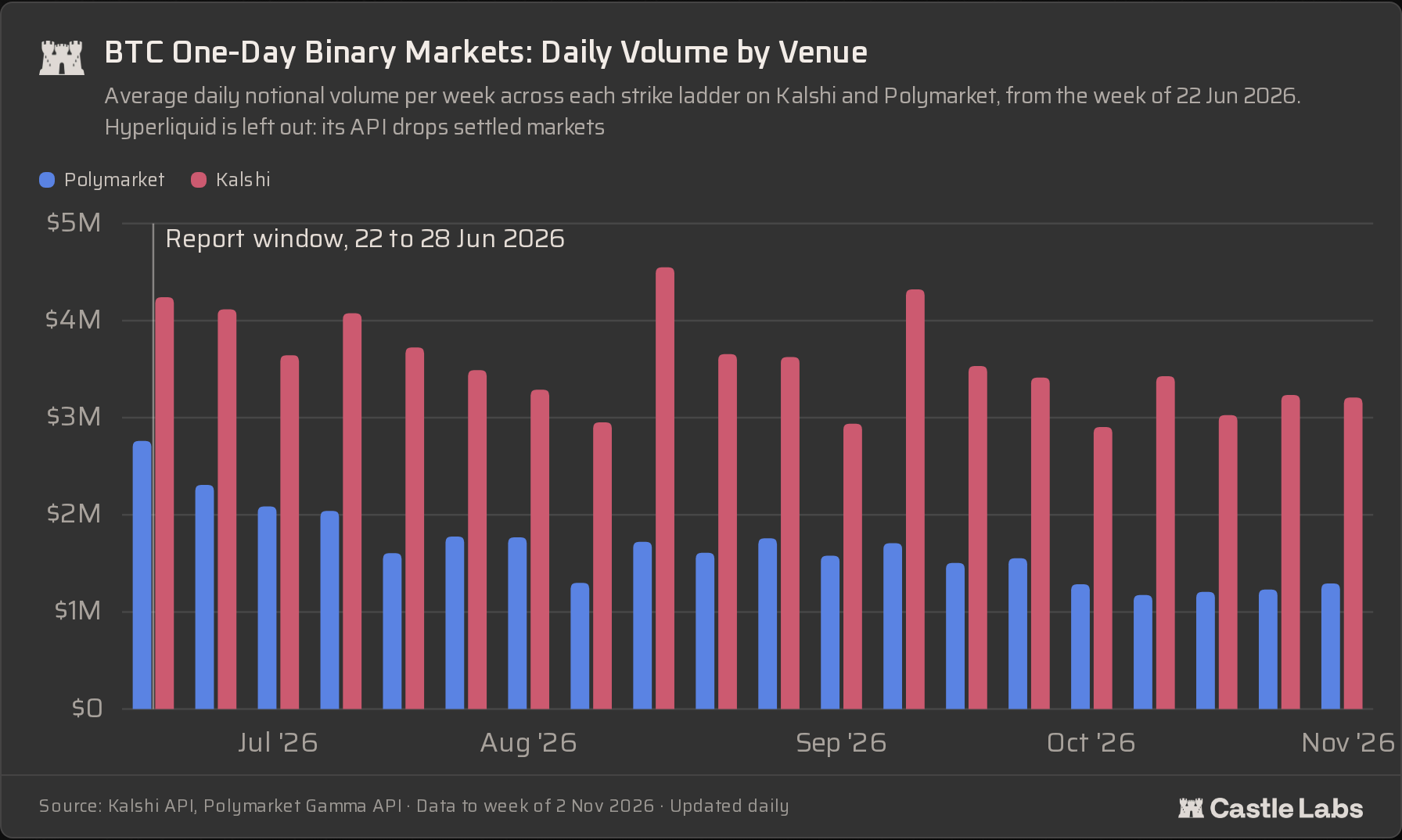
Now, week of 2 Nov 2026 Kalshi, daily average last week: $3.21M · Polymarket, daily average last week: $1.29M
In the report, July 2026 On BTC one-day binaries, Kalshi averaged $4.24 million a day, Polymarket $2.76 million and Hyperliquid $400K in the window we measured.
Report page 51
Source: Kalshi API, Polymarket Gamma API · Data to week of 2 Nov 2026 · Updated daily
Data as of November 15, 2026.
BTC one-day binary markets, 22 to 28 June 2026
| Venue | Average daily volume | Week's volume | Quoted spread | Product age |
|---|---|---|---|---|
| Kalshi | $4.24M | $29.6M | 107-154 bps | About 24 months |
| Polymarket | $2.76M | $19.3M | 5.8-19.8 bps (from trades, may look tighter) | About 36 months |
| Hyperliquid HIP-4 | About $400K | $2.8M | 50-587 bps | Launched May 2026 |
Source: Kalshi and Polymarket public APIs; Hyperliquid via 0xArchive
More Charts From the Report
11 charts from the 95-page PDF on this page, each with the number that matters.
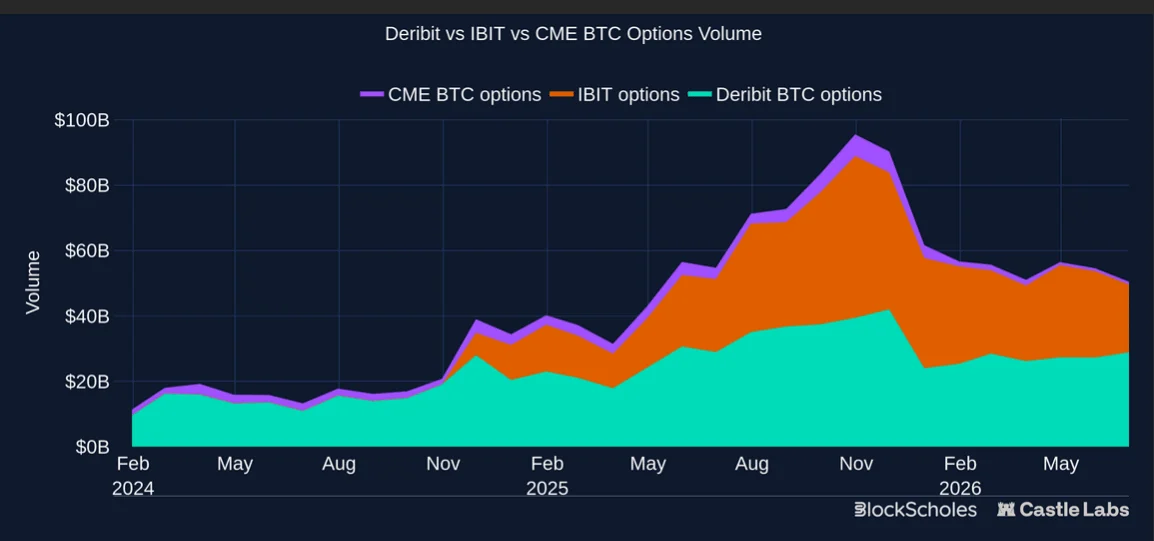
BTC options volume: Deribit vs IBIT vs CME
Institutional demand for crypto options has grown steadily, first through Deribit and more recently through BlackRock's IBIT options and CME.
Report page 14
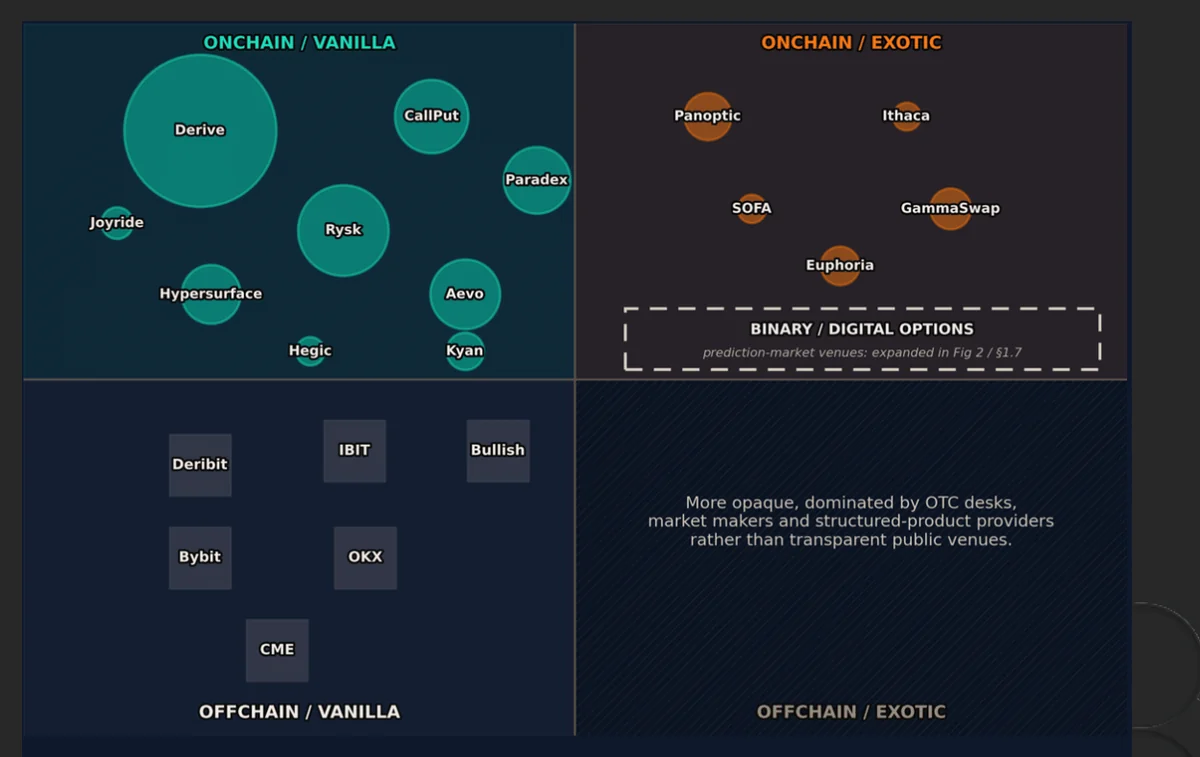
The crypto options ecosystem by settlement and payoff
Offchain vanilla options, led by Deribit, IBIT, CME, Binance and OKX, are still the clear leader. Onchain vanilla venues are rebuilding around order books, RFQs and simpler products that settle onchain.
Report page 17
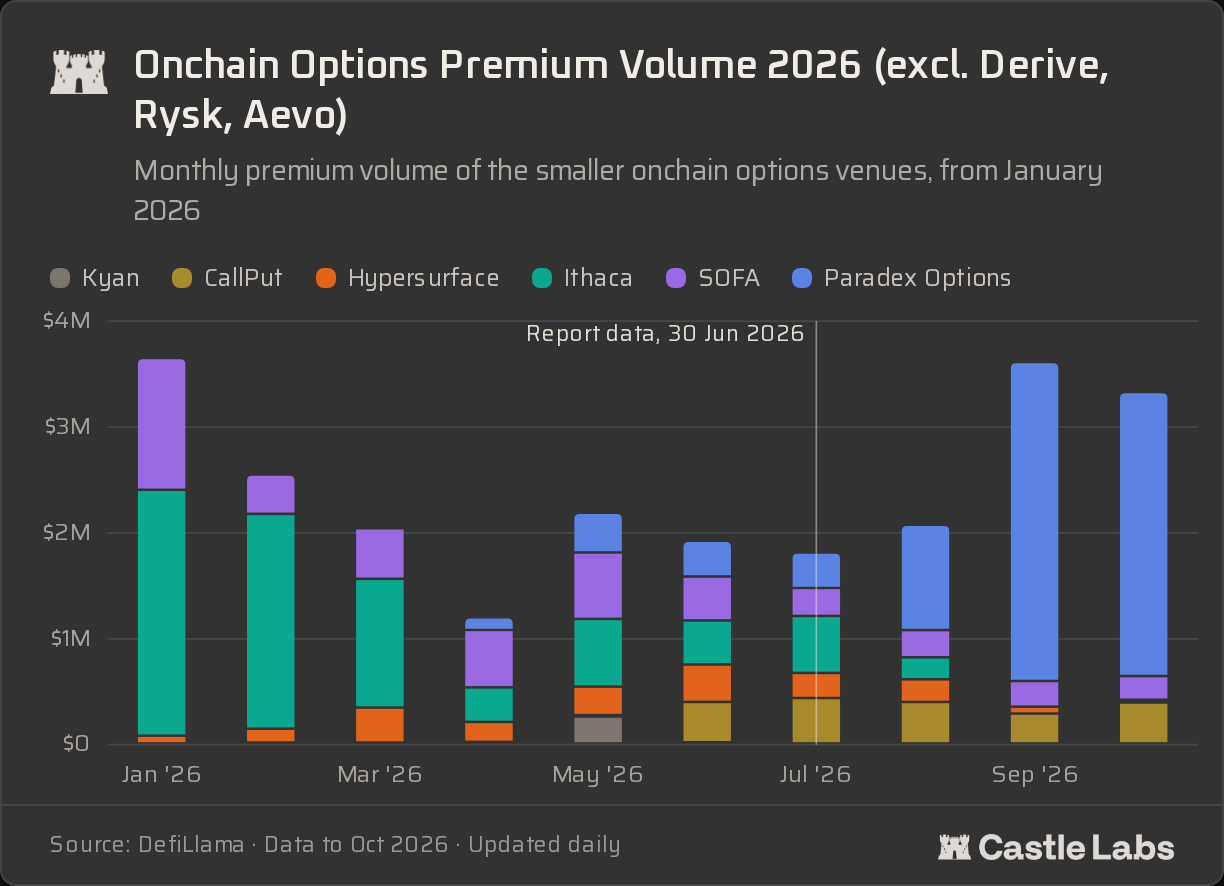
Now, Oct 2026 Six venues, last month: $3.32M · Paradex Options, last month: $2.68M
In the report, July 2026 Kyan, Paradex and CallPut are taking share at the low end. Better infrastructure is not enough on its own: options win when they solve a holder's problem, as Rysk did for HYPE holders.
Report page 27
Source: DefiLlama · Data to Oct 2026 · Updated daily
Data as of November 15, 2026.
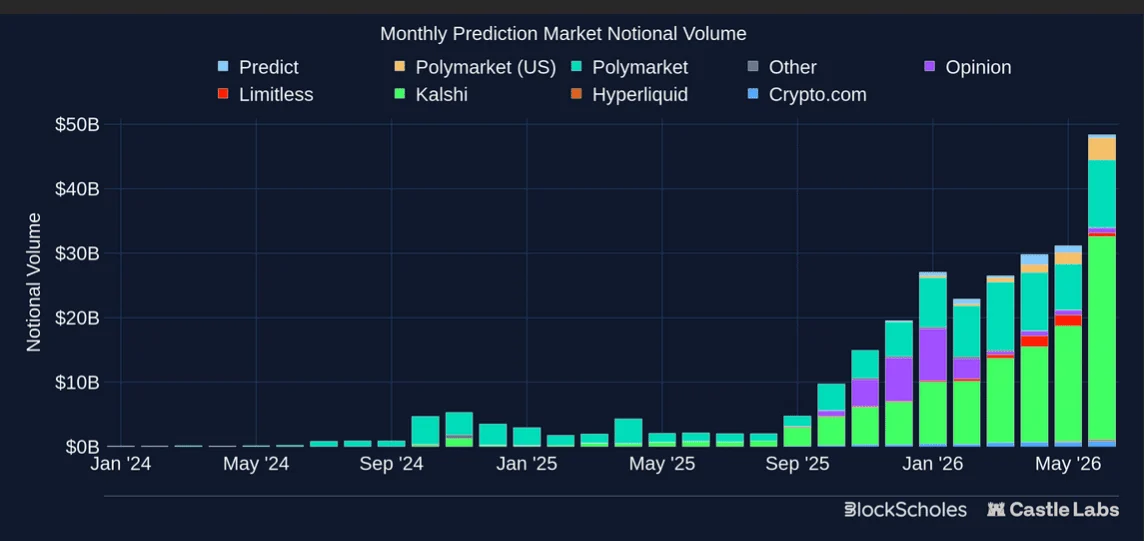
Monthly prediction market notional volume
Prediction markets grew from about $2 billion a month to about $30 billion a month in 18 months, most of it after the 2024 US election, when Polymarket's odds proved more accurate.
Report page 41
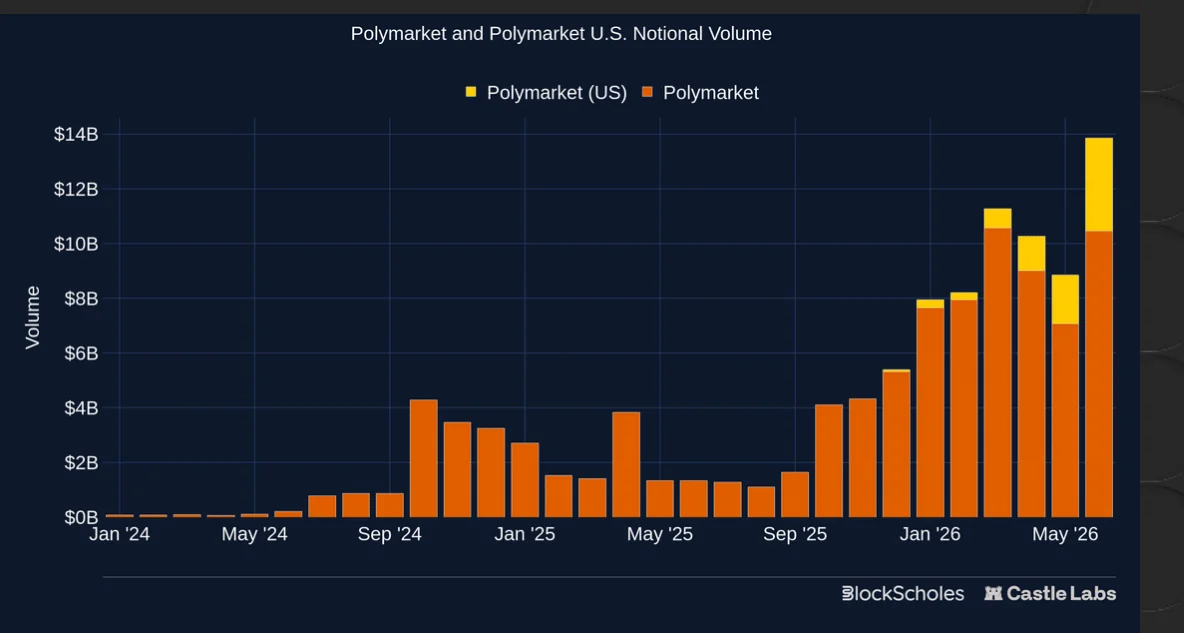
Polymarket and Polymarket US notional volume
Polymarket now does over $10 billion a month, driven by crypto, sports and politics. It bought QCEX, a CFTC-licensed exchange, in 2025 to return to the US market.
Report page 42
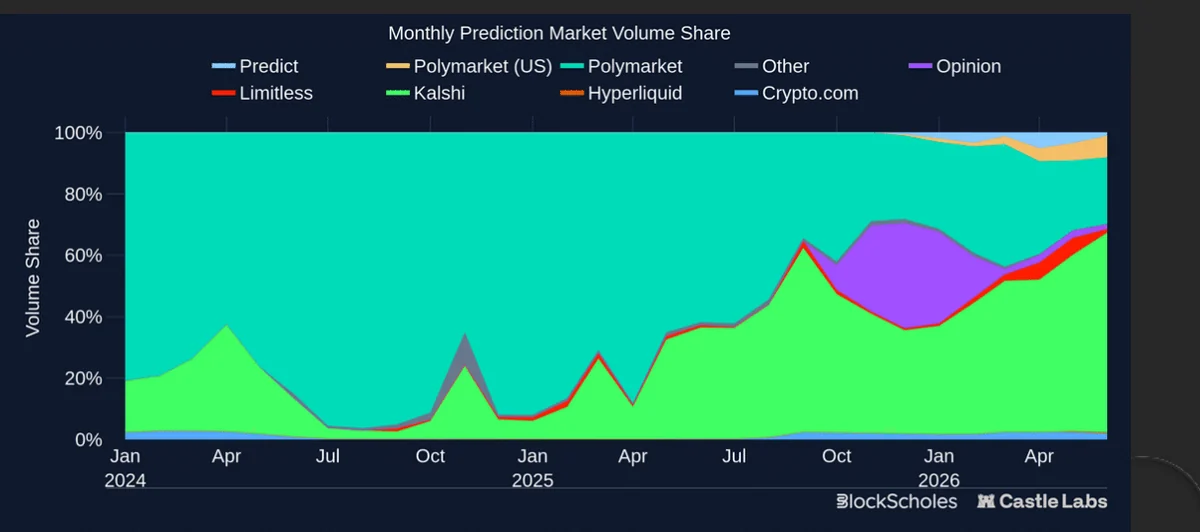
Monthly prediction market volume share
Kalshi holds over 65% of prediction market volume, helped by its regulated approach and US reach. It is eyeing a $40 billion valuation, against $15 billion targeted by Polymarket.
Report page 44
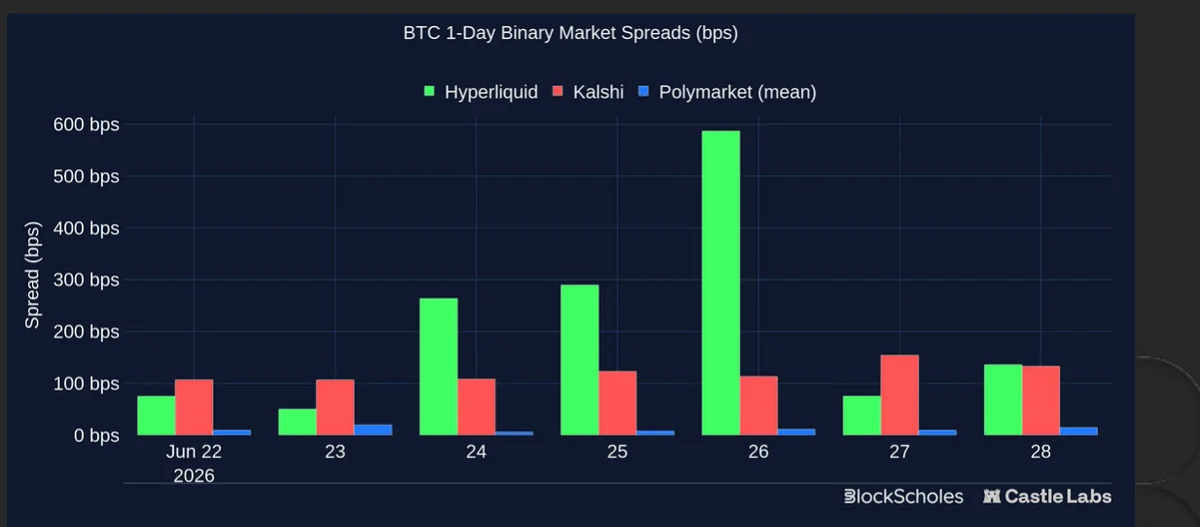
BTC one-day binary market spreads
Hyperliquid had the widest and most volatile spreads (50 to 587 bps), Kalshi a steady 107 to 154 bps. Polymarket's 5.8 to 19.8 bps is reconstructed from trades and likely understates its true spread.
Report page 52
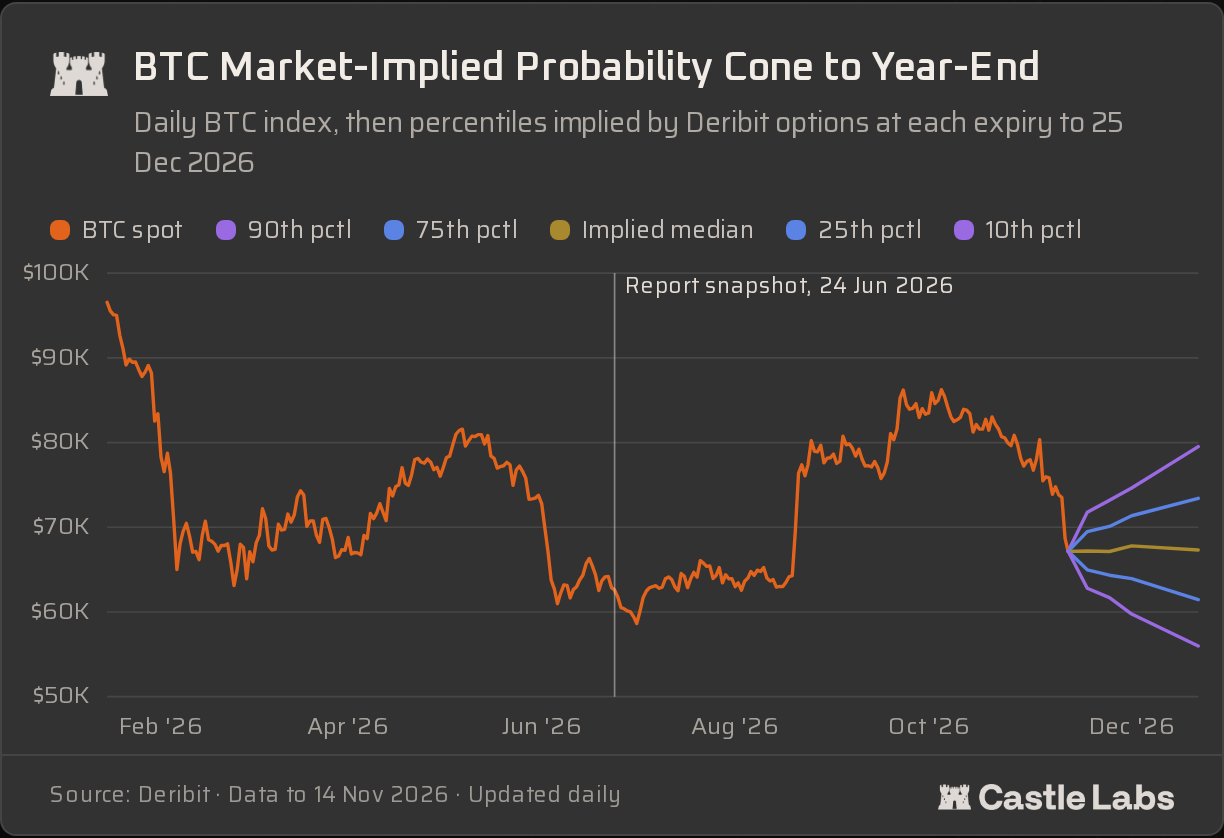
Now, 14 Nov 2026 Chance BTC is above $100K on 25 Dec 2026: 0.4% · Implied median on 25 Dec 2026: $67.32K
In the report, July 2026 Options price a 3.9% chance that BTC closes the year above $100K, a 90% chance it ends below $87K and a 75% chance it ends below $75K.
Report page 80
Source: Deribit · Data to 14 Nov 2026 · Updated daily
Data as of November 15, 2026.
Get every chart in the full report →
Method and Data Boundary
Castle and Block Scholes map onchain options venues and analyse BTC and ETH volatility surfaces. The binary-market comparison covers 22 to 28 June 2026 using Hyperliquid data from 0xArchive and public Polymarket and Kalshi APIs, with volume and spread calculated separately for each venue.
- Published July 2026
- Data snapshot July 2026
Primary Evidence
- FIA exchange-traded derivatives volume
- Cboe 2025 options industry review
- CME 24/7 crypto derivatives announcement
- 0xArchive market data
- Block Scholes research and analytics
Data From the Report
What BTC options priced for year-end 2026
Probabilities derived from the Block Scholes options surface for the 25 December 2026 expiry, compared with Polymarket, late June 2026.
| Outcome | Probability |
|---|---|
| BTC above $100K at year-end (options) | 3.9% |
| BTC touches $100K at any point before year-end (options) | 10.5% |
| BTC touches $100K before 2027 (Polymarket) | 14.5% |
| BTC above $87K at year-end (options) | 10% |
| BTC below $75K at year-end (options) | 75% |
Source: Block Scholes composite volatility surface; Polymarket
Options in traditional markets, for scale
| Data point | Value |
|---|---|
| Options vs futures contracts traded globally, 2024 | Over 4x |
| US-listed options contracts, 2025 (sixth record year) | About 15.2B, ~$36B premium a day |
| SPX zero-day options, 2025 | 59% of the product's volume, 2.3M contracts a day |
| BlackRock IBIT options open interest, April 2026 | $27.6B, above Deribit BTC options |
Source: Cboe; Castle Labs and Block Scholes
Questions This Report Answers
Which onchain options platform is the largest?
Derive. Over the 30 days to late June 2026 it did $1.142 billion of notional and $44.3 million of premium, 79.2% of onchain options notional and 87.2% of premium, though market-maker rewards and token incentives support that volume. Rysk was second with $136.3 million, then Aevo with $45.1 million.
Why did onchain options struggle for so long?
Options split liquidity across many strikes and expiries, while perps concentrate it in one book. Early designs pushed hard-to-hedge risk onto passive LP pools, market makers struggled to update hundreds of quotes onchain, and products were too complex for retail but not professional enough for institutions. Vault yields also compressed until premiums no longer paid for the risk.
What changed for onchain options in 2026?
Yield. With stablecoin and basis yields compressed, selling volatility through covered calls and cash-secured puts became competitive, and builders call volatility "the last product left that is unfarmed." Order books and RFQs replaced options AMMs, cheaper chains cut costs, and products such as Rysk reframed options as income on assets users already hold.
Are prediction markets the same as binary options?
For financial outcomes, yes. A BTC up/down or "above X" contract pays $1 or $0 at expiry, identical to a binary option, and its fair price is set by the vanilla options market. In June 2026, Polymarket's BTC ladder and the Block Scholes options surface disagreed by up to about 6 points at some strikes, in both directions.
How big are prediction markets?
About $30 billion a month in mid-2026, up from about $2 billion 18 months earlier, with fees over $300 million in June 2026, roughly double the fees of lending. Kalshi holds over 65% of volume, Polymarket does over $10 billion a month, and Hyperliquid's HIP-4 passed $150 million in its first weeks.
What was BTC options skew telling us in 2026?
That traders paid up for protection. BTC's 25-delta skew was negative for most of 2026 and never stayed above zero, dropping to -30% in the February sell-off. In June the 7-day put wing traded 10-25% above at-the-money volatility while calls traded 5-13% below, so the smile steepened mainly from demand for downside puts.
What happened to BTC volatility in June 2026?
On 5 June 2026 BTC fell below $60,000 for the first time since October 2024, 7-day realised volatility jumped from 30% to 70%, and 7-day implied volatility spiked to 65%, inverting the term structure. Within a week short-dated implied volatility fell back toward 30%, a multi-year low, showing how volatile volatility itself was.