
- $68mAdded Hyperliquid revenue a year from the US venue in the base case, at a 50% fee share.
- $114bntrade[XYZ]'s record monthly notional volume, in July 2026, up from $4.1bn in November 2025.
- 24%Share of all Hyperliquid perpetual volume on trade[XYZ]'s markets in September.
- $2.9bnCirculating market value added by the 16% rise in MVHYPE on October 29.
Key Takeaways
- The deal. On October 29, Intercontinental Exchange (ICE) signed a definitive agreement to be the exclusive operator of trade[XYZ]’s US-regulated perpetual futures markets, which will be built on Hyperliquid. ICE is also taking an undisclosed minority stake. The venue still needs CFTC approval and has no launch date.
- The market reaction. MVHYPE rose 16.0% on the day to 93.99, 2.6% below its September 22 high. It is up 267% year to date.
- Who trade[XYZ] is. trade[XYZ] is the largest third-party market deployer on Hyperliquid. It designs and lists perpetuals on stocks, indexes, commodities and FX, while Hyperliquid’s engine does the matching, margining and settlement. It accounted for about 97% of all HIP-3 volume in September.
- The economics are mostly undisclosed. The fee schedule, the revenue split, leverage limits, the product list and which brokers will join have not been announced. Using Hyperliquid’s actual revenue and trade[XYZ]’s actual volumes, we estimate the US venue would add $9m (bear), $68m (base) or $274m (bull) of Hyperliquid revenue a year at a 50% protocol fee share. That is 1% to 32% of the current run-rate. With four parties sharing fees onshore, the protocol’s share could be closer to 25%, which halves every figure.
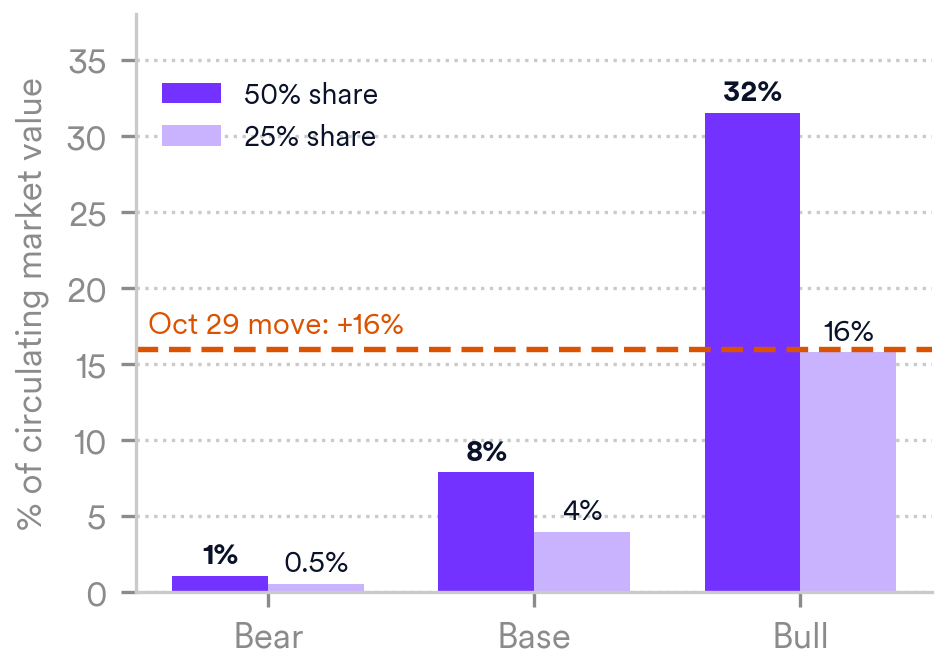
- Putting the scenarios in context. At a constant revenue multiple, the scenarios correspond to roughly 1%, 8% and 32% of current circulating market value at a 50% fee share, or half that at 25%. The October 29 move was larger than the base case. This is an illustrative sensitivity, not a price target.
- The hurdles are regulatory and practical. Single-stock perpetuals need SEC sign-off as well as CFTC approval. The CFTC blocked CME’s 24/7 oil contract this summer. Leverage for US retail traders is unresolved. A permissioned US order book will start without offshore liquidity, and the clearing structure has to reconcile ICE’s emergency powers with Hyperliquid’s validators.
- Our read. For Hyperliquid, the question has moved from whether it can be regulated toon what terms. The validation is real. The near-term revenue impact in our base case is modest and depends on approvals, so we see the deal mainly as option value on regulatory outcomes.
1. Hyperliquid in brief
Hyperliquid is a purpose-built layer-1 blockchain whose core application is fully on-chain perpetual futures exchange. Every order, cancel and liquidation is recorded on-chain, and trading carries no gas fees. In less than two years it went from a little-known project to the dominant decentralized derivatives venue. It overtook dYdX in monthly volume in August 2024, and since mid-2025 its monthly perpetual volume has averaged about $250bn, above $200bn in all but two months. In October 2026 it processed $228bn of notional volume, about $7.9bn a day.
How it won
Hyperliquid won through product quality and token design rather than incumbency. Its trading experience is comparable to a centralized exchange: a median finality of about 0.2 seconds, one-click trading through session keys, and deep books from day one. The books were seeded by HLP, a community-owned vault that makes markets and absorbs liquidations. Meanwhile, the leading incumbent, dYdX, was migrating to a new chain and gave token holders little economic link to fee revenue. The November 2024 HYPE airdrop reserved 31% of supply for the community and gave nothing to venture investors. Roughly 97–99% of trading fees flow to the Assistance Fund, which buys back HYPE. That creates a direct link between activity and token demand, although holders have no contractual claim on cash flows.
Architecture
- HyperCore runs the order books, margining, funding and settlement under HyperBFT, a custom Byzantine-fault-tolerant consensus that stays final as long as more than two-thirds of validator stake is honest.
- HyperEVM shares the same consensus and state. It lets standard Ethereum smart contracts read HyperCore positions and prices, and submit orders, so DeFi applications can be built directly on the exchange’s liquidity.
- Builder codes let third-party front ends, including Phantom and MetaMask, route orders to Hyperliquid and earn a fee. That spreads distribution without fragmenting liquidity. In the US structure, FCMs that join ICE’s venue would play a similar role.
- HIP-3(live since October 2025) lets anyone who stakes 500,000 HYPE deploy their own perpetual markets on HyperCore. The deployer can receive up to 50% of the fees. trade[XYZ] is by far the largest HIP-3 deployer.HIP-3* adds optional allowlists so a regulated operator can restrict trading to KYC-verified accounts. It is on test net today.
The trade-offs
Hyperliquid’s speed comes partly from deliberate centralization. The node software is closed-source. Stake is concentrated, including stake delegated to Hyper Foundation validators. Many users rely on Hyperliquid-operated APIs. The protocol has handled stress well: during the October 10, 2025 liquidation cascade, it processed roughly half of the market’s liquidations with no downtime and no bad debt. But the March 2025 JELLY episode required validators to step in and override a market price. For a US-regulated clearing structure that will settle on HyperCore, these governance and resilience questions are central to the regulatory review.
Why this matters for the ICE deal. ICE is not licensing software. It is putting a regulated exchange and clearing house on top of a decentralized engine it does not control. The protocol’s strengths (24/7 matching and settlement, a live product set, transparent risk) are what ICE is buying. Its weaknesses (validator concentration, closed-source code, a history of emergency interventions) are what regulators will examine most closely.
2. Who is trade[XYZ], and what does it do on Hyperliquid?
trade[XYZ] (trade.xyz) is a market operator, not a separate blockchain or a broker. Under HIP-3 it runs its own set of markets on Hyperliquid, called the xyz deployment. Every contract it lists carries an “xyz:” prefix, so its Tesla perpetual is xyz:TSLA. Its first market, the XYZ100 index of 100 large US-listed non-financial companies, began trading on October 13, 2025. By early October 2026 it listed about 110 markets: 76 single stocks plus ETFs, equity indexes (including an S&P 500 perpetual licensed from S&P Dow Jones Indices), commodities, FX and pre-IPO contracts.
Table 1: How the work is divided on an xyz market
Function |
Who does it |
|---|---|
Chooses which markets to list, their leverage, trading hours and price sources |
trade[XYZ], through its xyz deployment |
Publishes the reference (oracle) and mark prices used for funding, P&L and liquidation |
trade[XYZ]’s price relayers |
Matches orders, holds margin, pays funding, liquidates and settles in USDC |
Hyperliquid’s HyperCore engine |
Holds customer funds |
The user’s own Hyperliquid account; trade.xyz is a non-custodial front end |
Puts capital at stake for the markets it runs |
trade[XYZ] stakes 500,000 HYPE; it can be penalized for unsafe operation |
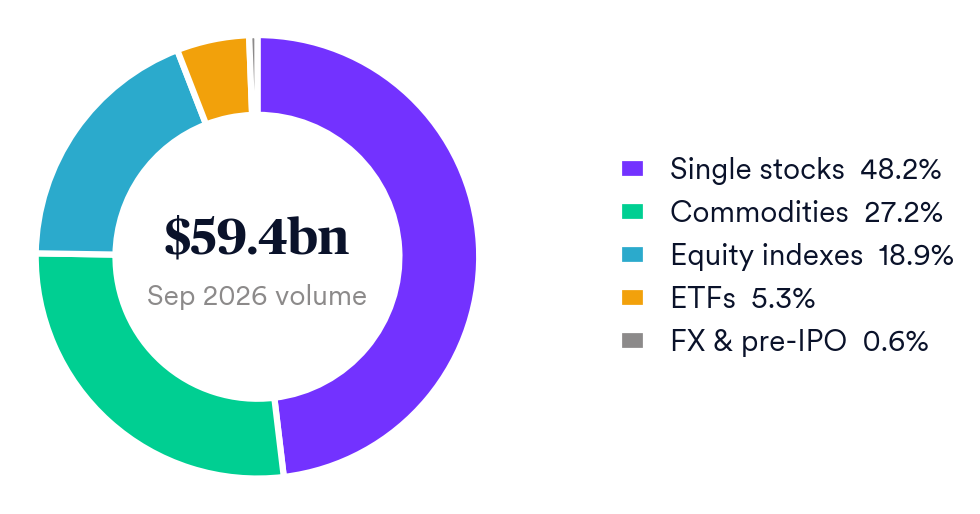
Its scale is what makes it valuable to ICE. In September its markets traded $59.4bn, about 97% of all HIP-3 volume and 24% of all perpetual volume on Hyperliquid. On a typical weekday the share rose to about 25%. Single stocks and ETFs made up 53% of that volume, and commodities, led by WTI crude oil, another 27%.
Figure 1: trade [XYZ] volume by asset class, September 2026
Source: 0xArchive (Hyperliquid on-chain data), trade.xyz documentation, MarketVector Indexes.
Its edge is price discovery when traditional markets are closed. While the underlying exchange is open, trade[XYZ]’s reference price tracks it. When the exchange closes, the reference price switches to trade[XYZ]’s own order book, and “discovery bounds” cap how far the price can drift before the real market reopens. That is why traders use its markets to price stocks and oil over the weekend. Weekend days still averaged about $0.54bn of volume in September.
Its fees are shared with Hyperliquid. Standard HIP-3 markets charge twice Hyperliquid’s own fees, and the deployer can receive up to half. Most xyz markets currently run in “Growth Mode”, which cuts those fees by 90%.
Why this matters for the ICE deal. In a US version of trade[XYZ], ICE would take over the regulated roles: running the exchange, setting the rules and clearing trades. trade[XYZ] would keep designing the contracts. That arrangement only works if regulators accept trade[XYZ]’s pricing method, especially the weekend pricing, and if they approve the asset classes that drive most of its volume. Single stocks, ETFs and oil are exactly the areas where the SEC and CFTC have so far been most cautious.
3. What was announced
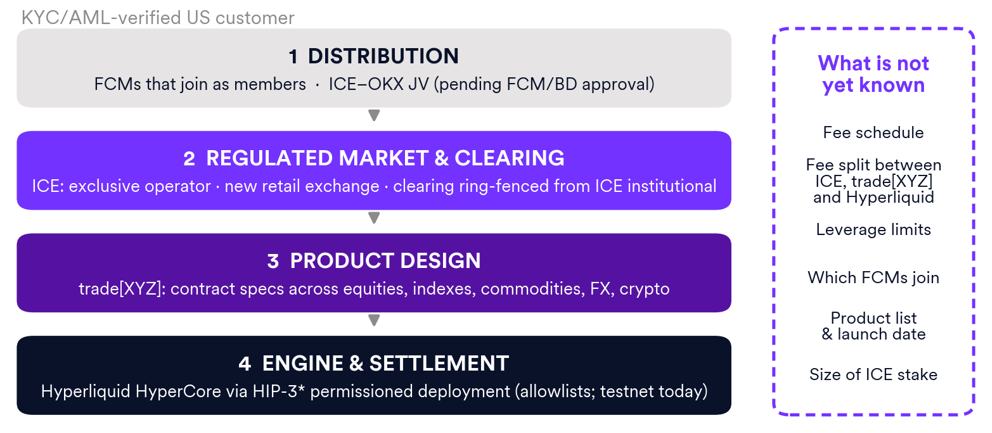
Under the agreement, ICE will be the exclusive operator of trade[XYZ]’s regulated markets. It plans to set up a new, dedicated retail exchange and clearing structure that is legally separate from its institutional futures and clearing business, so ICE’s commercial hedgers carry no exposure to retail counterparty risk. KYC/AML-verified customers would access the markets through futures commission merchants (FCMs) that become members of the platform. Distribution is also planned through ICE’s joint venture with OKX, which is awaiting its own FCM and broker-dealer approvals. ICE says more than 99% of its current participation is institutional, so retail is a new business line for the group. It describes the stake as not material to its 2026 results. Stan Druckenmiller has disclosed an investment in trade[XYZ] alongside ICE.
The roles split cleanly. trade[XYZ] designs the contracts. ICE runs the regulated exchange and clearing. Hyperliquid’s HyperCore matches and settles trades. The press release leaves out the variables that determine value for HYPE holders: fees, revenue sharing, leverage and launch timing. It also gives the HYPE token no direct role as collateral or payment.
Figure 2: How the planned US venue is organized
Source: ICE press release (Oct 29, 2026), Hyperliquid documentation, MarketVector Indexes. HIP-3* = HIP-3 with optional permissioning/allowlists.
Three practical questions: liquidity, collateral and emergency powers
Separate order books. Under HIP-3, each deployment runs its own order books, and HIP-3* adds allowlists on top. A venue for KYC-verified US customers would therefore most likely trade on its own permissioned books, not on trade[XYZ]’s existing offshore markets ($59.4bn of volume in September). US orders could not simply match against offshore liquidity, or against HLP. To avoid wide spreads at launch, market makers would need to quote on both the US and offshore books and arbitrage the gap. Sharing an engine and price references makes that easier, but a regulated venue that opens with thin books is a real risk.
Where customer collateral sits. HyperCore holds margin and settles in USDC on-chain, while ICE plans a legally separate clearing house. CFTC customer-protection rules require customer funds to be segregated by the FCM and the clearing house. Regulators will have to decide whether US customer margin can sit on-chain as USDC, or must stay in traditional segregated accounts with only a representation on HyperCore. The answer affects operational risk, and also whether Hyperliquid earns reserve income on US deposits, which is part of its revenue today.
Who can stop the market. A US clearing house must be able to halt trading and manage a member default on its own authority. On Hyperliquid, comparable interventions have so far been carried out by validators, as JELLY episode. How ICE’s authority fits with Hyperliquid’s validator governance is likely to be a central question in the approval.
4. Why ICE chose to build on Hyperliquid
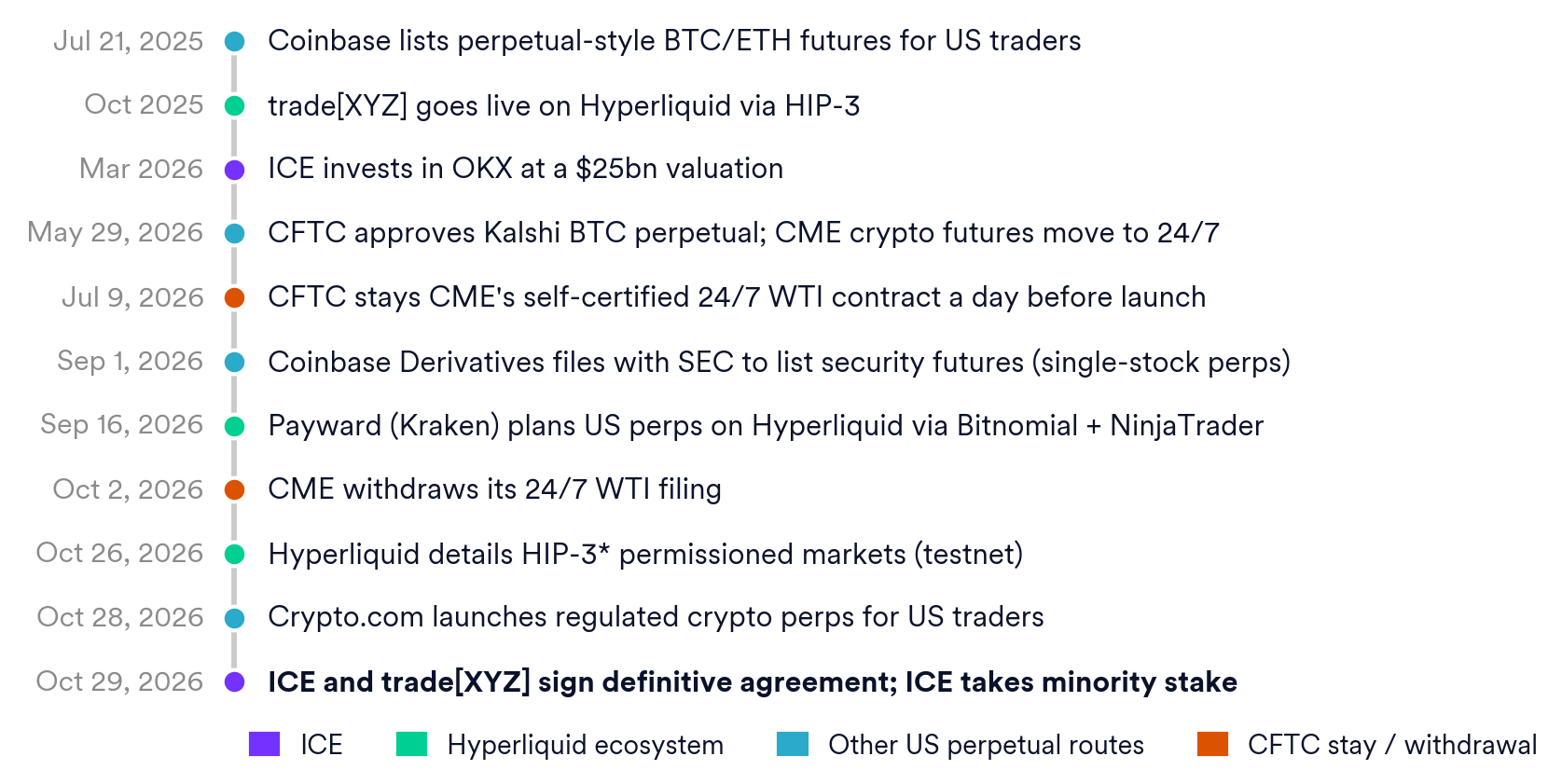
Two US exchange groups have now chosen different routes to 24/7 markets. CME built on its own systems. Its crypto futures and options have traded around the clock since May 29, but trades done on weekends and holidays are given the next business day’s trade date for clearing and settlement. When CME tried to extend 24/7 trading to a 10-barrel WTI contract, the CFTC stayed the self-certified listing on July 9, one day before launch. CME withdrew the filing on October 2, citing concerns from commercial participants.
ICE partnered for the engine. Building on HyperCore gives ICE matching and settlement that already run 24/7, a live product set with a year of offshore price history, and a partner whose markets are already used as a reference for weekend prices. In return, ICE shares the economics and depends on a protocol it does not control. The deal follows a series of moves by ICE into retail and crypto: an investment of up to $2bn in Polymarket (announced October 2025), a stake in OKX at a $25bn valuation (March 2026), and CEO Jeffrey Sprecher’s confirmation in May that ICE had held several meetings with Hyperliquid.
Figure 3: The race to bring perpetuals onshore in the US
Source: CFTC, CME Group, ICE, Coinbase, Payward, Hyperliquid, Crypto.com announcements and press coverage; MarketVector Indexes. Dates are announcement dates.
On the 3.75 million HYPE OTC sale. In early October, Hyperliquid’s team unstaked 3.75 million HYPE, worth about $330m at the time, for an over-the-counter sale to one unnamed institution. Market commentary has linked the buyer to ICE. Neither ICE nor Hyperliquid has confirmed this, and we do not assume it in our analysis.
5. Traction: trade[XYZ] and Hyperliquid in numbers
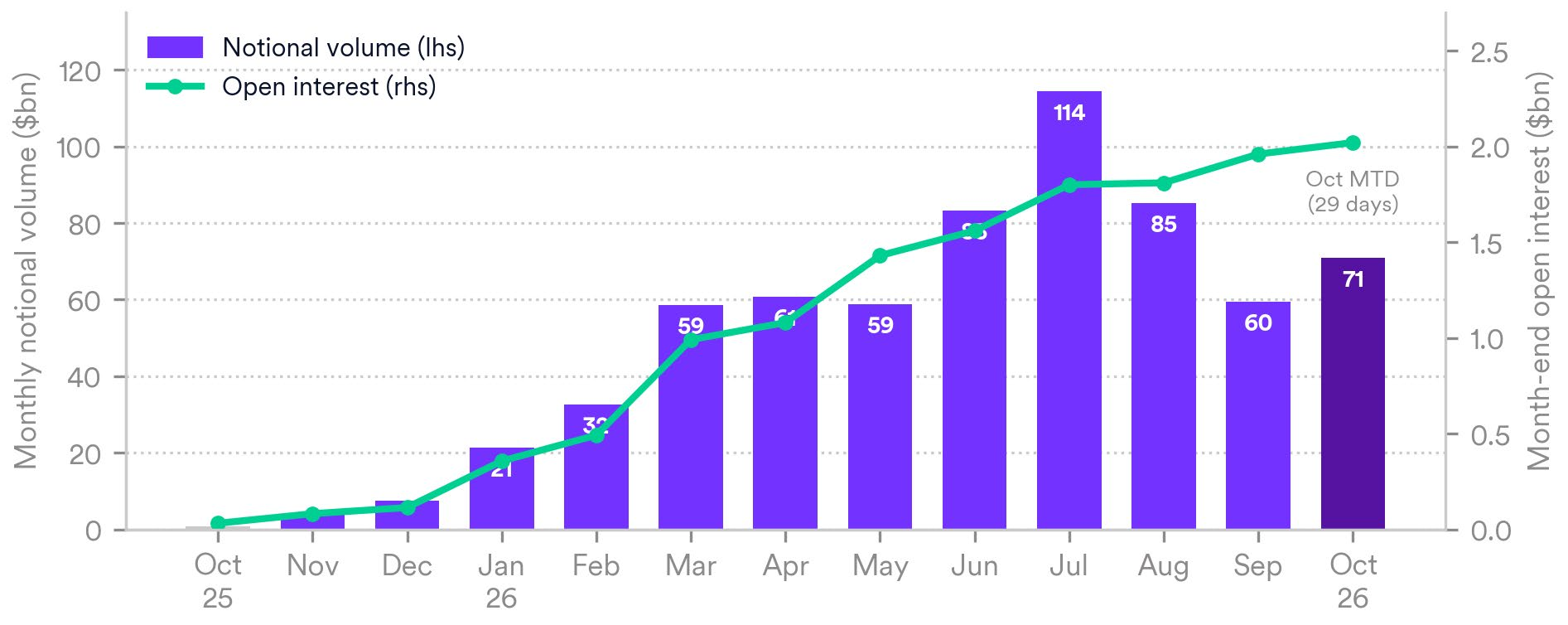
trade[XYZ] launched on Hyperliquid in October 2025 and grew quickly. Monthly notional volume rose from $4.1bn in November 2025 to a record $114bn in July 2026. October to date shows $71.0bn over 29 days, or about $2.4bn a day, with open interest at a record $2.02bn. Second-quarter volume was $202.7bn, and trade[XYZ] says its cumulative volume has passed $650bn.
Figure 4: trade{XYZ]: monthly notional volume and open interest
Source: Token Terminal, MarketVector Indexes. October 2025 covers 19 days; October 2026 covers Oct 1–29.
Its fees are low. October fees of $7.45m work out to about 1.05 basis points of notional, largely because Growth Mode cuts fees by 90% on most xyz markets. Token Terminal shows trade[XYZ] keeping $2.52m (34%) of those fees as revenue, below the nominal 50% deployer share, so the realized split differs from the headline terms. Hyperliquid itself earned $69.0m of protocol revenue in the first 29 days of October, or $868m annualized. Its revenue over the past twelve months is about $679m. At a circulating market cap of $21.3bn, HYPE trades at 24.3x annualized revenue, or about 97x on a fully diluted basis ($84.6bn).
Figure 5. Hyperliquid protocol revenue, normalized to a 30-day month ($m)
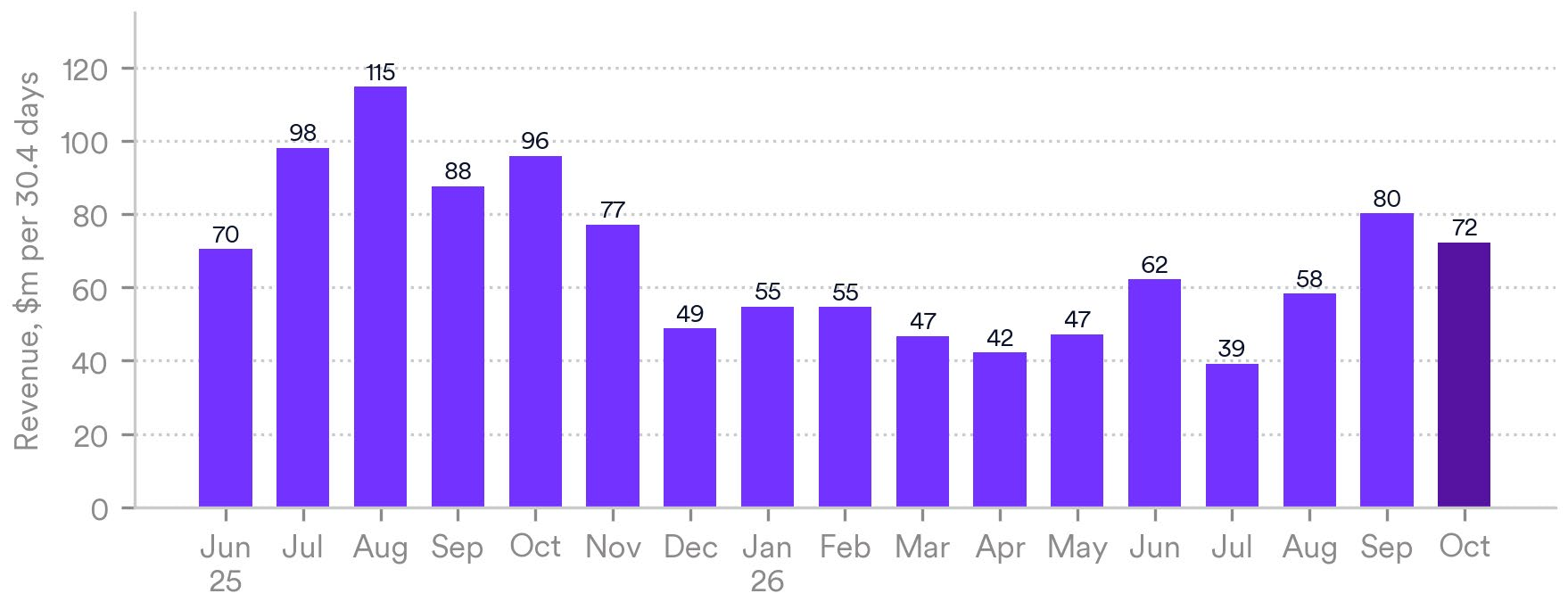
Source: Token Terminal, MarketVector Indexes. Revenue = fees retained by the protocol after builder-code and HIP-3 deployer pass-throughs, including USDC reserve income. October 2026 = Oct 1–29, scaled to 30.4 days.
6. What could the US venue add to Hyperliquid’s revenue?
None of the economic terms have been disclosed, so we frame the question as a sensitivity analysis rather than a forecast. We estimate incremental annual protocol revenue as: US venue average daily volume × 365 × all-in fee rate × Hyperliquid’s share of fees. Offshore, trade[XYZ] currently charges about 1 basis point under Growth Mode discounts. A regulated US venue is likely to charge more because exchange, clearing and broker costs are higher; Coinbase’s US perpetual-style futures start at 2 basis points for takers.
Table 2: Scenario assumptions and results
Swipe for 4 more columns
Scenario |
What has to happen |
US venue ADV |
All-in fee |
Revenue / yr at 50% share |
Revenue / yr at 25% share |
|---|---|---|---|---|---|
Bear |
Only crypto and broad indexes approved; few FCMs join; OKX JV delayed; low retail leverage |
$0.5bn |
1.0 bp |
$9m (1% of run-rate) |
$5m (0.5% of run-rate) |
Base |
Product set similar to offshore; several large retail FCMs join; activity matches trade[XYZ]’s offshore business today |
$2.5bn |
1.5 bp |
$68m (8% of run-rate) |
$34m (4% of run-rate) |
Bull |
Single-stock perpetuals approved; major brokers and OKX JV live; US venue volume equals all of Hyperliquid’s volume today |
$7.5bn |
2.0 bp |
$274m (32% of run-rate) |
$137m (16% of run-rate) |
Source: MarketVector Indexes estimates. All-in fee = the trading fee charged at the exchange/protocol level, before any FCM commissions or broker mark-ups. Run-rate = Hyperliquid revenue Oct 1–29, 2026 annualized ($868m, Token Terminal).
Why a 50% fee share may be too generous
Our starting assumption, a 50% protocol share, mirrors the standard HIP-3 terms. Offshore, fees are split between two parties: the deployer and the protocol. Onshore there are four. FCMs (and the ICE–OKX JV) handle distribution, ICE runs the exchange and clearing house, trade[XYZ] designs the products and HyperCore matches and settles. FCMs normally charge their own commissions on top, but ICE will expect a cut of the exchange fee. Either the all-in fee rises above the 1–2 basis points in our scenarios, or less of it reaches Hyperliquid. Even offshore, the split is not clean. From August to October, trade[XYZ] kept 35% of the fees on its markets, and the remaining 65% (about 0.7 basis points of volume) covers builder-code and referral payments as well as the protocol’s share. We therefore also show every scenario at a 25% protocol share.
At 25%, revenue halves: about $5m, $34m and $137m a year, or 0.5%, 4% and 16% of the run-rate. To get back to the base case’s $68m at a 25% share, the venue would need either $5bn a day at 1.5 basis points or $2.5bn a day at 3 basis points.
Figure 6. Where a dollar of trading fees goes: offshore today and on the planned US venue
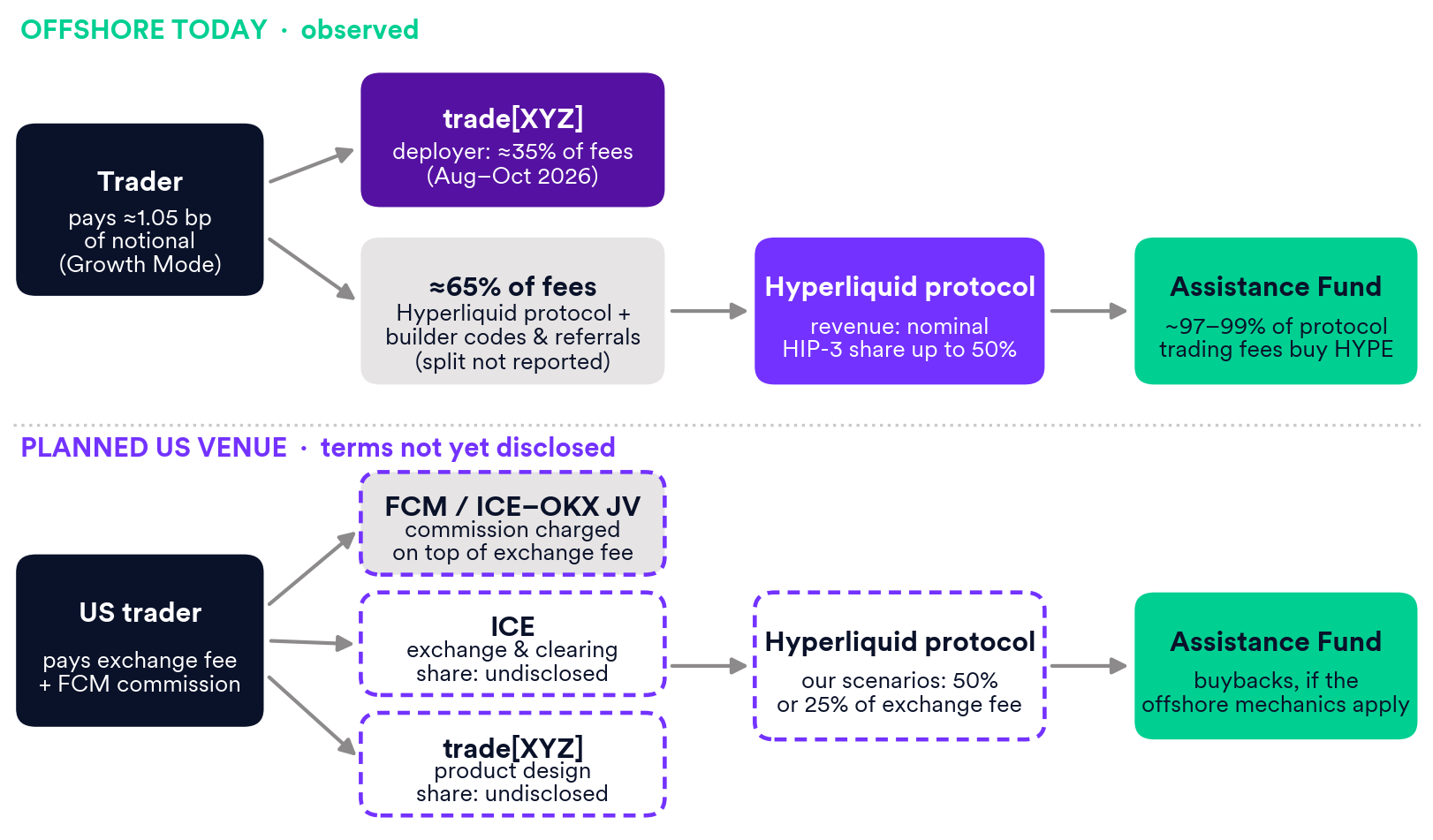
Source: Token Terminal (trade[XYZ] fees and revenue, Aug–Oct 2026), Hyperliquid and trade.xyz documentation, ICE, MarketVector Indexes. Dashed boxes = shares not yet disclosed. The Assistance Fund share refers to protocol trading fees as reported in secondary sources (97–99%).
How we set the volume assumptions
The volume figures are anchored assumptions, not a bottom-up forecast. No fee schedule, product list or broker line-up exists yet to build one from. Each scenario is pegged to a volume we can observe today, then cross-checked against the size of US regulated derivatives markets that retail traders already use.
Table 3. Where the volume assumptions come from
Scenario |
ADV |
Anchor |
Cross-check |
|---|---|---|---|
Bear |
$0.5bn |
About 20% of trade[XYZ]’s offshore volume today; close to its weekend run-rate ($0.54bn a day) |
Slow start, like Kalshi’s BTC perpetual (about $0.14bn a day in its first week) |
Base |
$2.5bn |
Equal to trade[XYZ]’s offshore volume today ($2.4bn a day) |
About 1/3 of CME’s crypto complex; about 1.3% of CME micro equity-index futures notional |
Bull |
$7.5bn |
Equal to all of Hyperliquid’s volume today ($7.9bn a day) |
About CME’s crypto complex; about 4% of CME micro equity-index notional |
Source: Token Terminal, 0xArchive, CME Group (Q3 2026 ADV), Kalshi, MarketVector Indexes.
Figure 7. Scenario volumes compared with existing venues (average daily notional, $bn, log scale)
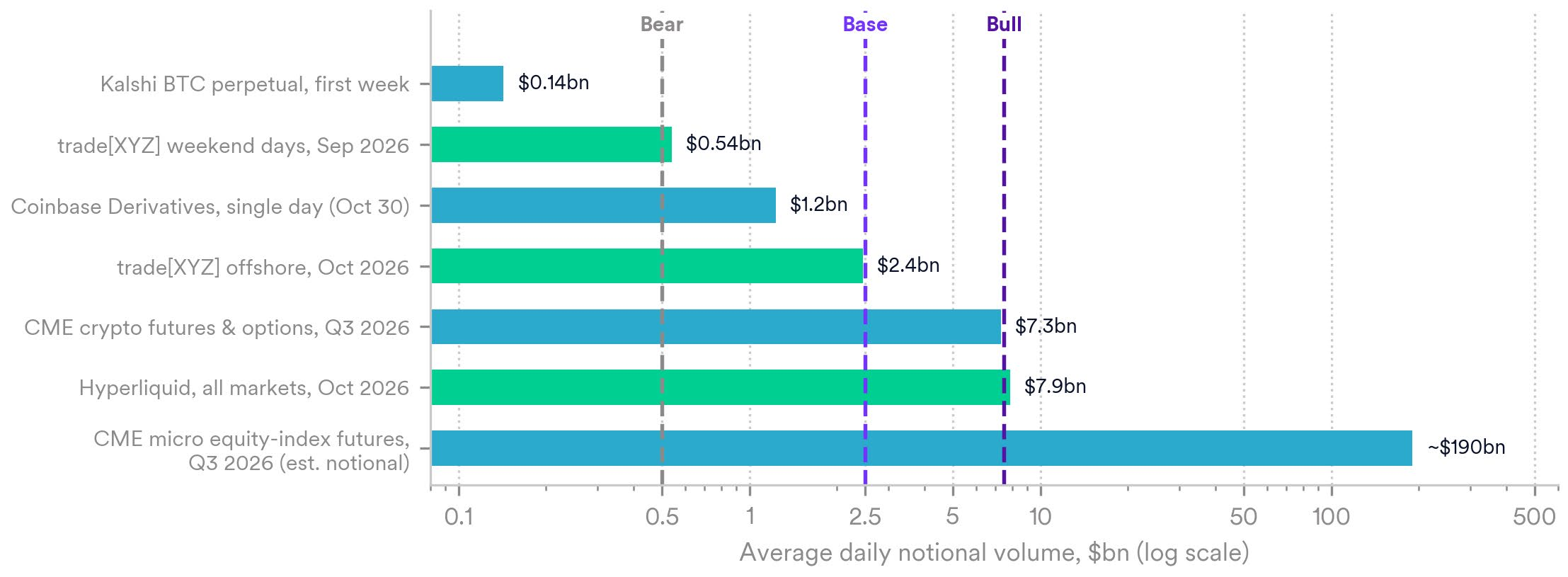
Source: Token Terminal, 0xArchive, CME Group, Coinbase, Kalshi, MarketVector Indexes. Scope of each benchmark: Kalshi = BTC perpetual only, launch week, based on the company’s “$1bn+ in the first week” statement; trade[XYZ] weekend days = all xyz markets (stocks, commodities, indexes, FX), September 2026 average; Coinbase Derivatives = all products on its US futures exchange, single day (Oct 30, 2026); trade[XYZ] offshore = all xyz markets, Oct 1–29 average; CME crypto = all crypto futures and options, Q3 2026 average; Hyperliquid = all markets incl. HIP-3, Oct 1–29 average (taker fills only); CME micro = CME micro equity-index futures only, our notional estimate from Q3 2026 ADV. The benchmarks differ in asset class, product type, period and counting method, so the chart is an order-of-magnitude check, not a like-for-like comparison.
Two points stand out. First, even the bull case would make the US venue small next to the micro equity-index futures that US retail traders already use at CME, so the scenarios do not assume demand that does not exist. Second, these benchmarks show the market is already crowded. The volume will have to be won from CME, Coinbase, Kalshi and others, not just captured.
Figure 8. Scenario results at a 50% and 25% protocol share (above) and sensitivity of annual ($m) to volume and fee rate at 50% (below)
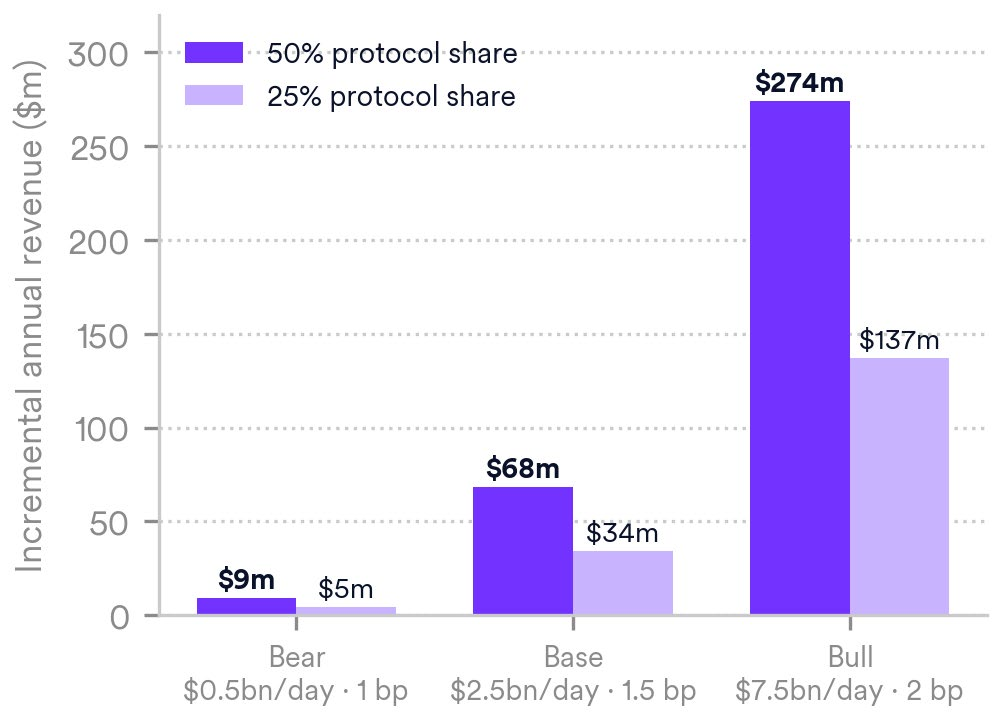
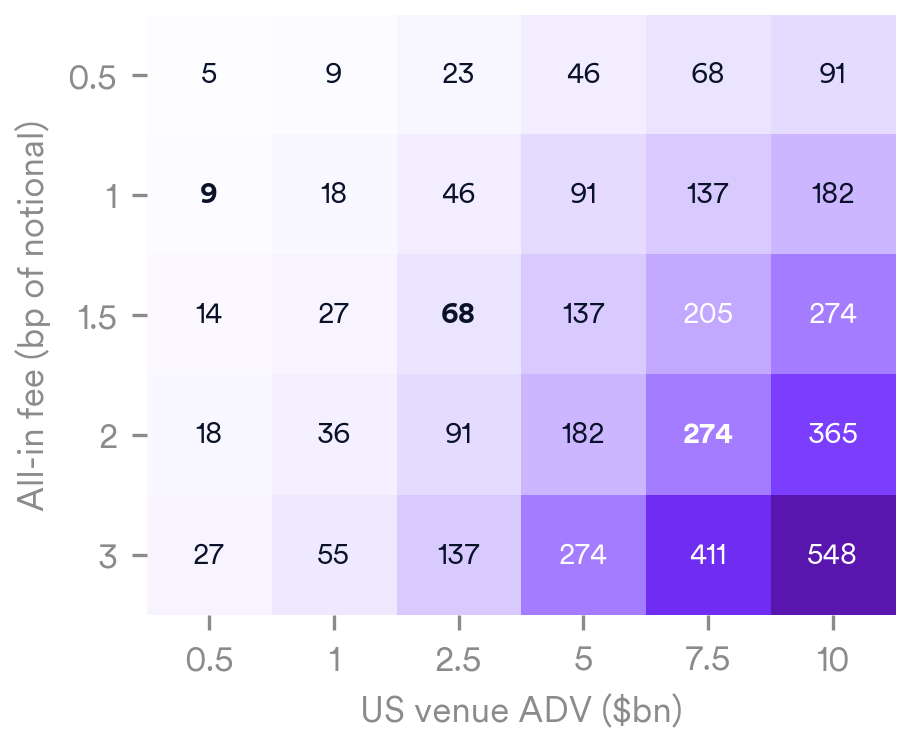
Source: MarketVector Indexes estimates. Bold cells in the heat map mark the three scenarios. At a 25% share, halve every value.
How to read the numbers. At a 50% share, the base case adds roughly one month of Hyperliquid’s current revenue each year, and the bull case about a third. At 25%, both halve. Volume, fee rate and fee share matter about equally, and every value scales directly with each of them.
What we do not model. Possible second-order effects include more HYPE staked by HIP-3* deployers, more USDC reserve income as deposits grow, and higher offshore volume as Hyperliquid gains legitimacy. Possible offsets include US volume that would otherwise have reached Hyperliquid through offshore routes, and competing US venues pushing fees down.
7. Putting the scenarios in context
To put the revenue scenarios in context, we compare them with HYPE’s current circulating market value at a constant revenue multiple. Token Terminal puts HYPE at 24.3x annualized revenue on a circulating basis ($21.3bn market cap). At that multiple, the base case corresponds to roughly 8% of current circulating market value and the bull case to roughly 32% at a 50% fee share. At a 25% share, the figures are about 4% and 16%.
Figure 9 and Table 4. Scenarios as a share of circulating market value at a constant revenue multiple, compared with the October 29 move
Scenario |
At 50% fee share |
At 25% fee share |
|---|---|---|
Bear |
$0.2bn (1%) |
$0.1bn (0.5%) |
Base |
$1.7bn (8%) |
$0.8bn (4%) |
Bull |
$6.7bn (32%) |
$3.4bn (16%) |
Source: Token Terminal, MarketVector Indexes estimates. Circulating market value of $21.3bn and 24.3x annualized revenue as of Oct 29, 2026. Illustrative sensitivity only, not a price target or forecast.
Compared with the October 29 move. The 16% rise in MVHYPE on October 29 added about $2.9bn of circulating market value. At a constant revenue multiple, the base case corresponds to roughly 8% of current circulating market value at a 50% fee share, or 4% at 25%; the October 29 move was larger than this.
Timing reduces the value further. A launch is probably at least 18 months away. Discounting at 30% a year, a rate meant to reflect early-stage regulatory risk, the present value of the base case falls by about a third: to roughly $1.1bn (5% of circulating value) at a 50% share, or $0.57bn (2.7%) at 25%. This still does not account for the chance that approval never comes.
8. Competitive landscape
ICE will not have the US market to itself. At least six other routes to US perpetuals are live or pending. The most important difference is distribution. Payward’s design runs through a single FCM that it owns. ICE’s design is open to any FCM that joins. But several of the largest retail platforms, including Coinbase, Robinhood and Crypto.com, are building perpetual products of their own, which could reduce their incentive to route customers to ICE.
Table 5. Routes to US-regulated perpetual futures
Route |
Structure |
Status (Oct 30, 2026) |
|---|---|---|
ICE / trade[XYZ] |
ICE-run exchange and separate clearing; HyperCore engine via HIP-3*; many FCMs plus the ICE–OKX JV |
Agreement signed Oct 29; approvals pending; no launch date |
Payward (Kraken) / Bitnomial |
Bitnomial as CFTC-regulated HIP-3* deployer and clearing house; NinjaTrader Clearing as the only FCM |
Announced Sep 16; Hyperliquid expects it to be the first regulated HIP-3* deployer; pending |
Coinbase Derivatives |
Own exchange and FCM; nano BTC/ETH perpetual-style futures |
Live since Jul 2025; single-stock perpetuals filed; SEC Form 1-N filed Sep 1 |
Kalshi |
Own exchange (DCM) |
BTC perpetual approved May 29 ($1bn+ volume in its first week); stock-index, copper and single-stock perpetuals filed |
Crypto.com / OG.com |
CFTC-regulated structure |
Crypto perpetuals live for US traders since Oct 28; single-stock perpetuals request pending |
Robinhood |
Broker / app distribution |
Crypto perpetuals announced Sep 29 for “the coming months” |
CME Group |
Own exchange and clearing |
Crypto futures trade 24/7 (next-day clearing); 24/7 WTI withdrawn Oct 2 |
Source: Company announcements, CFTC, press coverage; MarketVector Indexes. Not exhaustive.
9. Risks and open questions
Risk |
Why it matters |
What to watch |
|---|---|---|
Securities jurisdiction |
Perpetuals on single stocks and narrow-based indexes are security futures, so they need SEC as well as CFTC approval. Single stocks and ETFs were 53% of trade[XYZ]’s September volume. |
Outcomes of the Kalshi, Coinbase and OG.com filings; SEC staff expect some to begin trading this quarter |
24/7 commodities |
The CFTC stayed CME’s 24/7 WTI listing over weekend liquidity and benchmark concerns. trade[XYZ] and the Hyperliquid Policy Center asked in August for energy perpetuals. |
CFTC response to the energy request |
Leverage |
ICE says it will seek “approvals needed to support leveraged trading.” Offshore, trade[XYZ] offers up to 20x on some indexes. Lower US limits would mean less volume. |
Margin rules in the approval order |
Liquidity fragmentation |
Permissioned US books cannot match against offshore xyz markets ($59.4bn in September) or HLP, so the venue may open with thin books and wide spreads. |
Market-maker commitments; spreads at launch |
Clearing and governance |
A regulated clearing house needs its own authority to halt trading and manage defaults, while past interventions on Hyperliquid were made by validators. Rules on where customer USDC collateral sits are untested. HIP-3* is still on testnet. |
HIP-3* mainnet launch; CFTC conditions on validator governance and collateral custody |
Fee-layer compression |
With FCMs, ICE, trade[XYZ] and HyperCore all taking part, the protocol’s net share could fall well below 50%. |
Disclosure of the fee schedule and net protocol take |
Distribution |
FCMs have to choose to join as members. Several large retail platforms are building competing products. |
First FCM member announcements; approvals for the ICE–OKX JV |
Token economics |
HYPE has no direct role in the venue. Fully diluted value ($84.6bn) is 4x circulating value ($21.3bn), and unlocks during a long approval process could outpace buybacks. |
Circulating supply growth vs. buybacks; unlocks and OTC distributions |
Timing |
No launch date. Approvals could take several quarters, and the economics may change before launch. |
Regulatory filings by ICE |
Source: ICE, CFTC, SEC, Eversheds Sutherland, company announcements; MarketVector Indexes.
10. What to watch
- Nov 2: Kalshi’s SEC rule filing for single-stock perpetuals is set to take effect, subject to CFTC approval.
- Nov 8: OG.com’s single-stock perpetual contracts will be deemed approved if the CFTC takes no action. This is a first test of how the CFTC handles equity perpetuals.
- HIP-3* on mainnet, and the Payward/Bitnomial launch as the first live, CFTC-regulated deployment on Hyperliquid.
- The first FCMs to join ICE’s retail venue, and the ICE–OKX joint venture’s FCM and broker-dealer approvals.
- Disclosure of the fee schedule and revenue split, the single largest input to our scenarios.
Figure 10. MarketVector™ Hyperliquid Index (MVHYPE)
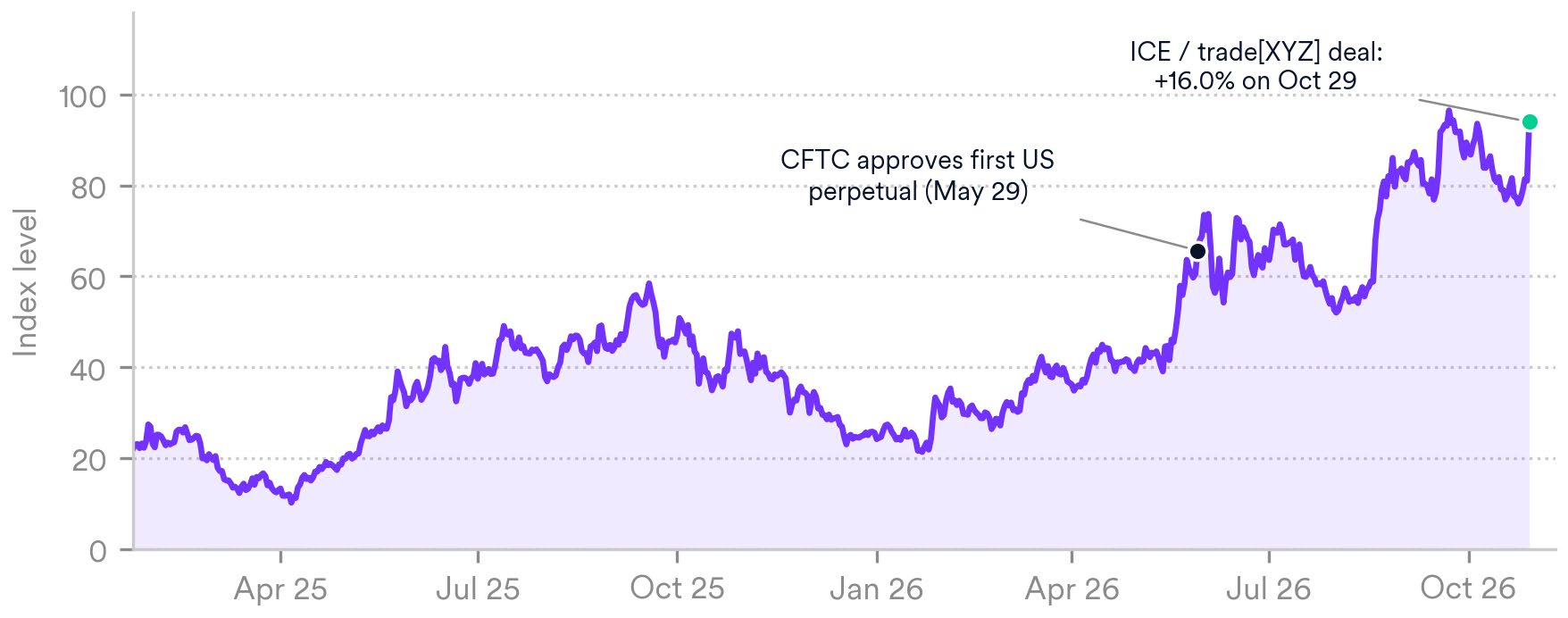
Source: MarketVector Indexes. Daily closing values, Jan 23, 2025 to Oct 29, 2026. Past performance is not a guarantee of future results.
Conclusion
The ICE–trade[XYZ] agreement is a turning point for how traditional finance views Hyperliquid. The operator of the NYSE decided it was better to build on HyperCore than to copy it, and it is willing to share the economics to do so. That supports the case that Hyperliquid is market infrastructure, not just an exchange.
The value to HYPE, however, depends on decisions still to come. The SEC has to rule on equity perpetuals, the CFTC on 24/7 commodities, leverage and clearing governance, FCMs have to decide whether to join, and the fee terms have to be disclosed. Our base case adds roughly 8% to Hyperliquid’s current revenue run-rate at a 50% fee share and 4% at 25%. The bull case adds a third at most, and only if most of those decisions go Hyperliquid’s way. The October 29 move was larger than the base case at a constant revenue multiple. We will update this framework as those details become public.
Sources and methodology
Data. Hyperliquid and trade[XYZ] fees, revenue, notional volume, open interest, market capitalization and P/S ratios: Token Terminal, retrieved October 30, 2026. Figures are rounded, and partial months are flagged. trade[XYZ] market structure and asset-class mix: 0xArchive and trade.xyz documentation. MVHYPE index levels: MarketVector Indexes. Scenario and valuation sensitivities: MarketVector Indexes, using the assumptions stated in Sections 6 and 7.
Primary documents and coverage.
- ICE: “Intercontinental Exchange and Trade[XYZ] to Bring Hyperliquid-Based Perpetual Markets Onshore,” Oct 29, 2026 (ir.theice.com)
- CFTC: “CFTC to Stay Self-Certified Contract on 24/7 Trading for Crude Oil Futures,” Release 9265-26 (cftc.gov)
- CME Group: 24/7 cryptocurrency futures and options announcement, Feb 19, 2026; WTI filing withdrawal, Oct 2, 2026; “CME Group Reports Record Average Daily Volume for September and Q3,” Oct 2, 2026
- Payward: Hyperliquid on-chain perpetual futures press release, Sep 16, 2026 (payward.com); The Block, Oct 26, 2026
- CoinDesk, “U.S. CFTC opens crypto ‘perp’ door with first approval at regulated firm,” May 28, 2026; Decrypt on Kalshi BTCPERP
- Eversheds Sutherland, “CFTC-registered exchanges seek approval to list single stock perpetual futures,” 2026; Crowdfund Insider on Kalshi and OG.com filings, Sep 2026
- Decrypt, “Hyperliquid’s HYPE Jumps 13% as NYSE Owner ICE Moves to Bring Its Perpetual Futures to the US,” Oct 29, 2026
- crypto.news, “NYSE owner ICE partners with trade[XYZ] for US perpetual futures,” Oct 29, 2026
- Crypto Briefing and AMBCrypto on the 3.75M HYPE OTC distribution, Oct 2026; Crypto Briefing on the HIP-3* announcement
- Hyperliquid documentation: HIP-3 builder-deployed perpetuals (hyperliquid.gitbook.io); trade.xyz documentation (docs.trade.xyz)
- 0xArchive, “TradeXYZ explained: how trade.xyz puts stocks, oil and indices on Hyperliquid,” Oct 4, 2026
- VanEck, “Exploring Hyperliquid,” May 2026, and Crypto Briefing on Assistance Fund buybacks (97–99% of trading fees)
- Trailing P/E ratios: stockrow, Macrotrends, Upfront Investment, companiesmarketcap (Oct 21–28, 2026); Coinbase derivatives market data (Oct 30, 2026)
- Coverage of Coinbase US perpetual-style futures (Jul 2025), Robinhood HOOD Summit (Sep 29, 2026), Crypto.com US perps (Oct 28, 2026)
About the Author(s):
Martin Leinweber leads digital asset research and strategy at MarketVector Indexes, where he develops index products, publishes institutional research, and serves as the firm's primary voice on crypto markets to a global client base. His work sits at the intersection of systematic investing and an emerging asset class, translating rigorous quantitative frameworks into actionable insight for institutional investors. Before joining MarketVector, Martin spent nearly two decades as a Portfolio Manager across equities, fixed income, and alternative investments. At Quoniam Asset Management, one of Germany's foremost quantitative houses, he managed active funds for institutional clients including insurance companies, pension funds, and sovereign wealth funds. Earlier in his career at MEAG, the asset manager of Munich Re and ERGO, he contributed to the firm's international expansion, including the establishment of a joint venture with PICC, China's largest insurance company, with operations in Shanghai and Beijing. Martin is co-author of two Wiley publications: Asset-Allokation mit Kryptoassets: Das Handbuch (2021), the first institutional handbook on integrating digital assets into traditional portfolios, and Mastering Crypto Assets: Investing in Bitcoin, Ethereum, and Beyond (2024). He holds a Master of Economics from the University of Hohenheim and is a CFA Charterholder.
IMPORTANT DEFINITIONS AND DISCLOSURES
Copyright © 2026 by MarketVector Indexes GmbH (‘MarketVector’) All rights reserved. The MarketVector family of indexes (MarketVectorTM, Bluestar®, MVIS®) is protected through various intellectual property rights and unfair competition and misappropriation laws. MVIS® is a registered trademark of Van Eck Associates Corporation that has been licensed to MarketVector. MarketVectorTM and MarketVector IndexesTM are pending trademarks of Van Eck Associates Corporation. BlueStar®, BlueStar Indexes®, BIGI®, and BIGITech® are trademarks of MarketVector Indexes GmbH.
Redistribution, reproduction, and/or photocopying in whole or in part are prohibited without written permission. All information provided by MarketVector is impersonal and not tailored to the needs of any person, entity, or group of persons. MarketVector receives compensation in connection with licensing its indexes to third parties. You require a license from MarketVector to launch any product that is linked to a MarketVectorTM Index to use the index data for any business purpose and all use of the MarketVectorTM name or name of the MarketVectorTM Index. The past performance of an index is not a guarantee of future results.
It is not possible to invest directly in an index. Exposure to an asset class represented by an index is available through investable instruments based on that index. MarketVector does not sponsor, endorse, sell, promote, or manage any investment fund or other investment vehicle that is offered by third parties and that seeks to provide an investment return based on the performance of any index. MarketVector makes no assurance that investment products based on the index will accurately track index performance or provide positive investment returns. MarketVector is not an investment advisor, and it makes no representation regarding the advisability of investing in any such investment fund or other investment vehicle. A decision to invest in any such investment fund or other investment vehicle should not be made in reliance on any of the statements set forth in this document.
Investments into cryptocurrencies and/or digital assets are subject to material and high risk including the risk of total loss. The calculated prices may not be achieved by investors as the calculated price is based on prices from different trading platforms. Furthermore, an investment into cryptocurrencies and/or digital assets may become illiquid depending on the trading platform or investment product used for the specific investment. Investors should carefully review all risk factors disclosed by the relevant trading platform or in the product documents of relevant investment products.
Prospective investors are advised to make an investment in any such fund or other vehicle only after carefully considering the risks associated with investing in such funds, as detailed in an offering memorandum or similar document that is prepared by or on behalf of the issuer of the investment fund or other vehicle. The inclusion of a security within an index is not a recommendation by MarketVector to buy, sell, or hold such security, nor is it considered to be investment advice.
All information shown prior to the index launch date is simulated performance data created from backtesting ("Simulated past performance”). Simulated past performance is not actual but hypothetical performance based on the same or fundamentally the same methodology that was in effect when the index was launched. Simulated past performance may materially differ from the actual performance. Actual or simulated past performance is no guarantee for future results.
These materials have been prepared solely for informational purposes based upon information generally available to the public from sources believed to be reliable. No content contained in these materials (including index data, ratings, credit-related analyses and data, model, software, or other application or output therefrom) or any part thereof (Content) may be modified, reverse-engineered, reproduced or distributed in any form by any means, or stored in a database or retrieval system, without the prior written permission of MarketVector. The Content shall not be used for any unlawful or unauthorized purposes. MarketVector and its third-party data providers and licensors (collectively “MarketVector Parties”) do not guarantee the accuracy, completeness, timeliness, or availability of the Content. MarketVector Parties are not responsible for any errors or omissions, regardless of the cause, for the results obtained from the use of the Content. THE CONTENT IS PROVIDED ON AN “AS IS” BASIS. MARKETVECTOR PARTIES DISCLAIM ANY AND ALL EXPRESS OR IMPLIED WARRANTIES, INCLUDING, BUT NOT LIMITED TO, ANY WARRANTIES OF MERCHANTABILITY OR FITNESS FOR A PARTICULAR PURPOSE OR USE, FREEDOM FROM BUGS, SOFTWARE ERRORS, OR DEFECTS, THAT THE CONTENT’S FUNCTIONING WILL BE UNINTERRUPTED OR THAT THE CONTENT WILL OPERATE WITH ANY SOFTWARE OR HARDWARE CONFIGURATION. In no event shall MarketVector Parties be liable to any party for any direct, indirect, incidental, exemplary, compensatory, punitive, special, or consequential damages, costs, expenses, legal fees, or losses (including, without limitation, lost income or lost profits and opportunity costs) in connection with any use of the Content even if advised of the possibility of such damages.