
Hyperliquid historical data comes from four places. Hyperliquid's own S3 buckets, the public info API, a node you run yourself, and data providers that were recording before you started.
Each one covers a different slice of history. Pick the wrong one and you find out halfway through a backtest.
Hyperliquid's S3 archive has L2 snapshots and fills, uploaded about once a month
Hyperliquid publishes raw history to two Amazon S3 buckets, documented on its historical data page. You need an AWS account to read them, because the requester pays the transfer cost.
| Bucket | What is in it | Format |
|---|---|---|
| hyperliquid-archive | L2 book snapshots (market_data) and asset contexts (asset_ctxs) | LZ4 files, hourly per coin |
| hl-mainnet-node-data | Fills by block, explorer blocks, L1 transactions, transfers, staking and funding events | Raw node output |
The asset contexts file is where historical open interest, funding and mark prices live, one CSV per day.
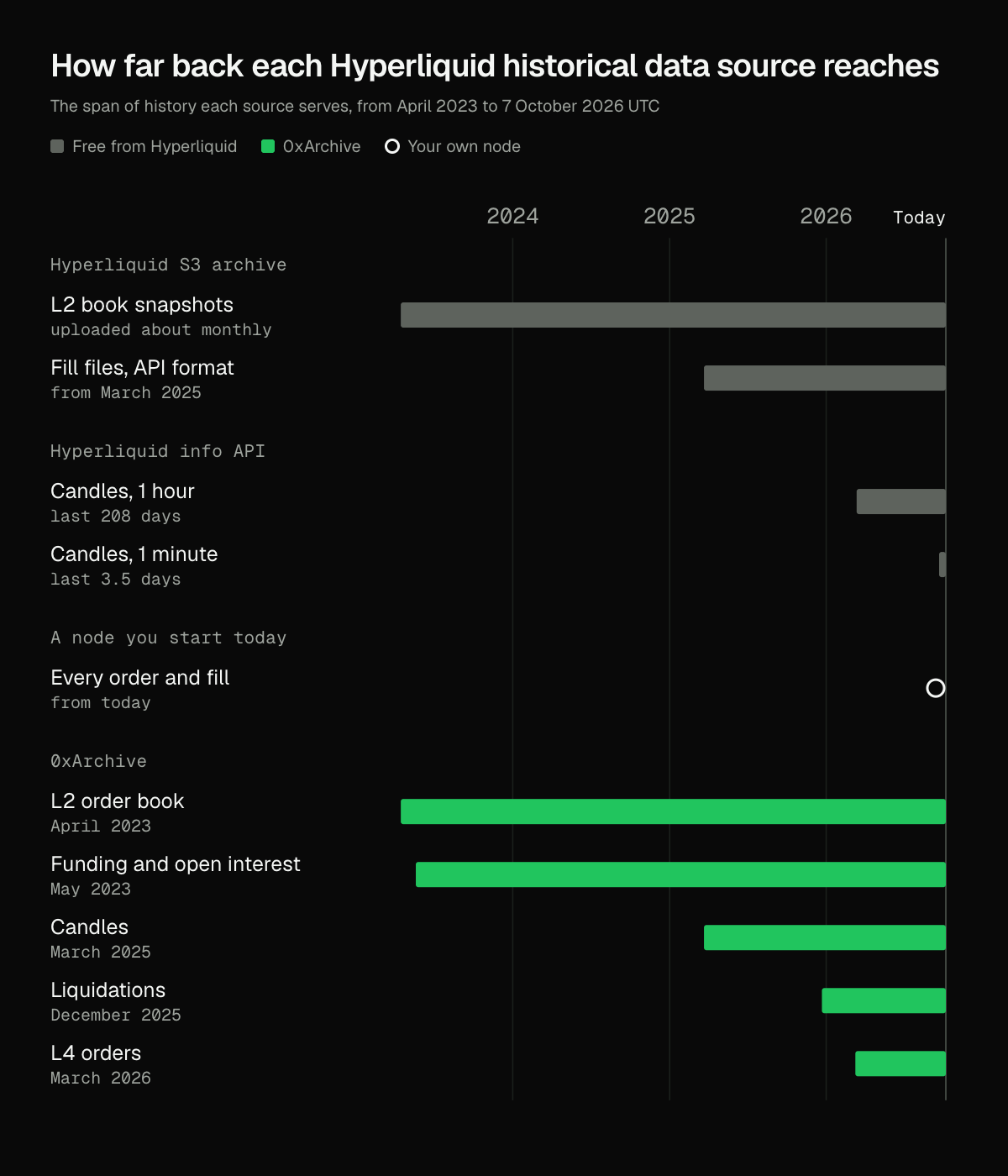
The L2 snapshots go back to April 2023. Fills in the same format as the API start in March 2025, and older trade files use a different format.
aws s3 cp s3://hyperliquid-archive/market_data/20230916/9/l2Book/SOL.lz4 /tmp/SOL.lz4 --request-payer requester
unlz4 --rm /tmp/SOL.lz4
Hyperliquid's docs say uploads happen "approximately once a month", and "there is no guarantee of timely updates and data may be missing". There are no candles and no spot data in the archive.
So S3 suits a research project that can wait for last month's files and is fine parsing raw node output. It does not suit anything that needs yesterday.
The info API gives candles and funding, but only recent history
The public info API at api.hyperliquid.xyz is free and needs no account. It answers POST requests for candles, funding, the current book and your own account.
Candles are capped. Hyperliquid's docs put the limit at the most recent 5,000 candles for any coin and interval.
| Interval | How far back 5,000 candles reach |
|---|---|
| 1 minute | 3.5 days |
| 15 minutes | 52 days |
| 1 hour | 208 days |
| 1 day | Hyperliquid's whole history |
curl -s https://api.hyperliquid.xyz/info \
  -H 'Content-Type: application/json' \
  -d '{"type":"candleSnapshot","req":{"coin":"BTC","interval":"1m","startTime":1681992000000}}'
Ask for 1-minute bars from April 2023 like this and the response still starts 3.5 days ago.
Funding history goes back further. Responses return 500 rows at a time, and you page forward by timestamp.
The rest is current state only. The L2 book endpoint returns the book right now, there is no endpoint for past open interest, and there is no market-wide trade history at all. Your own fills stop at the 10,000 most recent.
A node records everything from the day you start it, and nothing before
A non-validating node sees everything the chain does. Run with the right flags, it writes every fill, every order status and every raw book change to disk as blocks arrive.
The node writes from the moment it is running. Hyperliquid's node docs say its local server does not answer historical time series queries, so a node started today has no yesterday.
Hyperliquid's node docs list the non-validator minimum:
| Resource | Minimum |
|---|---|
| CPU | 16 vCPUs |
| Memory | 128 GB RAM |
| Storage | 500 GB SSD, Ubuntu 24.04 |
Storage fills fast. With default settings the node writes about 100 GB of logs a day, and order statuses alone run several hundred GB a day.
A node also needs a steady connection to its peers. The Hyperliquid Foundation lists infra providers for non-validating nodes on its docs, and 0xArchive is one of them, with dedicated Tokyo peering at $200 per node per month.
GitHub download tools pull from the same S3 buckets
Searching GitHub for Hyperliquid historical data turns up download scripts, not new data. The most used one, hyperliquid-historical, downloads the hourly L2 files from the hyperliquid-archive bucket, decompresses them and converts them to CSV.
These tools save you the AWS command line. They still need an AWS account, they still pay the requester's transfer cost, and they carry every gap the S3 archive has.
Which Hyperliquid data source fits which job
| Job | Free source | What it misses |
|---|---|---|
| A chart of recent prices | Info API candles | Anything older than 5,000 bars |
| Funding history | Info API funding | Speed, 500 rows a call |
| Order book history | S3 L2 snapshots | Monthly uploads and gaps |
| Open interest history | S3 asset contexts | Monthly uploads |
| Every trade, market-wide | S3 node fills | Anything before March 2025 in the API format |
| Your own trades | Info API fills | Fills past the latest 10,000 |
| Every order, from today on | Your own node | Everything before the day you start it |
Full Hyperliquid history from one API with 0xArchive
0xArchive records Hyperliquid and serves it from one REST API, WebSocket replay and Parquet file exports. The history you would otherwise stitch together from S3, the API and a node comes back from the same routes, in UTC, with cursors.
| Hyperliquid data | Served from (UTC) |
|---|---|
| L2 order book | April 2023 |
| Funding and open interest | May 2023 |
| Candles | March 2025 |
| Liquidations | December 2025 |
| L4 orders, every resting order with its wallet | March 2026 |
curl "https://api.0xarchive.io/v1/hyperliquid/orderbook/BTC/history?start=1681992000000&end=1681992060000&limit=5" \
  -H "X-API-Key: $OXARCHIVE_API_KEY"
That returns the BTC book from 20 April 2023, the same window the info API cannot reach. The venue coverage page lists the first served instant for every data type.
A free key gets the most recent 30 days on every route. The full archive starts on the Build plan at $49 a month. Create a free key.
Common questions about Hyperliquid historical data
Is Hyperliquid historical data free? Yes, in pieces. The info API is free, and the S3 archive is free to read apart from the AWS transfer cost the requester pays.
How far back do Hyperliquid API candles go? The info API serves the most recent 5,000 candles per coin and interval. That is 3.5 days of 1-minute candles or 208 days of hourly ones.
Where does Hyperliquid store historical data? In two S3 buckets, hyperliquid-archive for L2 book snapshots and asset contexts, and hl-mainnet-node-data for fills and node data. Hyperliquid uploads them about once a month.
Can a Hyperliquid node give me past data? No. A node writes data from the moment it starts running, so history before that date has to come from S3 or a data provider.
Run this analysis from an agent
Hyperliquid books, trades, funding and open interest all come from routes an agent can call. 0xArchive ships an MCP server, so Claude and other AI agents can pull Hyperliquid history in plain language. There is a Claude Code skill for terminal workflows and an agentic gateway for agents that pay per call. Start with the agent surfaces overview or the guide to replayable market data for MCP, CLI and agent workflows.
Route references
Use the order book routes reference for L2 and L4 history, the trades reference for fills, the funding reference and open interest reference for positioning, and the candles reference for bars. The guide to Hyperliquid historical data for backtesting covers pulling a window cleanly, and the one-symbol parity test shows how to check Hyperliquid's own data against managed history before you switch. For paid providers side by side, see the data provider comparisons.
For current API availability and plan details, use the Hyperliquid data API, data catalog, pricing, and status.