
0xArchive keeps order-level records for the HIP-3 builder-perp markets covered by the relevant routes: the order book reconstructed to L4, plus add, cancel, and fill events attributed by wallet. Arrakis Finance used that record for a 21-day study of 175,703 wallets and $161.4B in volume, published in April 2026 with 0xArchive credited for the data.
| HIP-3 markets | 182 live, six established builders plus a growing long tail |
| Order-level depth | L4 book reconstructed, plus the order lifecycle (adds, cancels, fills, TP and SL) from order-flow, order-history, and tpsl |
| Attribution | per wallet, via the L4 user_address |
| History by type | served trades 2026-02; order book, funding, OI 2026-02-16; L4 2026-03-10 |
| Access | published route families within each market's schema coverage; every route, schema, and served depth on every plan; Free history covers the most recent rolling 30 days, and Build and above keep the full retained archive |
Most HIP-3 data stops at the chart. This is what the order record holds, and how to query it.
What candles hide
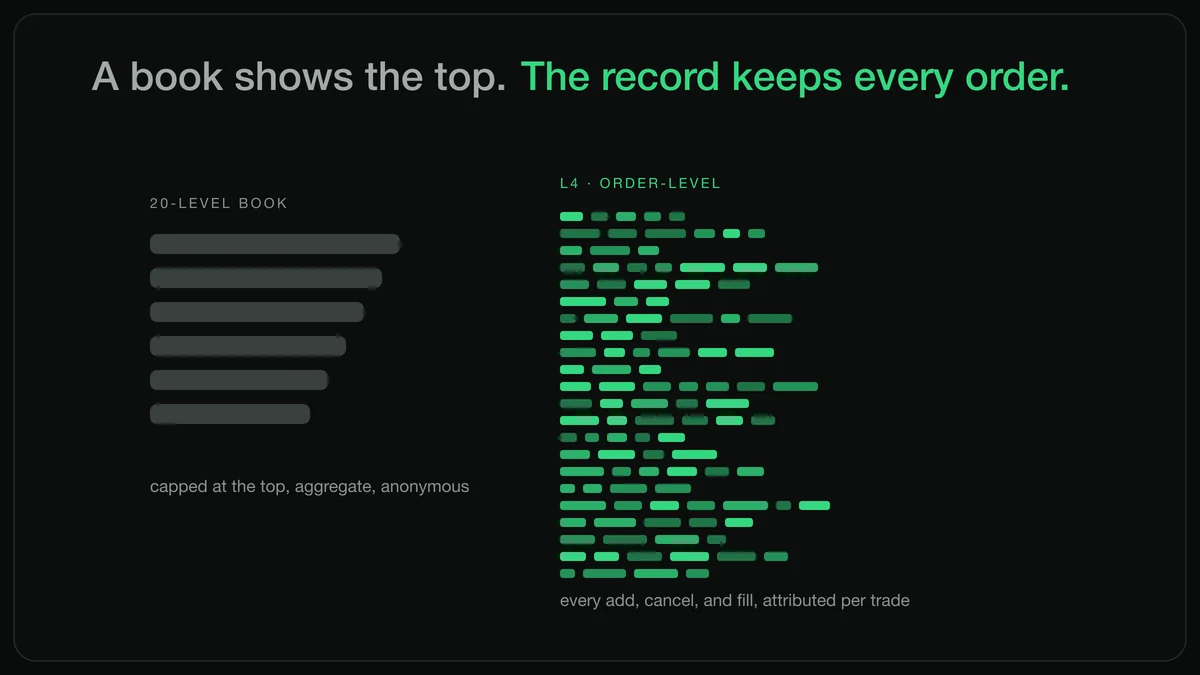
A candle is four prices and a volume. It tells you the interval closed green. It does not tell you who was in the book, where your order would have queued, or which fills moved the price. A native 20-level L2 snapshot is better and still blind: aggregate depth, capped at 20 levels per side, with no identity. On a thin builder market the orders that move price often sit past level 20, or arrive and cancel between snapshots.
| What you can see | Candle (OHLCV) | L2 (native, 20-level) | Order-level (L4 + flow) |
|---|---|---|---|
| Aggregate depth | — | top 20 levels | full book |
| Depth past level 20 | — | — | ✓ (reconstructed) |
| Individual resting orders | — | — | ✓ |
| Cancels between prints | — | — | ✓ |
| Wallet behind each fill | — | — | ✓ |
| Queue position | — | — | ✓ |
| Backtest fill model | mid-price guess | approximate | reconstructed: partial, slipped, or missed |
Sample once a second and you miss the order that set the high. The L4 book keeps those orders, and all-level L2 past the native 20-level cap is reconstructed from it.
L4, defined
L4 is the order book rebuilt order by order: captured resting orders, with order IDs and the wallet that placed them. Alongside it, the order lifecycle (adds, cancels, fills, TP and SL) comes from the order-flow, order-history, and tpsl endpoints. Together that is queue position and per-wallet attribution a candle never carries.
Every level from the best bid to the wallet, shown on one order book, is in level 1 vs level 2 vs level 3 market data.
The difference shows up when you backtest. With candles you may assume a fill at the mid. With L4 you reconstruct queue position and model whether a fill would have been partial, slipped, or missed. The example below distinguishes a price touch from the order sequence that produced the result: "the price touched 1.2040" versus "your 1.2040 bid sat behind 38 contracts, and 12 of them cancelled before the print."
The HIP-3 landscape
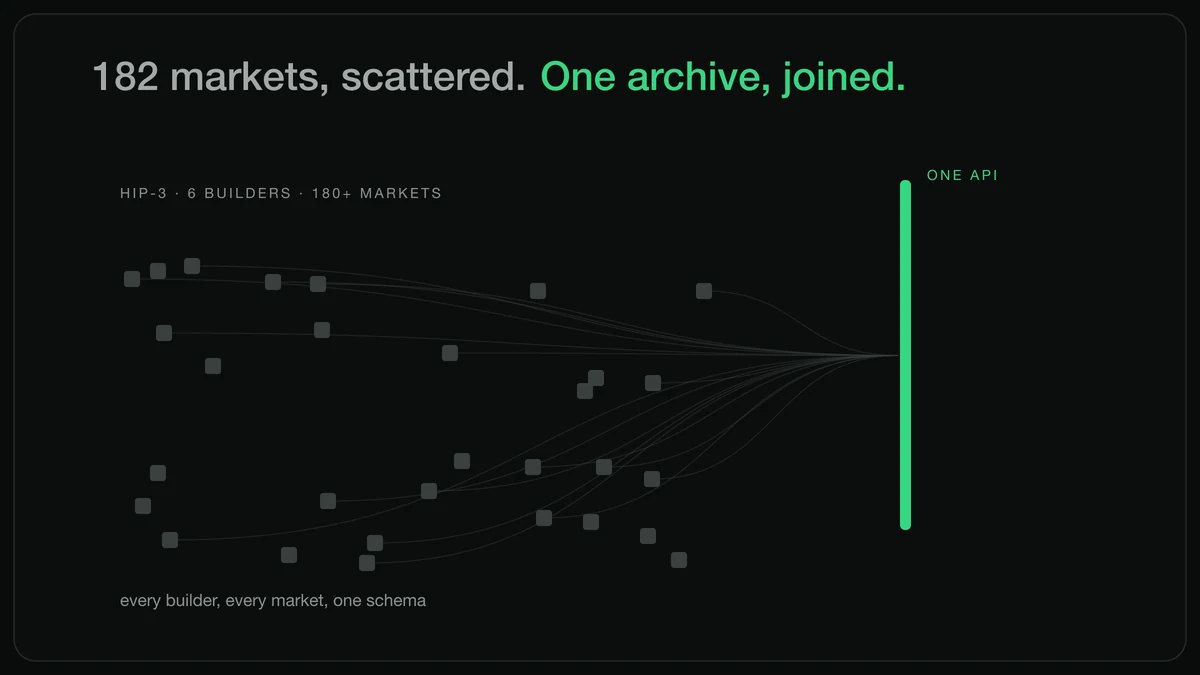
HIP-3 lets builders deploy their own perps on Hyperliquid. In the June 30, 2026 snapshot used here, the landscape had 182 live markets across eight namespaces, with six established builders and a growing long tail. Each namespace had its own market roster, liquidity, order book, and order flow. Check the live roster for current coverage.
| Builder | Namespace | Live markets |
|---|---|---|
| xyz | xyz | 87 |
| HyENA | hyna | 23 |
| Kinetiq | km | 22 |
| Felix | flx | 15 |
| Ventuals | vntl | 15 |
| dreamcash | cash | 15 |
| emerging | para | 4 |
| emerging | mkts | 1 |
| Total | 182 |
Six established builders account for 177 of 182 markets; para (4) and mkts (1) are an emerging namespace tail. Live snapshot, 2026-06-30; read /v1/hyperliquid/hip3/instruments for the current roster.
That fragmentation is why HIP-3 history is hard to assemble by hand. One builder's market is live for a week, another for months, each with its own coverage window. Read the live roster and per-market count at /v1/hyperliquid/hip3/instruments.
How far it goes
HIP-3 history runs back by data type, not as one cliff: trades from 2026-02-01, the order book and funding and open interest from 2026-02-16, and the L4 order-level book from 2026-03-10.
| Data type | HIP-3 history from |
|---|---|
Trades (with is_liquidation flags) | 2026-02-01 |
| Order book (native L2), funding, open interest | 2026-02-16 |
| L4 order-level book | 2026-03-10 |
Liquidations arrive as a fill row with is_liquidation: true, inside the trade record; candles derive from those trades. If you have read "Hyperliquid since 2023," that is core perps native L2 and trades, not HIP-3. HIP-3 is a newer family with its own start. Quote the start for the datatype you query, and confirm per-market windows at /v1/data-quality/coverage.
What the record reveals
The order record answers questions at the wallet and order level:
- Participation. Arrakis classified all 175,703 wallets from 21 days of attributed fills. Segment them by builder, by market, or by size.
- Concentration. A young builder market often runs on a handful of wallets. The L4 record shows exactly which, and how the rest of the book reacts when they pull.
- Liquidation cascades. Tie each
is_liquidationfill to the order book state that triggered it. Reconstruct the cascade, not just the wick. - Order flow. Aggregate adds and cancels to see how a market fills, where TP and SL cluster, and how maker and taker behavior splits builder by builder.
175,703 wallets. 21 days. $161.4B in volume. One order-by-order record, and 0xArchive credited for the data.
OHLCV keeps none of this. It survives only in order-level records.
What you build
- Reproducible backtests. Replay the exact market window with original timing, so the same test run twice returns the same result, provided the research logic and inputs remain unchanged.
- Microstructure research. Queue position, fill realism, and maker/taker dynamics across HIP-3 markets with served L4 coverage, using one schema.
- Liquidation and risk studies. Every liquidation against the book that caused it.
Teams that need this history can otherwise combine node dumps and exchange snapshots, then rebuild the order-level context themselves. That approach is slow to reproduce and does not preserve the order details. 0xArchive provides the order, lifecycle, and wallet-attributed records in the routes above.
How to query it
Every plan, including Free, can query the published HIP-3 route families within each market's actual schema coverage and served depth. Free includes the most recent rolling 30 days of history, with a maximum 30-day span per request or replay; Build and above keep the full retained archive. Plans gate capacity and Free's 30-day history window, not route families, schemas, or served depth.
| Surface | Path | What you get |
|---|---|---|
| REST | /v1/hyperliquid/hip3/... | order book (native L2 and all-level L2 derived from L4), L4, trades, candles, funding, open interest, plus order-flow, order-history, and tpsl for the lifecycle |
| WebSocket replay | same connection as live | stream HIP-3 history back with original timing, at configurable speed |
| Parquet export | /data | HIP-3 history at dataset scale for offline work, from $1/GB |
Create a key at 0xarchive.io/signup, or browse coverage at 0xarchive.io/data.