Trade[xyz] 2026 Q1 Report

This quarterly report documents Trade[XYZ]'s progress with the same rigor we brought to the Annual Report.

12 min read

From Hyperliquid Research Collective

Read the original

Key findings

  1. 85 to 90%Trade[XYZ]'s share of all HIP-3 volume, as the first and largest deployer.
  2. 50%Share of the fees on their own markets that HIP-3 deployers earn.
  3. 500,000 HYPEStake each deployer posts as economic collateral.

Earlier this year, HRC published the Hyperliquid 2025 Annual Report, a TradFi-style review of Hyperliquid's financial performance, key milestones, and ecosystem dynamics, written for investors and market participants more accustomed to reading earnings reports than parsing blockchain data. The goal was to reduce information asymmetry and lower barriers for new entrants.

That mission does not stop at Hyperliquid itself. HIP-3 formalized the open-infrastructure thesis at the market layer: external teams can deploy perpetual markets on Hyperliquid's orderbook, controlling oracle design, leverage, discovery bounds, and fee structures, while earning 50% of the fees their markets generate. The protocol requires deployers to stake 500,000 HYPE as economic collateral, aligning incentives without centralized gatekeeping. For Hyperliquid, each new deployer adds volume at zero marginal infrastructure cost.

Trade[XYZ] was the first team to deploy under this framework and remains by far the largest, accounting for approximately 85 to 90% of all HIP-3 volume. Processing billions of dollars in daily volume and the emerging signs of genuine weekend price discovery all point to something larger than a successful product launch. They point to a structural shift in how global markets could operate. Given that scale, independent and structured reporting on its performance has become a necessity.

This quarterly report documents Trade[XYZ]'s progress with the same rigor we brought to the Annual Report.

We hope you find it valuable.

Read Full Report

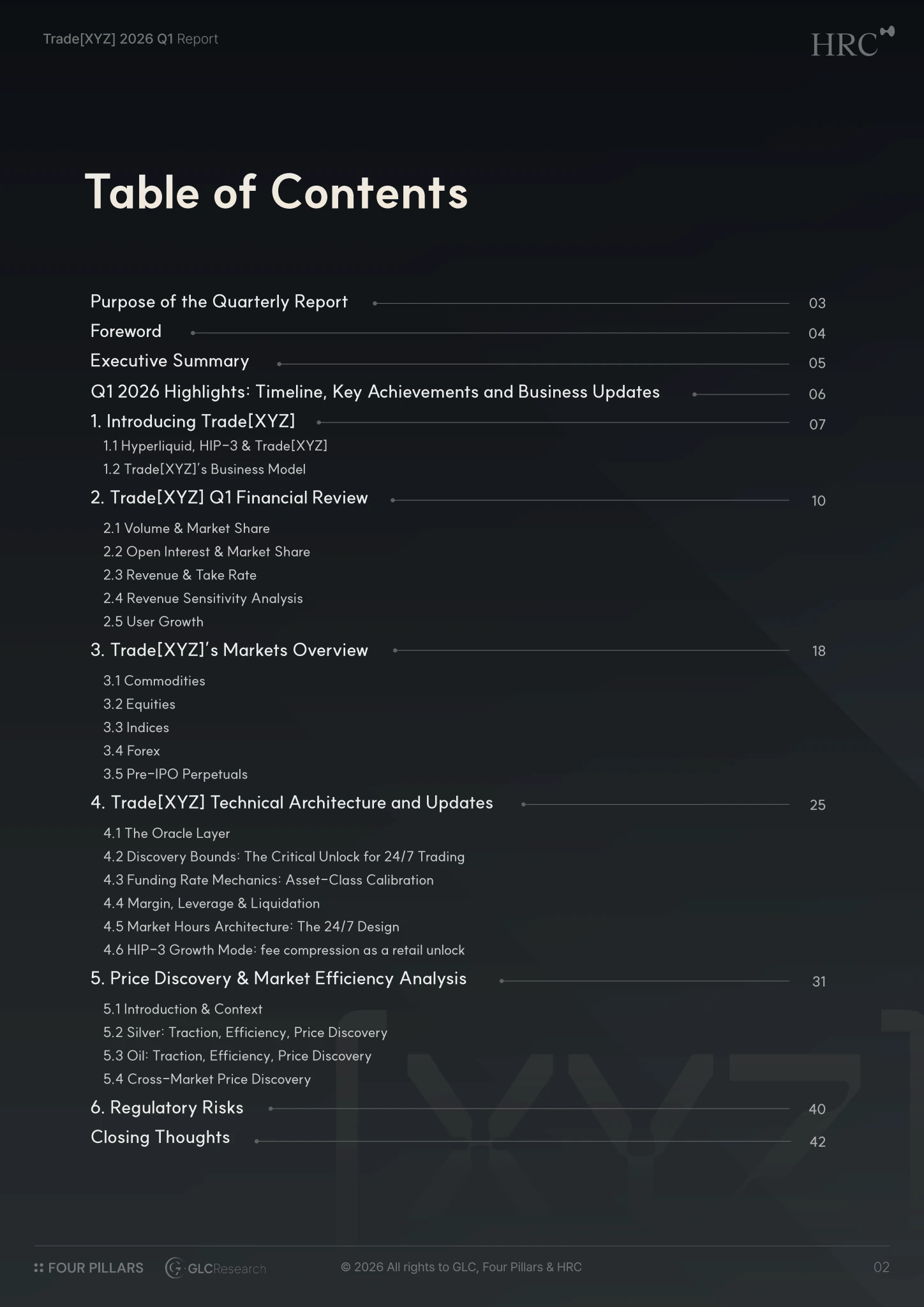
Table of Contents

  • Purpose of the Quarterly Report (page 03)
  • Foreword (page 04)
  • Executive Summary (page 05)
  • Q1 2026 Highlights: Timeline, Key Achievements and Business Updates (page 06)
  • 1. Introducing Trade[XYZ] (page 07)
    • 1.1 Hyperliquid, HIP-3 & Trade[XYZ]
    • 1.2 Trade[XYZ]'s Business Model
  • 2. Trade[XYZ] Q1 Financial Review (page 10)
    • 2.1 Volume & Market Share
    • 2.2 Open Interest & Market Share
    • 2.3 Revenue & Take Rate
    • 2.4 Revenue Sensitivity Analysis
    • 2.5 User Growth
  • 3. Trade[XYZ]'s Markets Overview (page 18)
    • 3.1 Commodities
    • 3.2 Equities
    • 3.3 Indices
    • 3.4 Forex
    • 3.5 Pre-IPO Perpetuals
  • 4. Trade[XYZ] Technical Architecture and Updates (page 25)
    • 4.1 The Oracle Layer
    • 4.2 Discovery Bounds: The Critical Unlock for 24/7 Trading
    • 4.3 Funding Rate Mechanics: Asset-Class Calibration
    • 4.4 Margin, Leverage & Liquidation
    • 4.5 Market Hours Architecture: The 24/7 Design
    • 4.6 HIP-3 Growth Mode: fee compression as a retail unlock
  • 5. Price Discovery & Market Efficiency Analysis (page 31)
    • 5.1 Introduction & Context
    • 5.2 Silver: Traction, Efficiency, Price Discovery
    • 5.3 Oil: Traction, Efficiency, Price Discovery
    • 5.4 Cross-Market Price Discovery
  • 6. Regulatory Risks (page 40)
  • Closing Thoughts (page 42)
Report cover: trade[XYZ] 2026 Q1 Report by HRC, GLC Research and Four Pillars, supported by Hypurr Collective, Hyperion DeFi, Hyperliquid Strategies and B-Harvest, above the report's disclaimer.

Slide 1

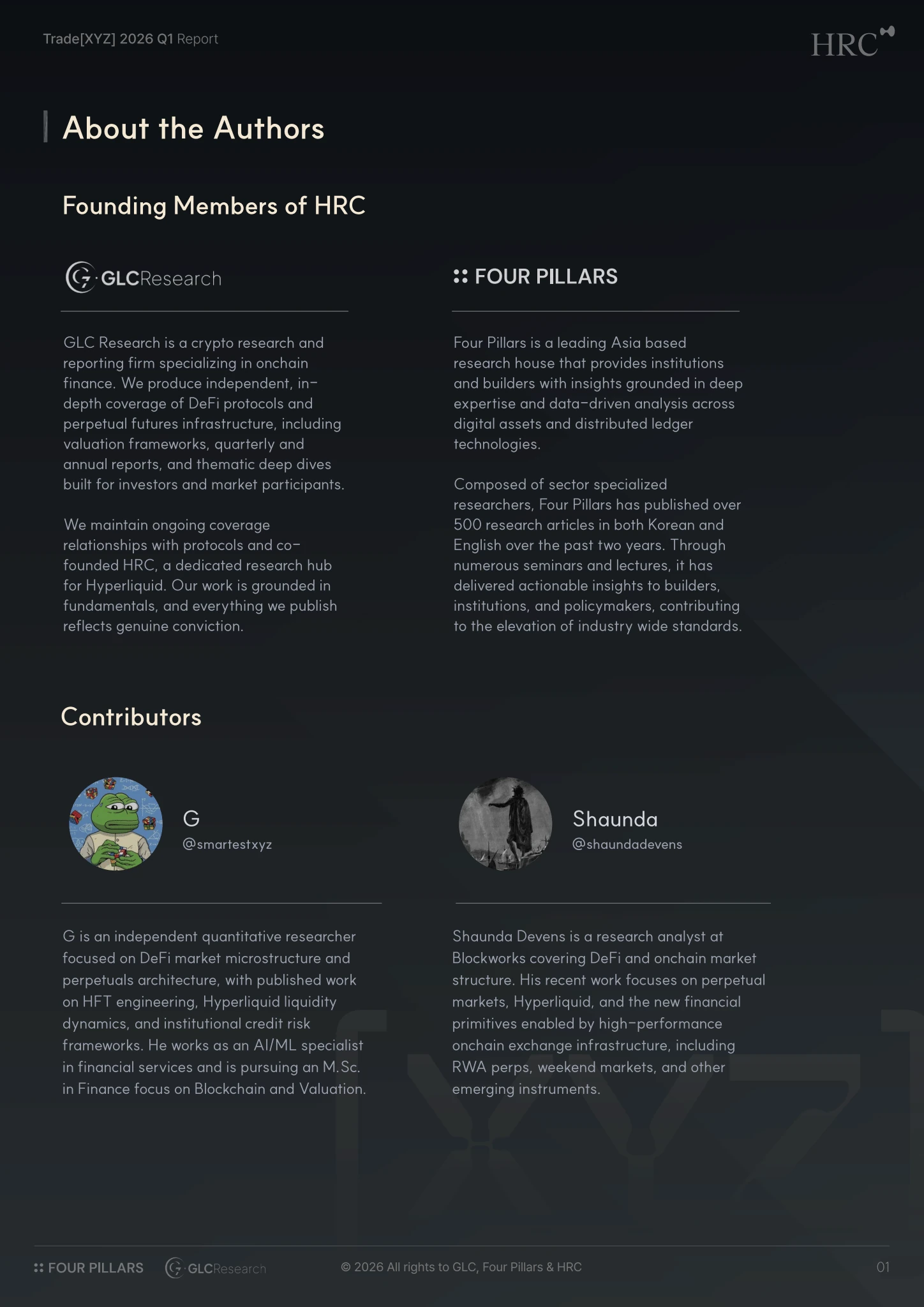
About the Authors page profiling HRC founding members GLC Research and Four Pillars, and contributors G (@smartestxyz) and Shaunda Devens (@shaundadevens) of Blockworks.

Slide 2

Table of contents: purpose, foreword, executive summary and Q1 highlights, then six numbered sections from Introducing Trade[XYZ] to Regulatory Risks, and closing thoughts on page 42.

Slide 3

Purpose of the Quarterly Report

Text page on the report's purpose: Trade[XYZ], the first HIP-3 deployer, accounts for about 85 to 90% of HIP-3 volume. Deployers stake 500,000 HYPE and earn 50% of their markets' fees.

Slide 4

Foreword

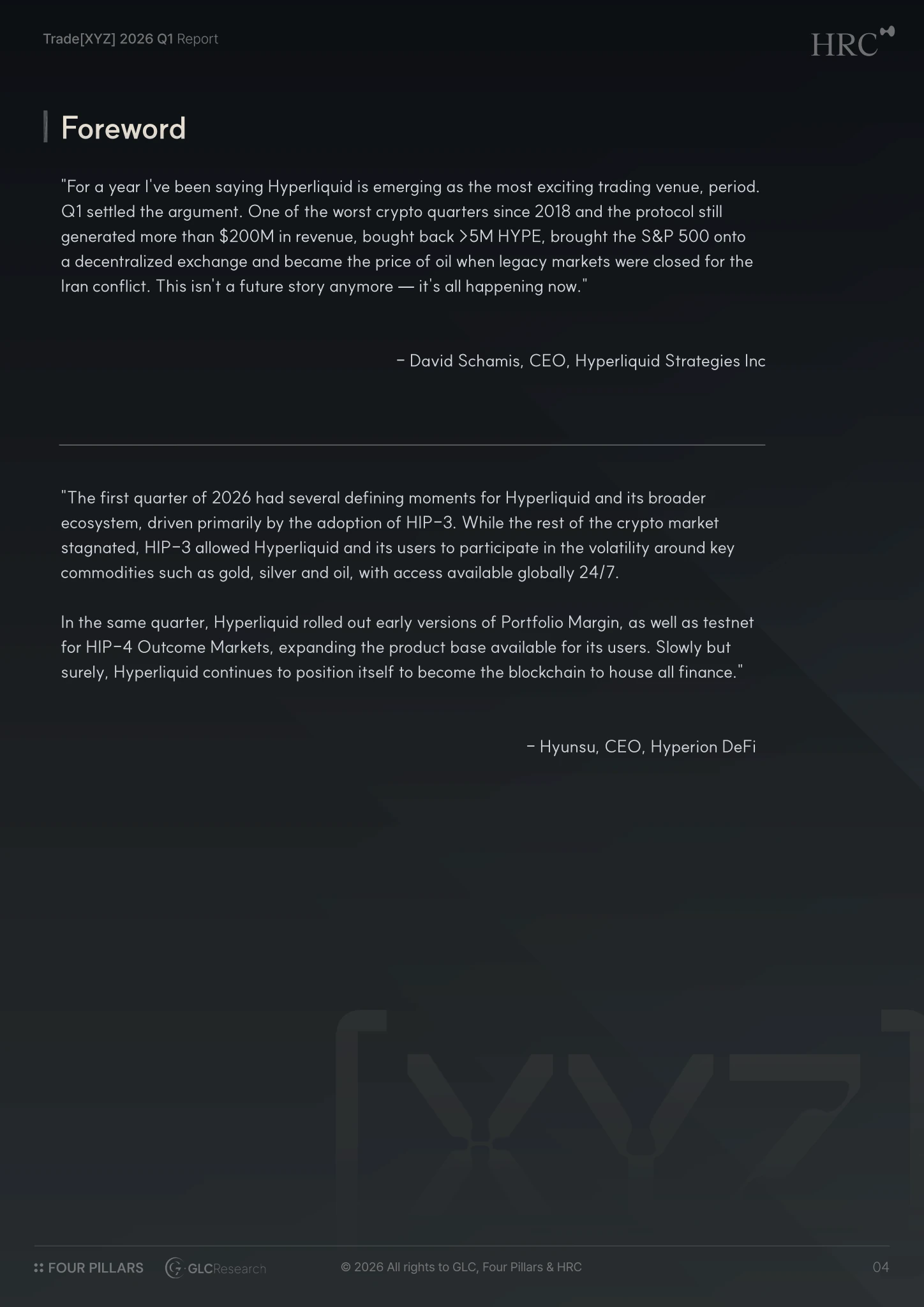
Foreword quotes from David Schamis, CEO of Hyperliquid Strategies, citing more than $200M of Q1 revenue and over 5M HYPE bought back, and from Hyunsu, CEO of Hyperion DeFi, on HIP-3 adoption.

Slide 5

Executive Summary

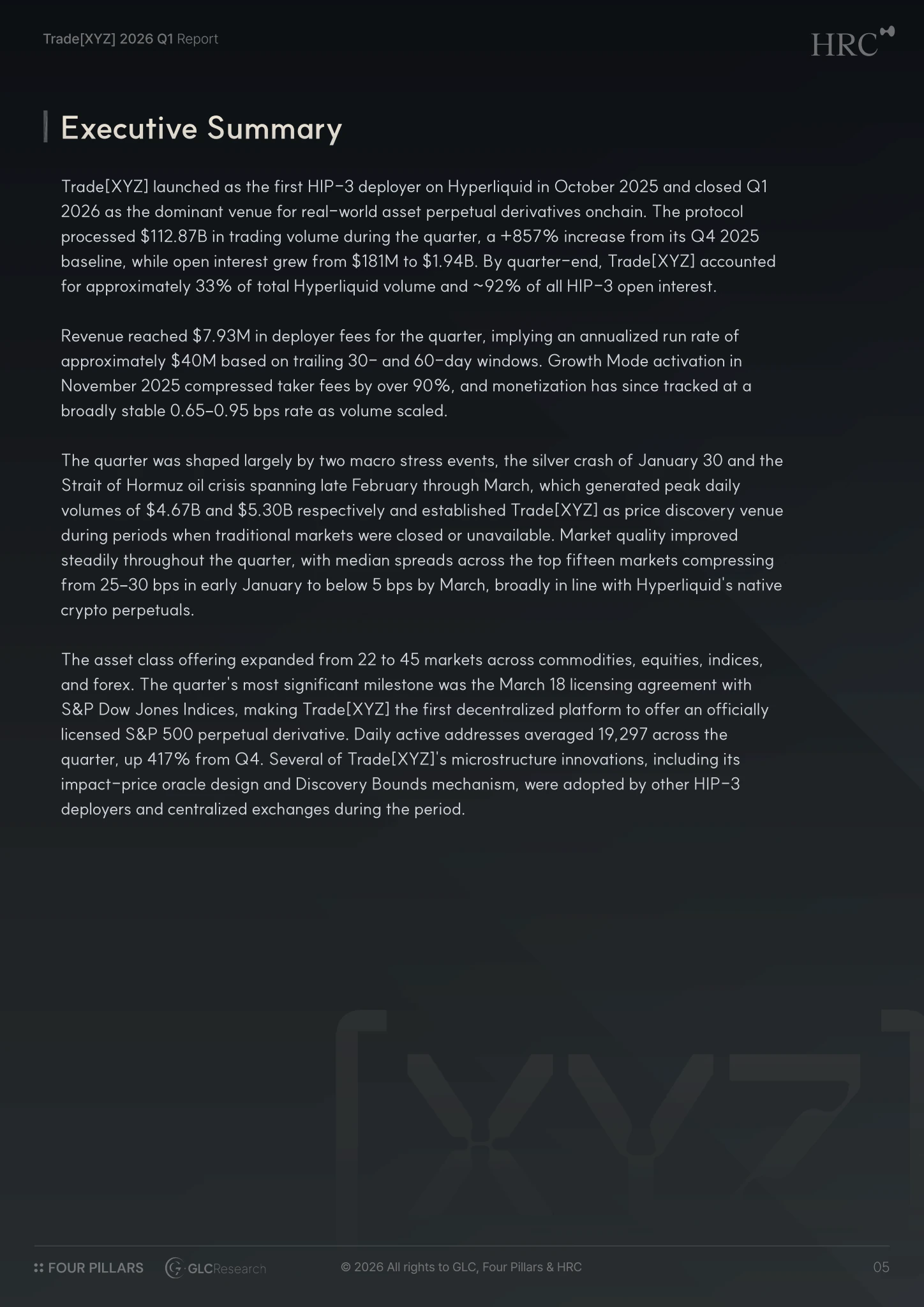
Executive summary: Trade[XYZ] processed $112.87B of Q1 2026 volume, up 857% on Q4 2025, while open interest grew from $181M to $1.94B.

Slide 6

Q1 2026 Highlights: Timeline, Key Achievements and Business Updates
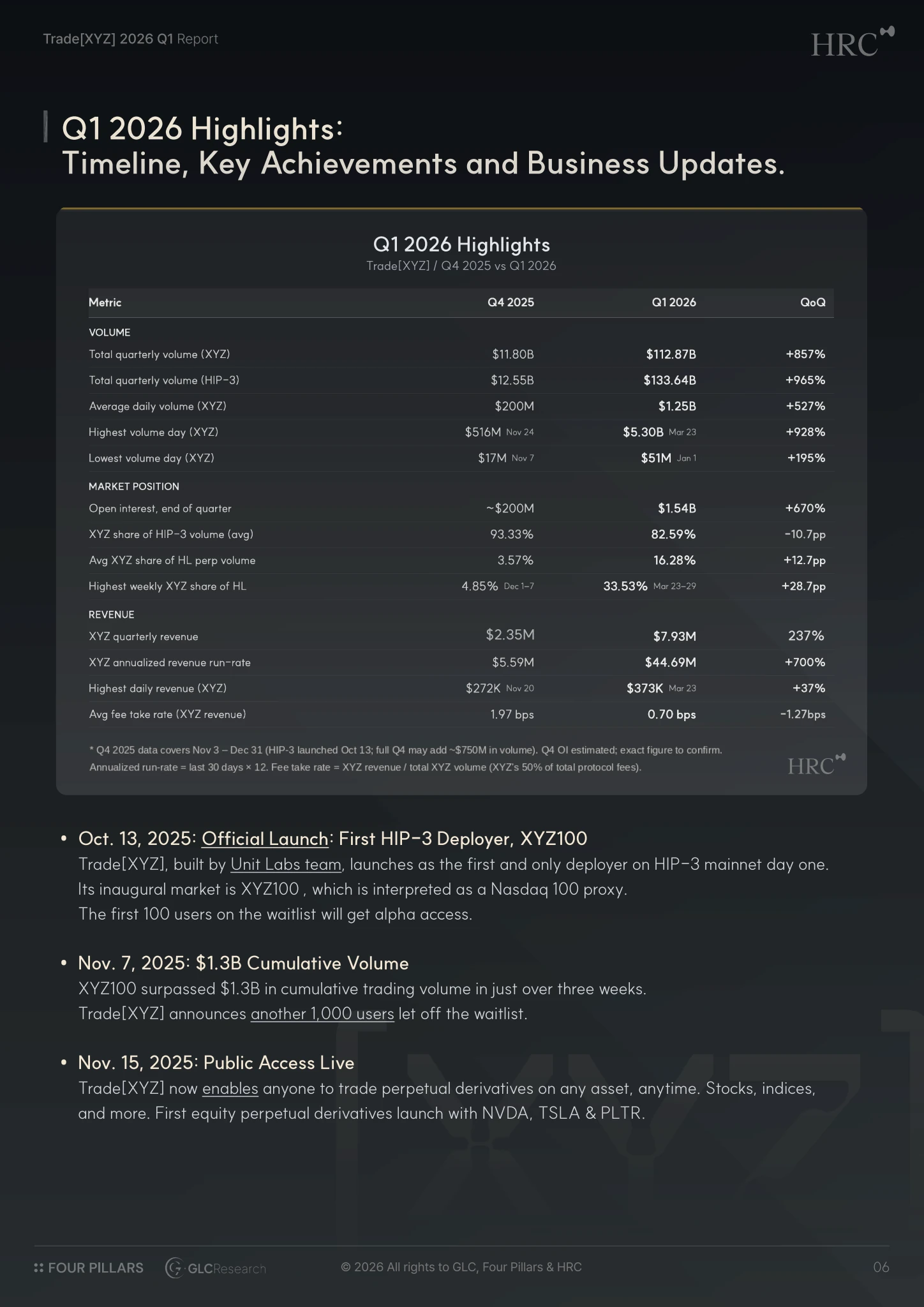
Q1 highlights table, Q4 2025 vs Q1 2026: XYZ volume $11.80B to $112.87B (+857%), end-of-quarter open interest about $200M to $1.54B, quarterly revenue $2.35M to $7.93M. A timeline starts with the October 13, 2025 launch.

Slide 7

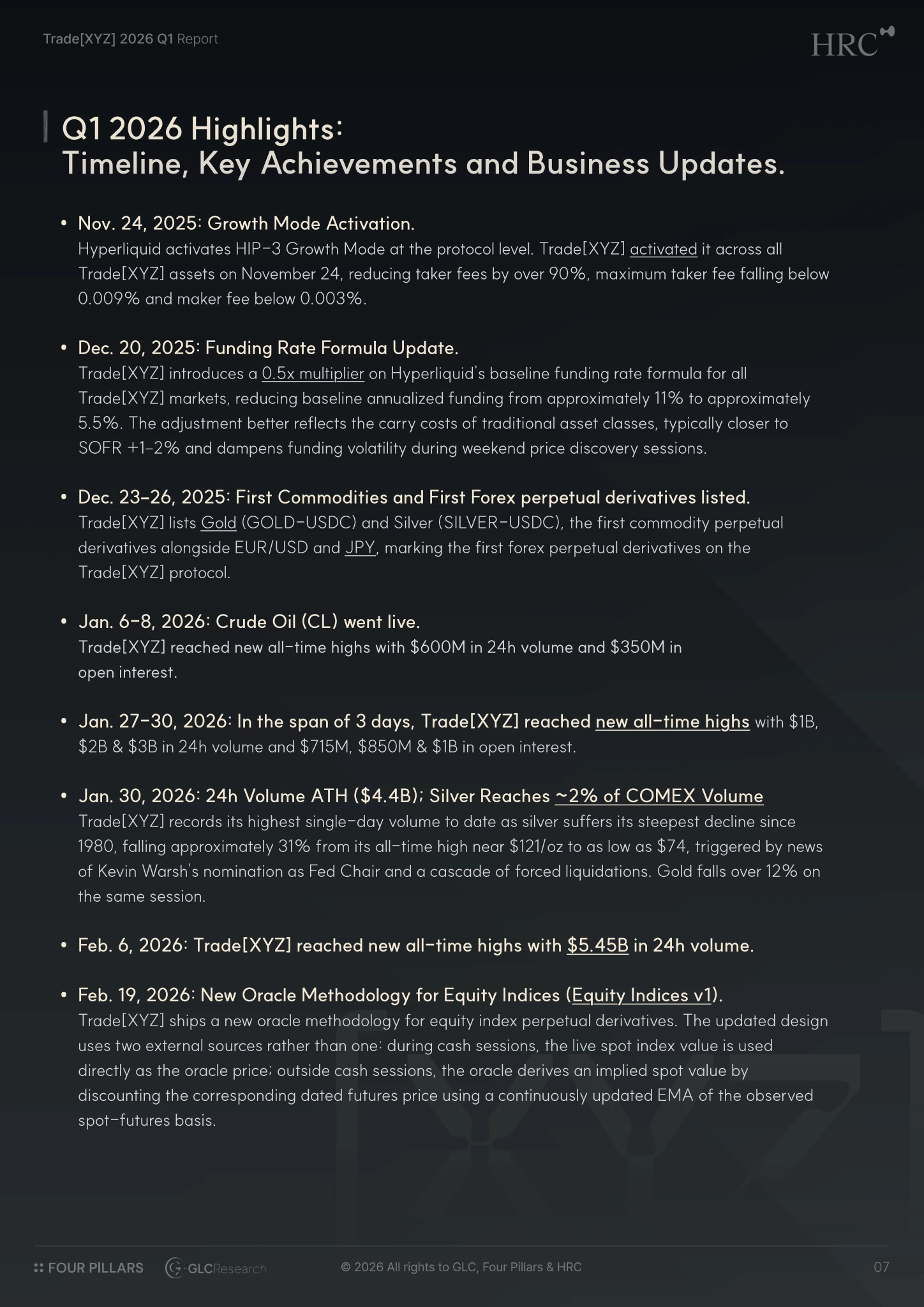
Timeline of Q1 highlights, starting with the November 24, 2025 Growth Mode activation that cut Trade[XYZ] taker fees by over 90%, then new listings and record volume days.

Slide 8

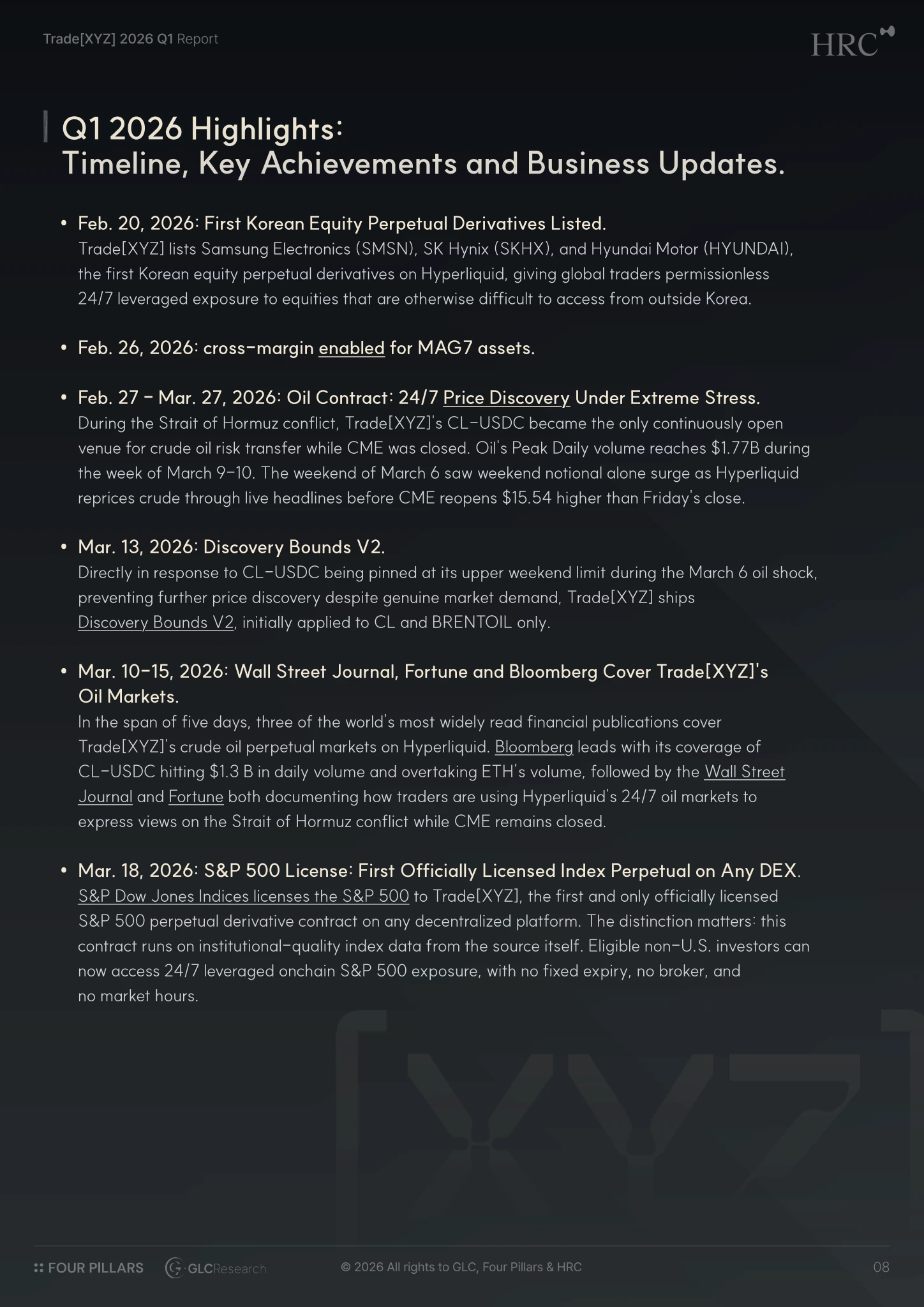
Timeline continued: the first Korean equity perps on February 20, 2026, oil volume peaking on March 9 to 10, and the licensed S&P 500 perpetual on March 18.

Slide 9

1. Introducing Trade[XYZ]

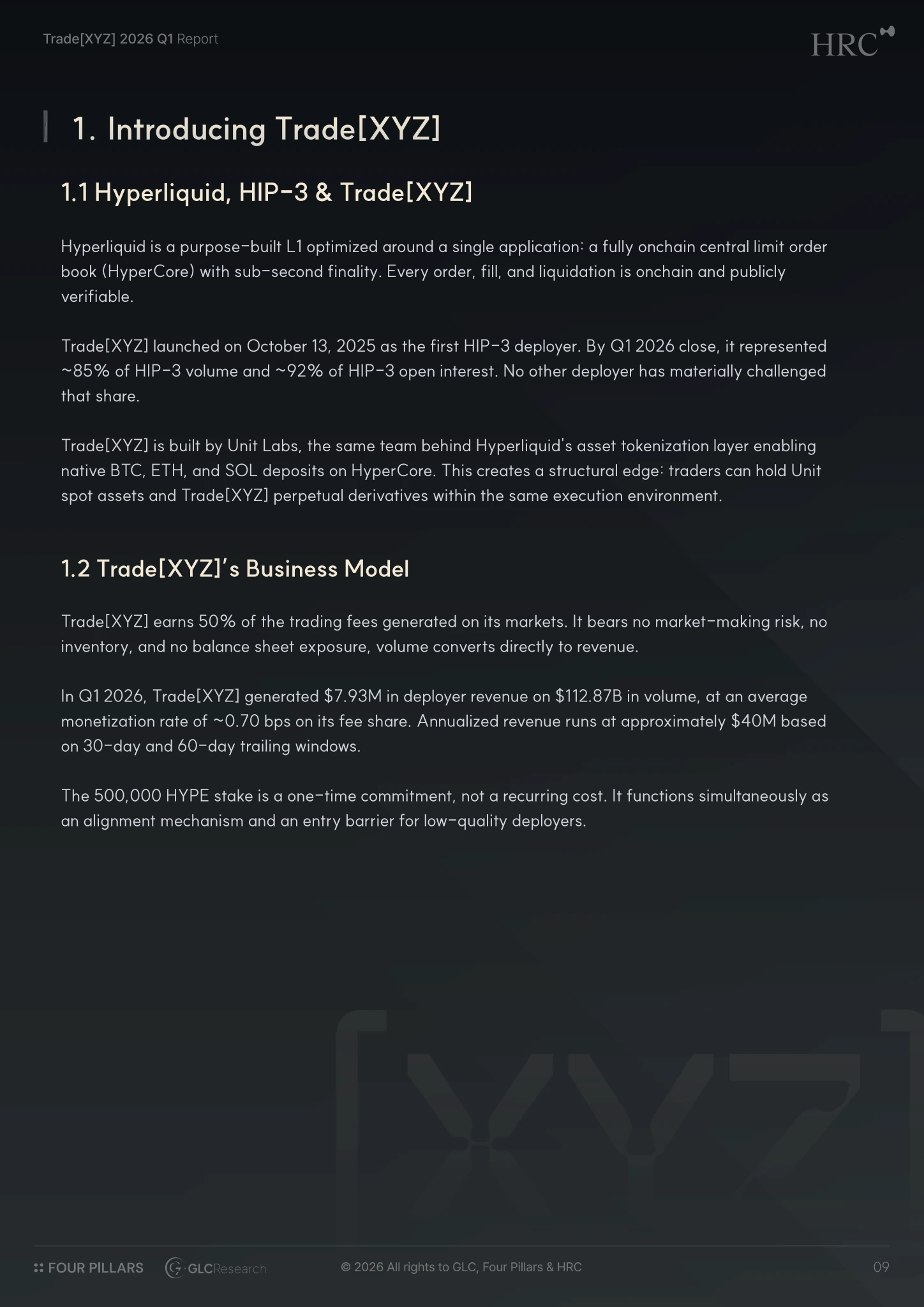
Section 1 text introducing Hyperliquid, HIP-3 and Trade[XYZ], which launched on October 13, 2025 as the first HIP-3 deployer, and its fee-sharing business model.

Slide 10

2. Trade[XYZ] Q1 Financial Review
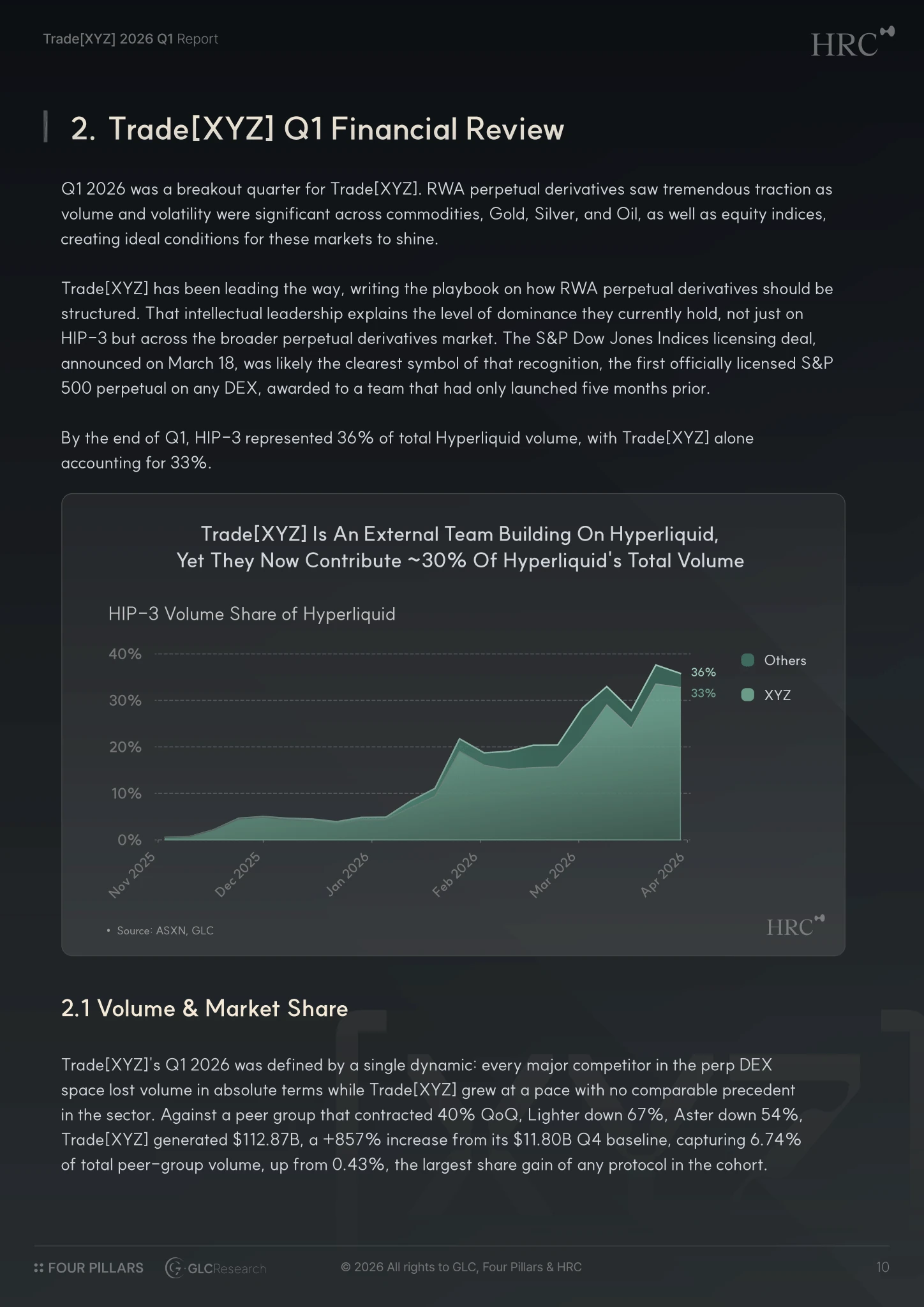
Area chart of HIP-3's share of Hyperliquid volume climbing toward a third by March 2026, most of it from Trade[XYZ]. Its Q1 volume of $112.87B was up 857% on Q4.

Slide 11 · Source: ASXN, GLC

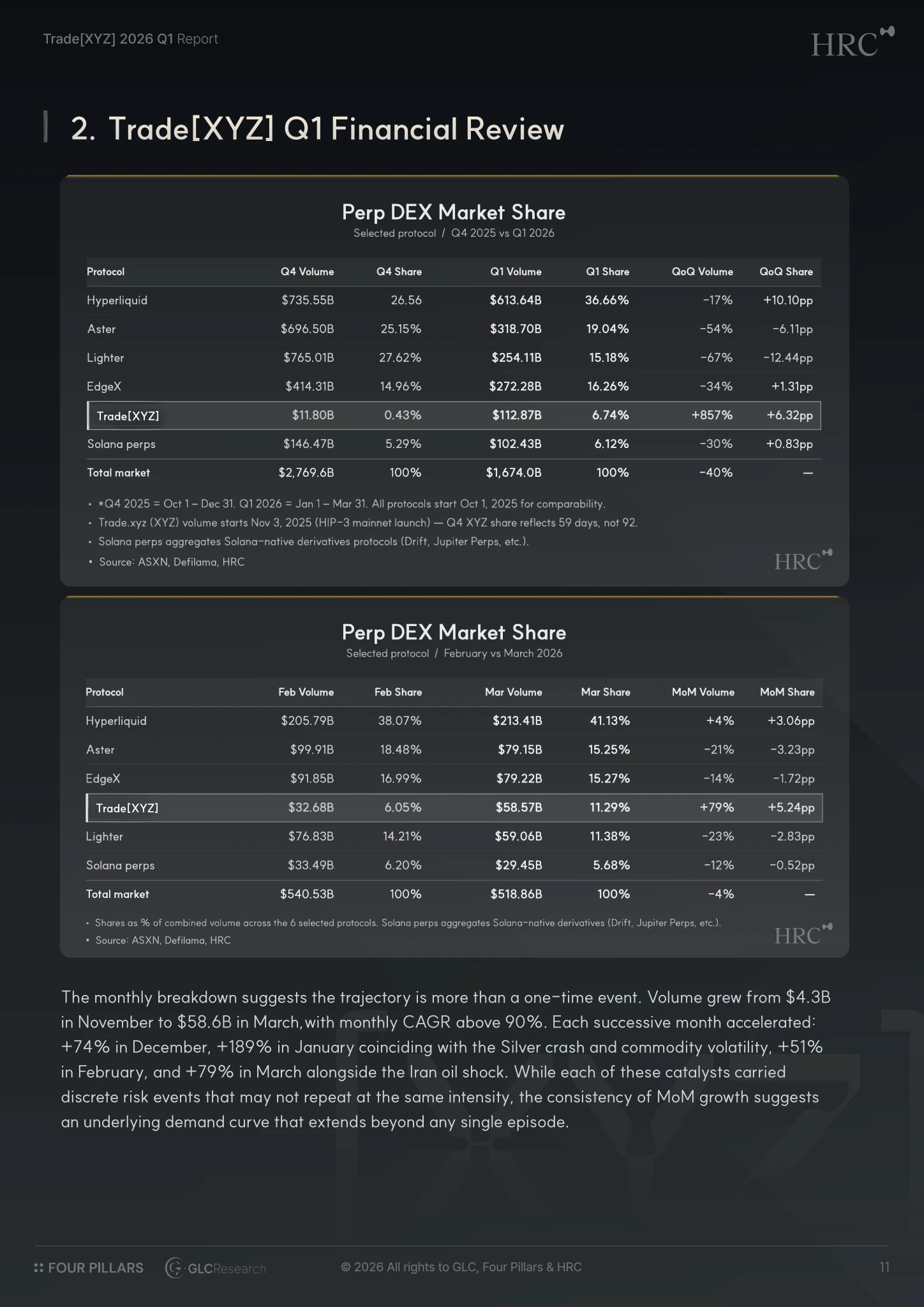
Two perp DEX market share tables: Trade[XYZ] volume rose from $11.80B to $112.87B between Q4 and Q1 and its share from 0.43% to 6.74%, reaching 11.29% in March 2026.

Slide 12 · Source: ASXN, Defilama, HRC
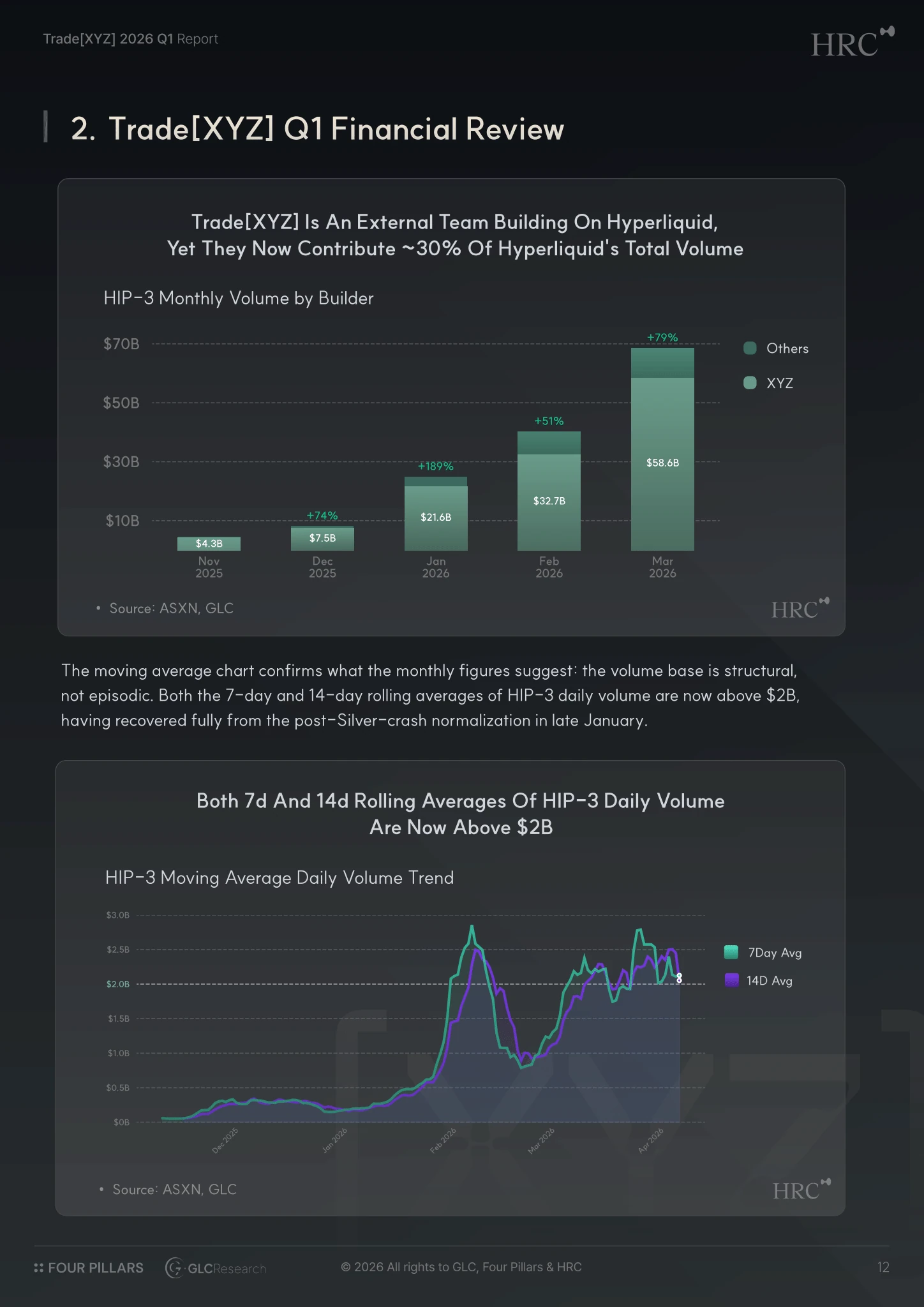
Two charts: HIP-3 monthly volume by builder, mostly xyz, from November 2025 to March 2026, and 7-day and 14-day rolling averages of HIP-3 daily volume, both now above $2B.

Slide 13 · Source: ASXN, GLC

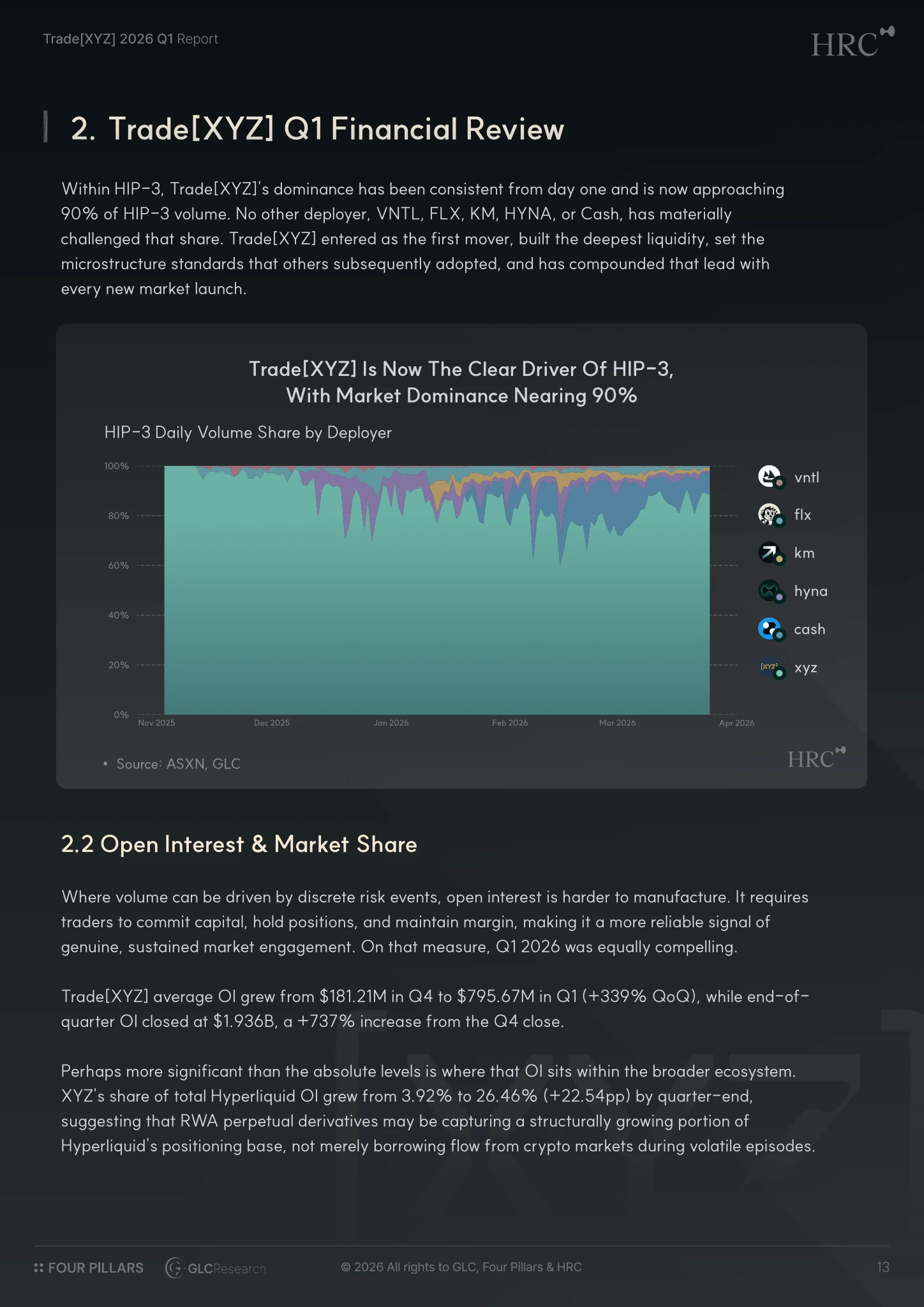
Stacked area chart of HIP-3 daily volume share by deployer, with Trade[XYZ] dominant and nearing 90%, followed by the start of the open interest section.

Slide 14 · Source: ASXN, GLC

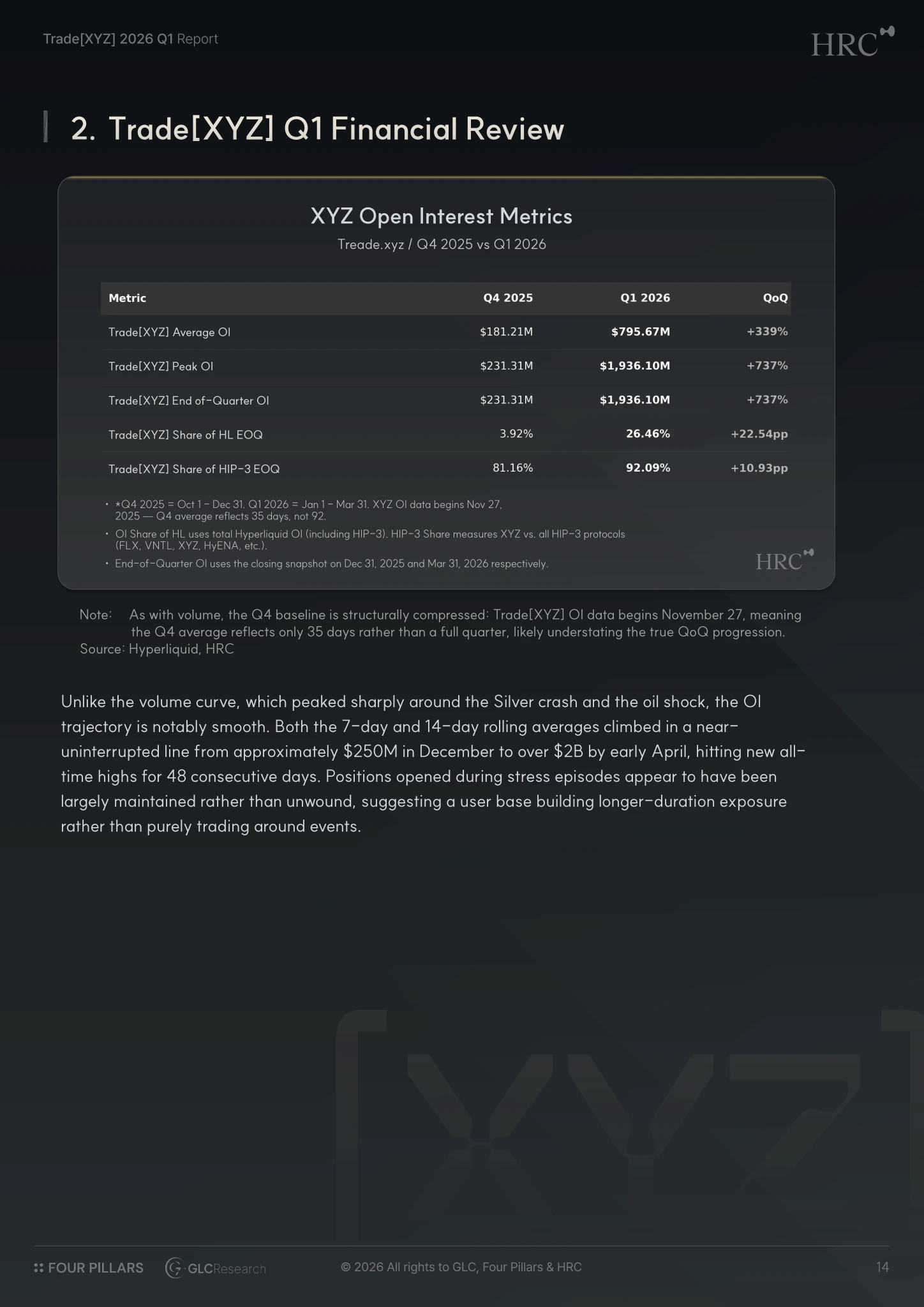
Open interest table: Trade[XYZ] average OI rose from $181.21M in Q4 2025 to $795.67M in Q1 2026, end-of-quarter OI from $231.31M to $1,936.10M, and its share of Hyperliquid OI from 3.92% to 26.46%.

Slide 15 · Source: Hyperliquid, HRC

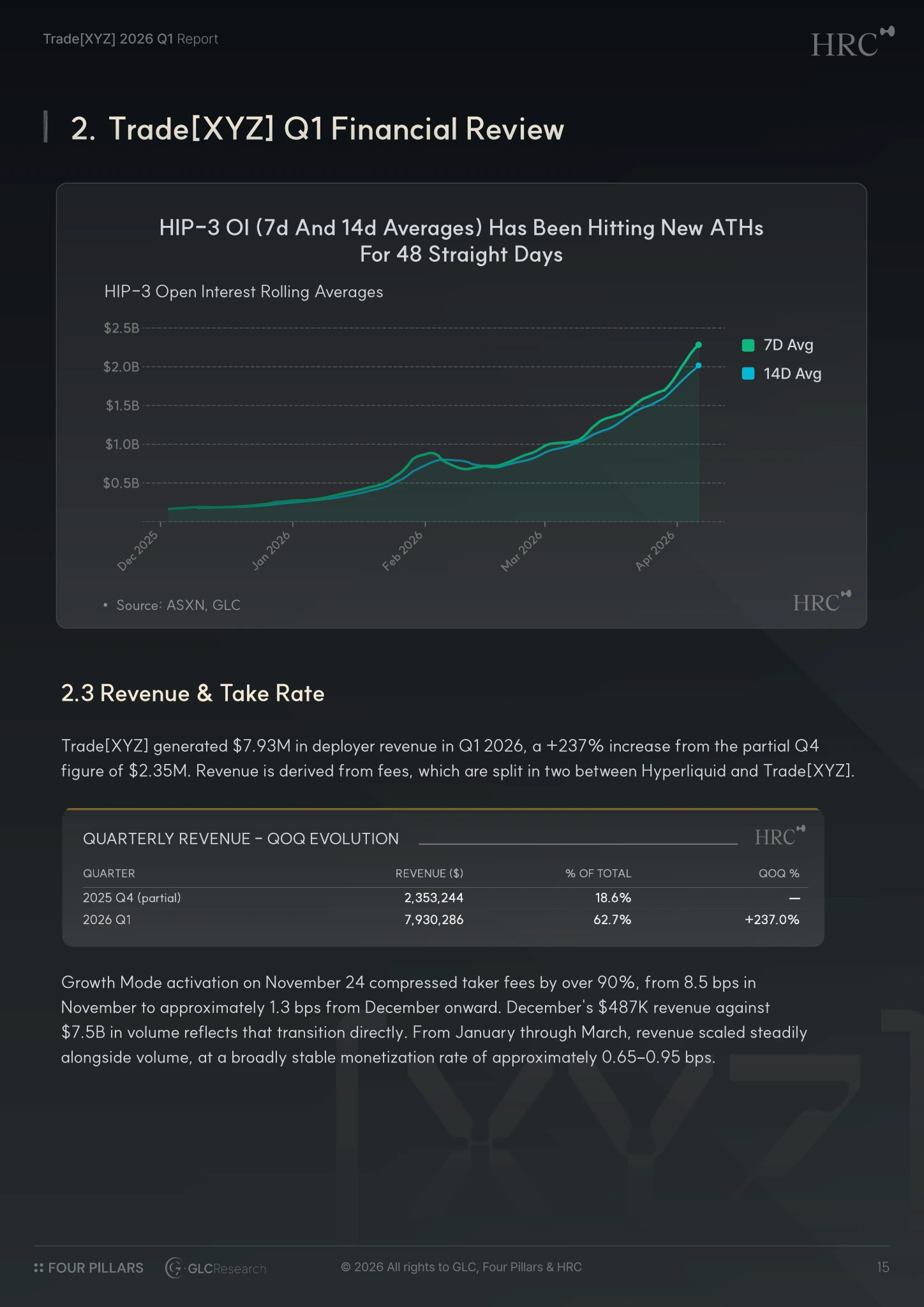
Chart of HIP-3 open interest 7-day and 14-day averages at all-time highs for 48 straight days, and a revenue table: Q1 deployer revenue of $7,930,286, up 237% on the partial Q4.

Slide 16 · Source: ASXN, GLC

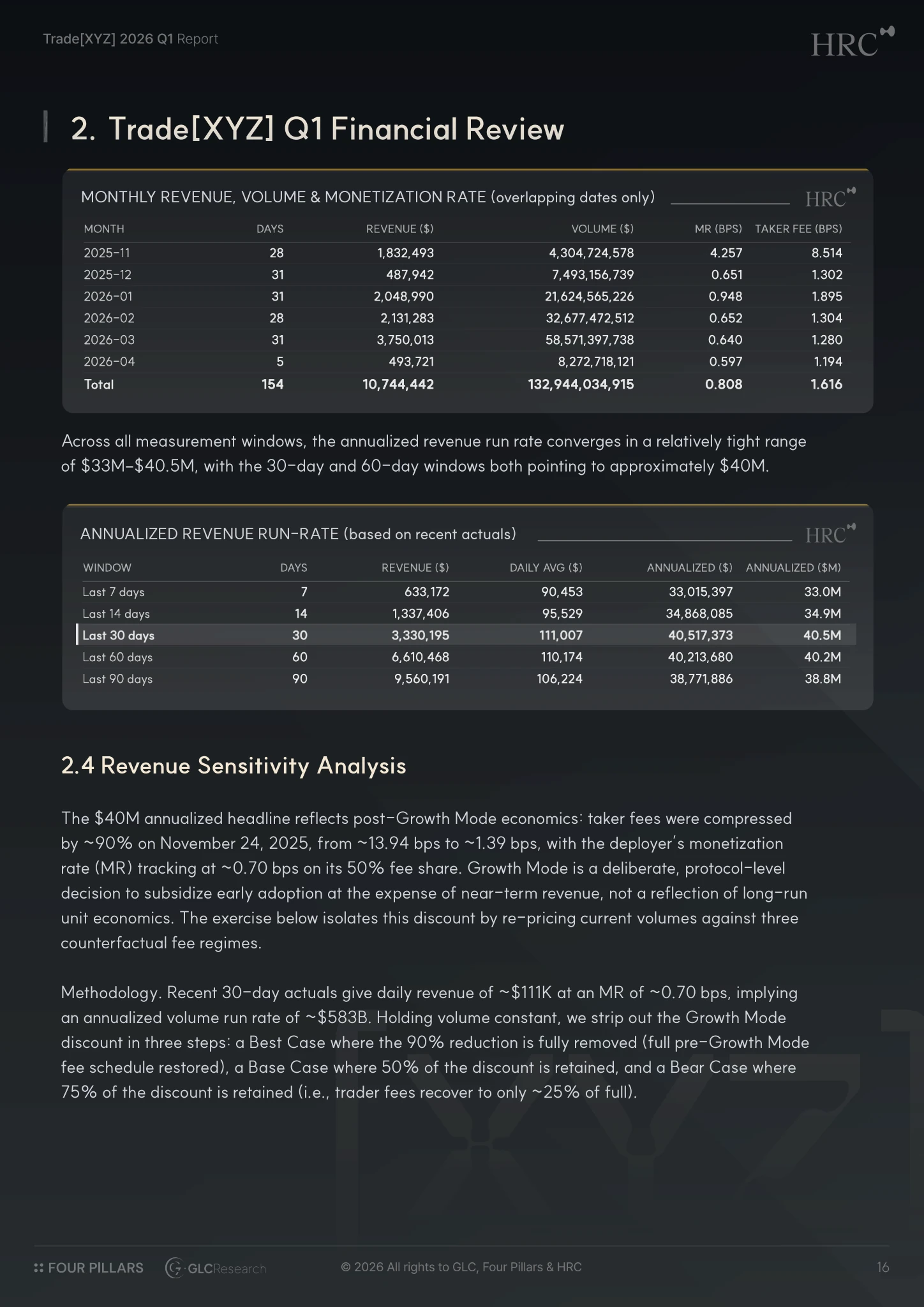
Tables of monthly revenue, volume and monetization rate from November 2025 to early April 2026, and an annualized revenue run-rate based on recent actuals.

Slide 17

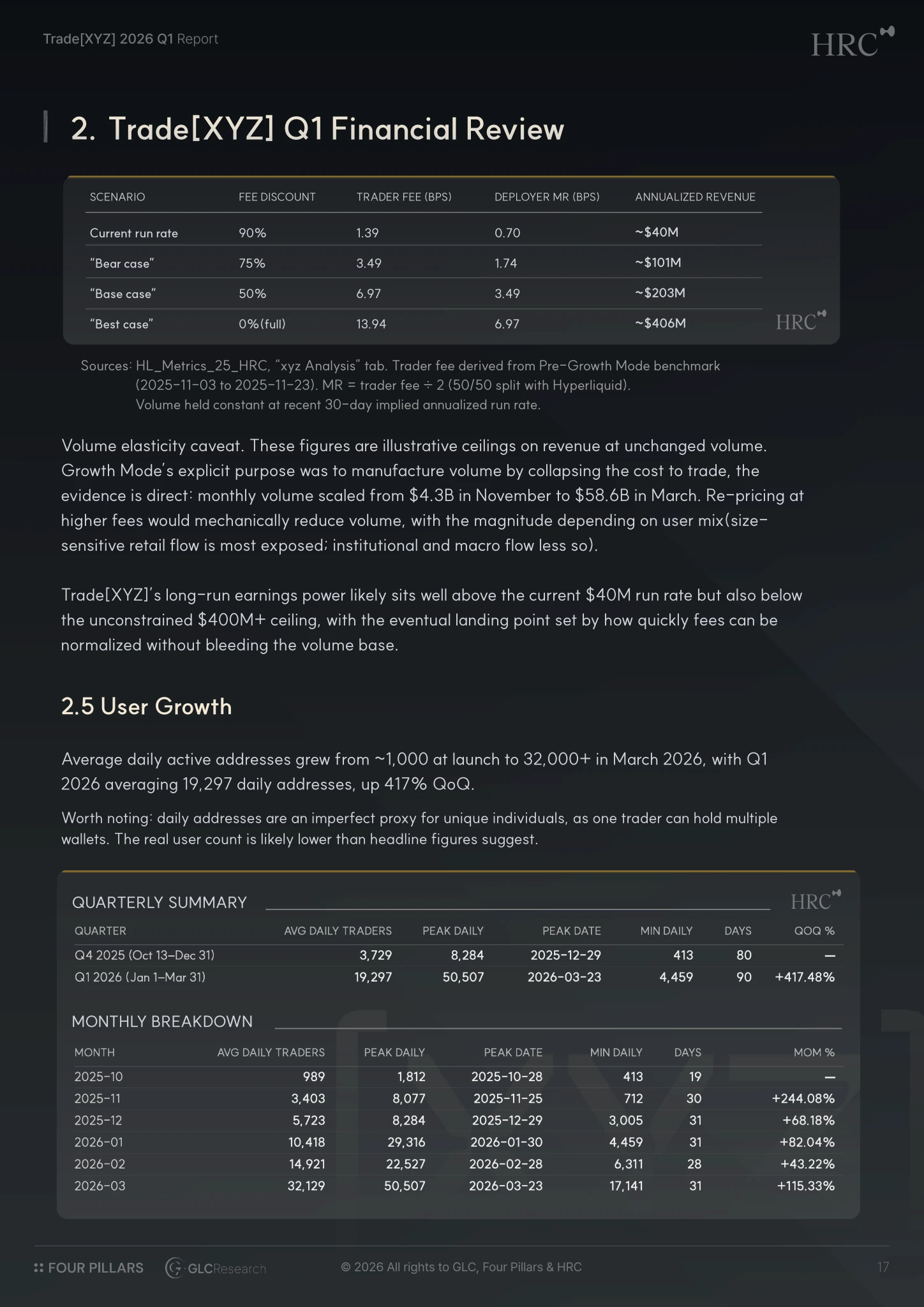
Revenue scenarios from about $40M a year at the current 90% fee discount to about $406M with no discount, and user growth tables: average daily traders rose from 3,729 in Q4 to 19,297 in Q1.

Slide 18 · Sources: HL_Metrics_25_HRC, “xyz Analysis” tab.

3. Trade[XYZ]'s Markets Overview
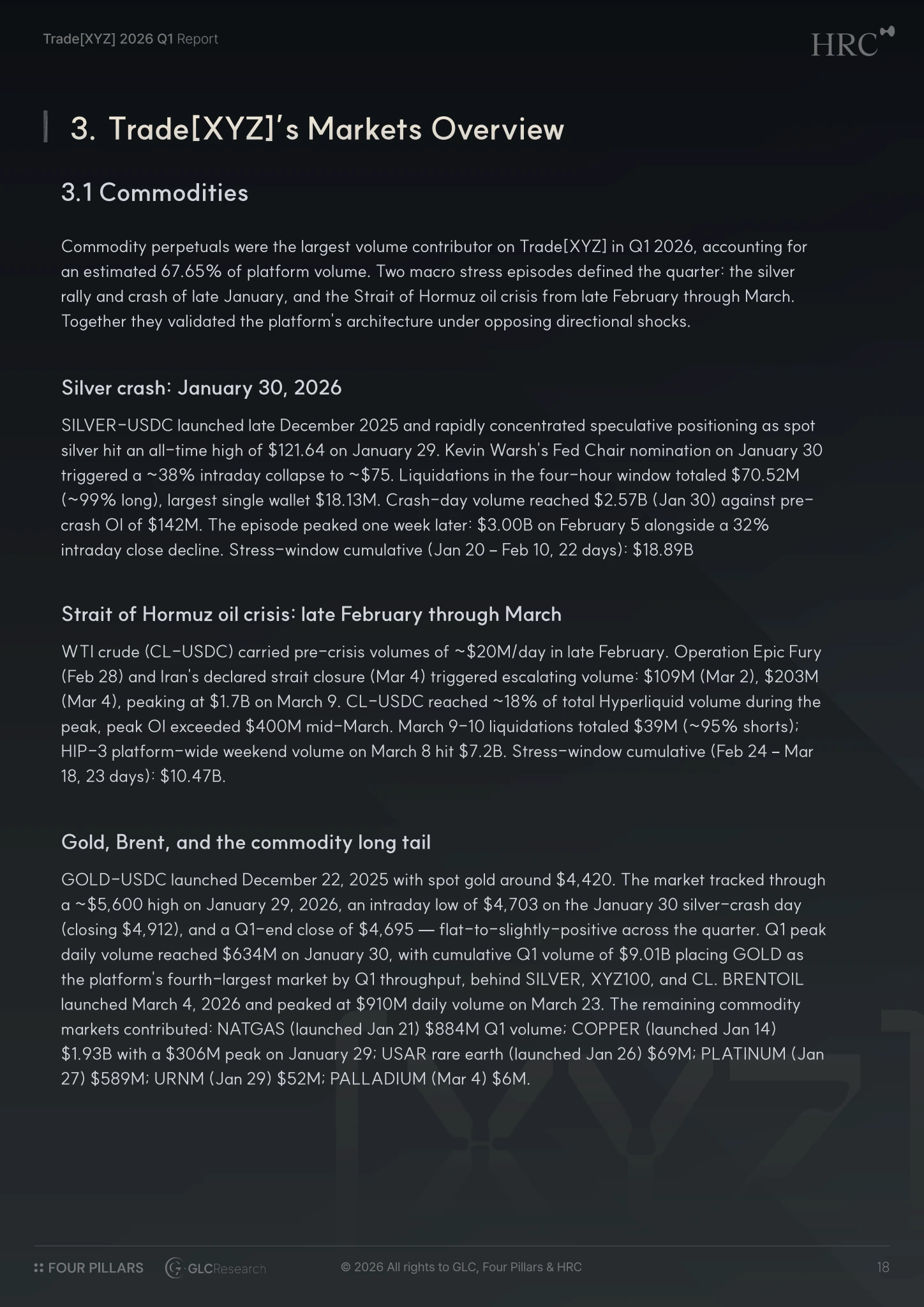
Text on commodities, about 67.65% of Q1 platform volume, shaped by the late-January silver crash and the Strait of Hormuz oil crisis from late February through March.

Slide 19

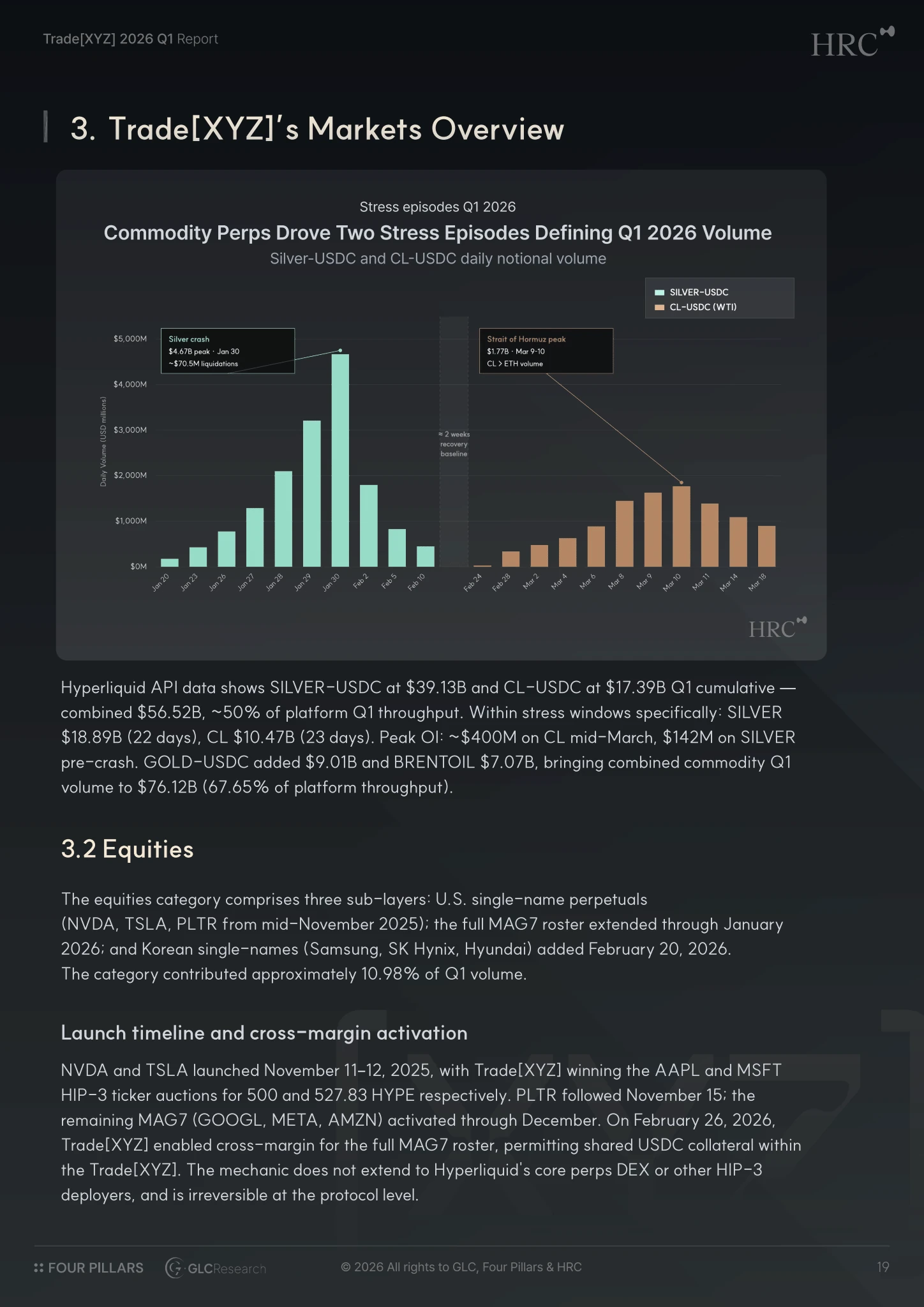
Daily notional volume chart for SILVER-USDC and CL-USDC: a silver spike around the January 30 crash and an oil peak on March 9 to 10 during the Strait of Hormuz crisis.

Slide 20

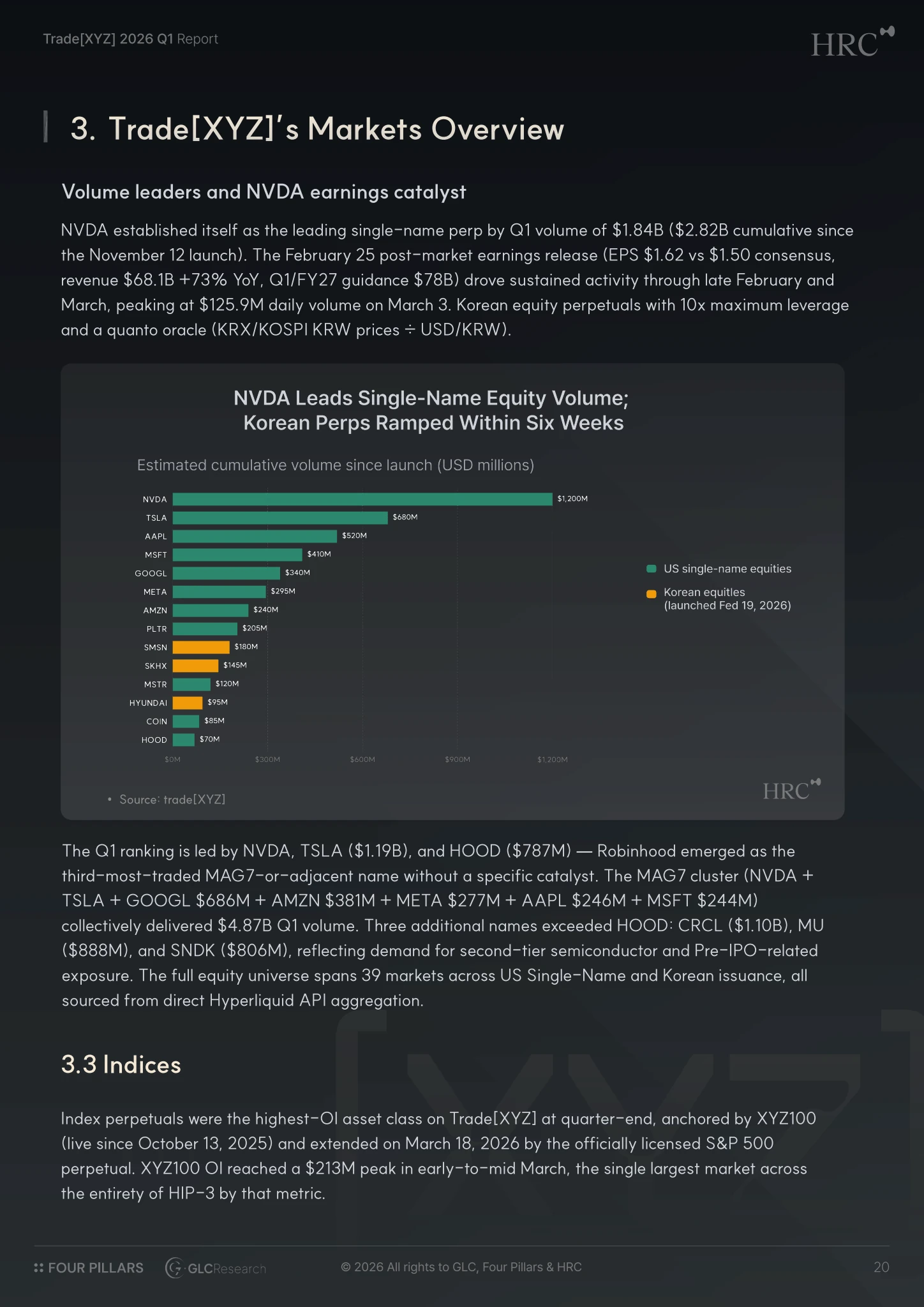
Chart of estimated cumulative volume since launch for single-name equity perps, led by NVDA, with Korean equity perps ramping within six weeks. NVDA traded $1.84B in Q1.

Slide 21 · Source: trade[XYZ]

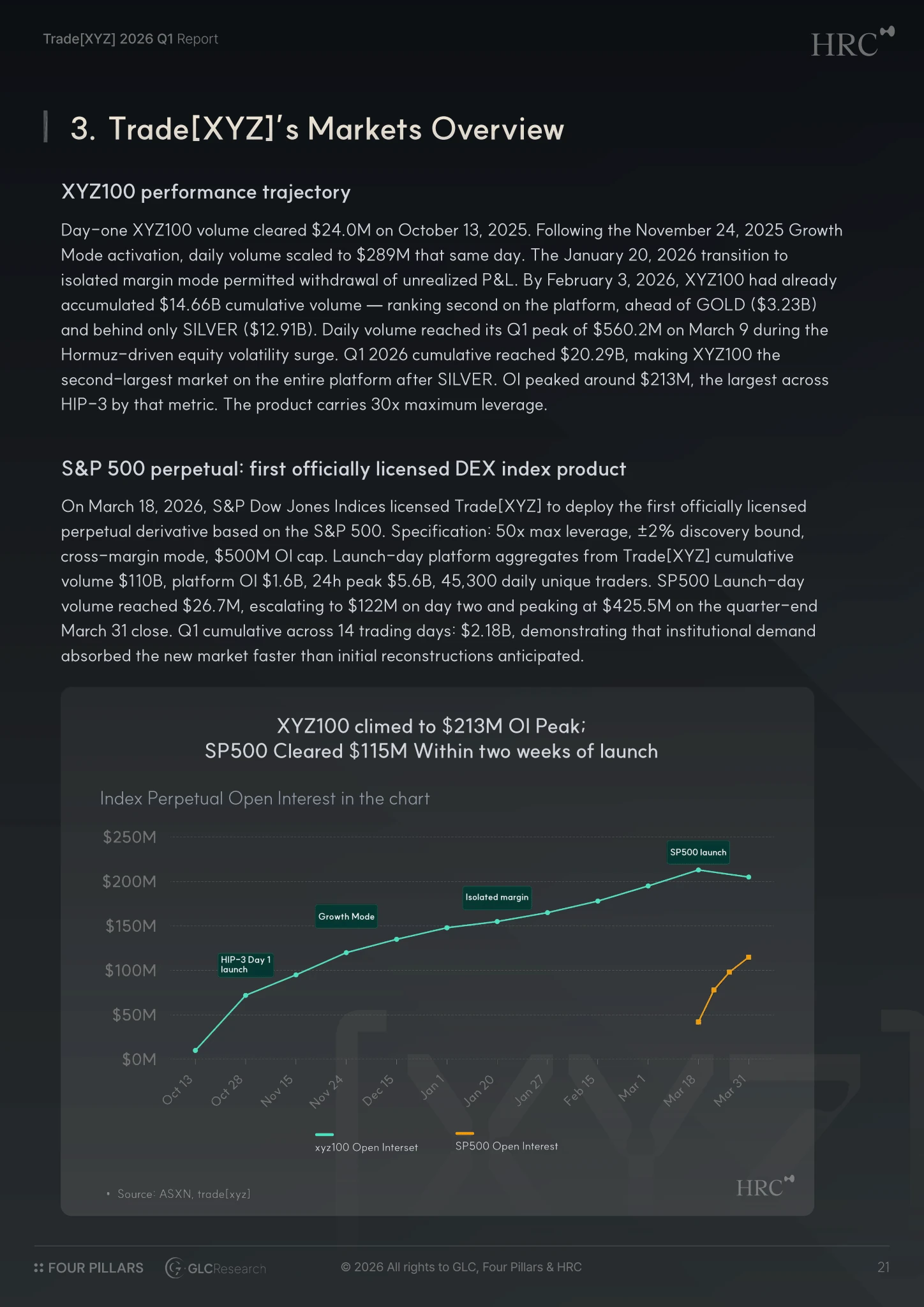
Index perp open interest chart: XYZ100 peaked at $213M of OI, and the licensed SP500 perp cleared $115M within two weeks of launch.

Slide 22 · Source: ASXN, trade[xyz]

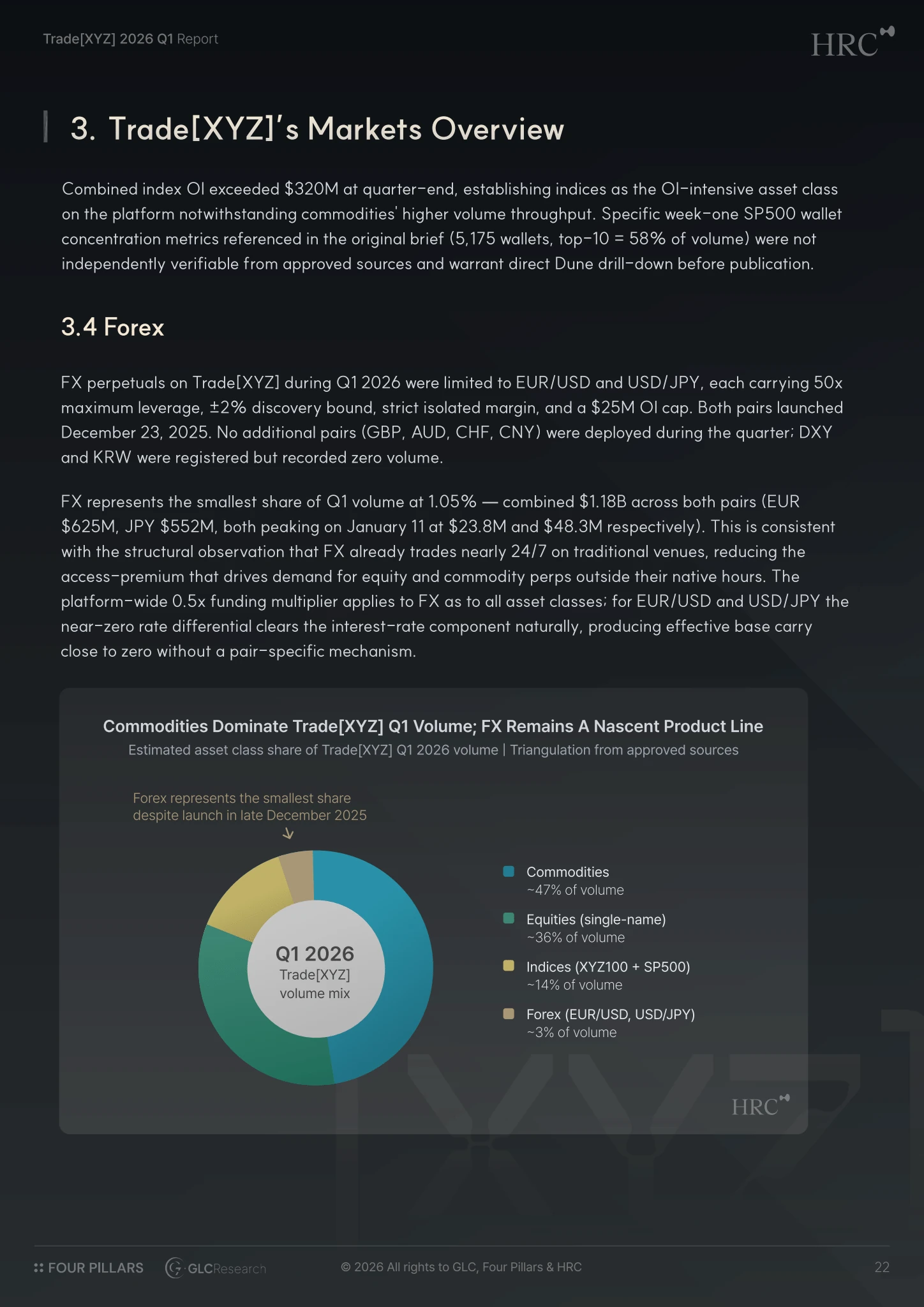
Donut chart of estimated Q1 volume mix: commodities about 47%, single-name equities about 36%, indices about 14% and forex about 3%, beside text on the EUR/USD and USD/JPY pairs.

Slide 23

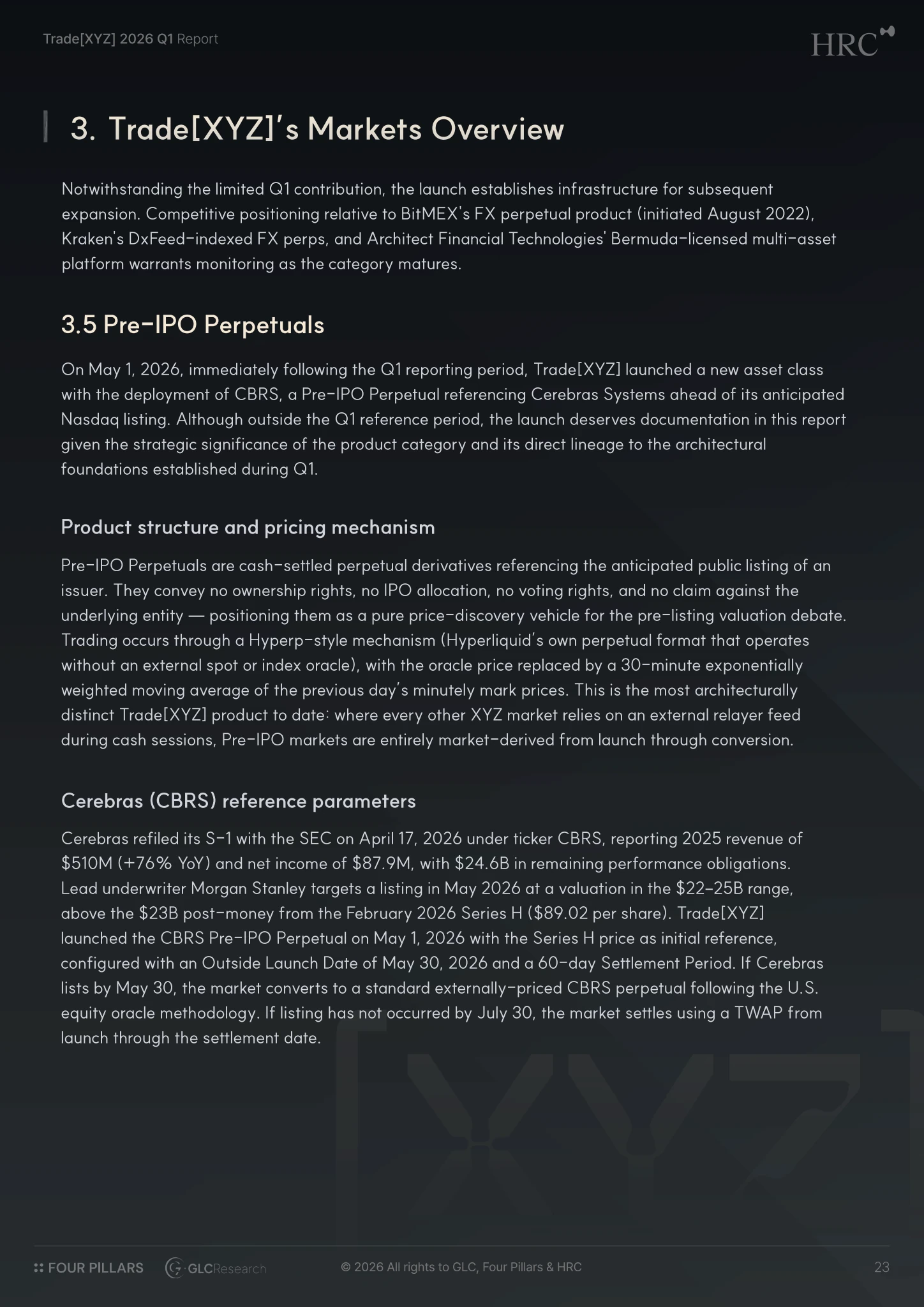
Text on pre-IPO perpetuals: the Cerebras (CBRS) perp launched May 1, 2026 with an $89.02 Series H reference price, and converts or settles depending on whether the company lists.

Slide 24

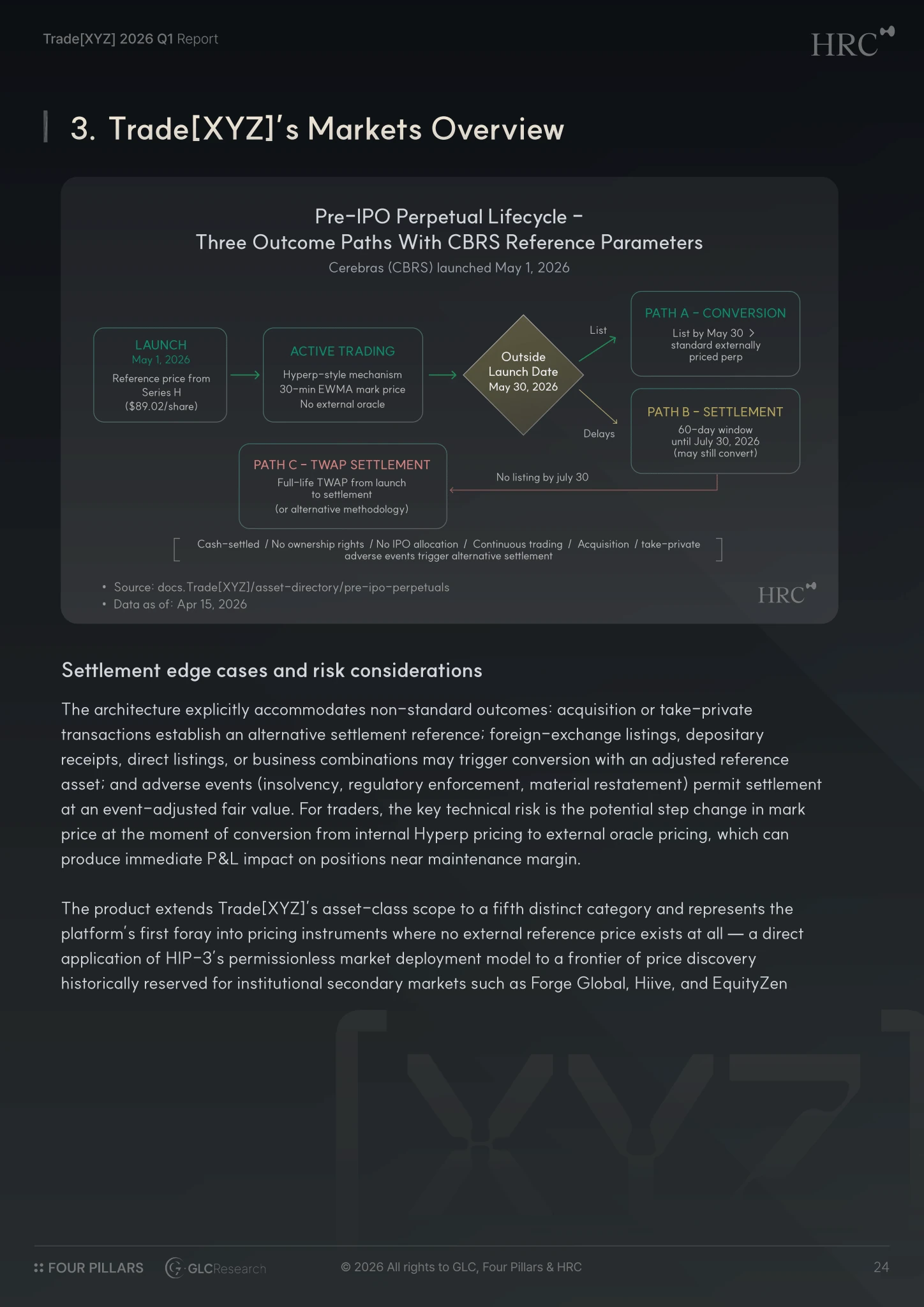
Flowchart of the CBRS pre-IPO perpetual lifecycle with three outcome paths: conversion if it lists by May 30, 2026, a settlement window, or TWAP settlement by July 30, 2026.

Slide 25 · Source: docs.Trade[XYZ]/asset-directory/pre-ipo-perpetuals · Data as of: Apr 15, 2026

4. Trade[XYZ] Technical Architecture and Updates
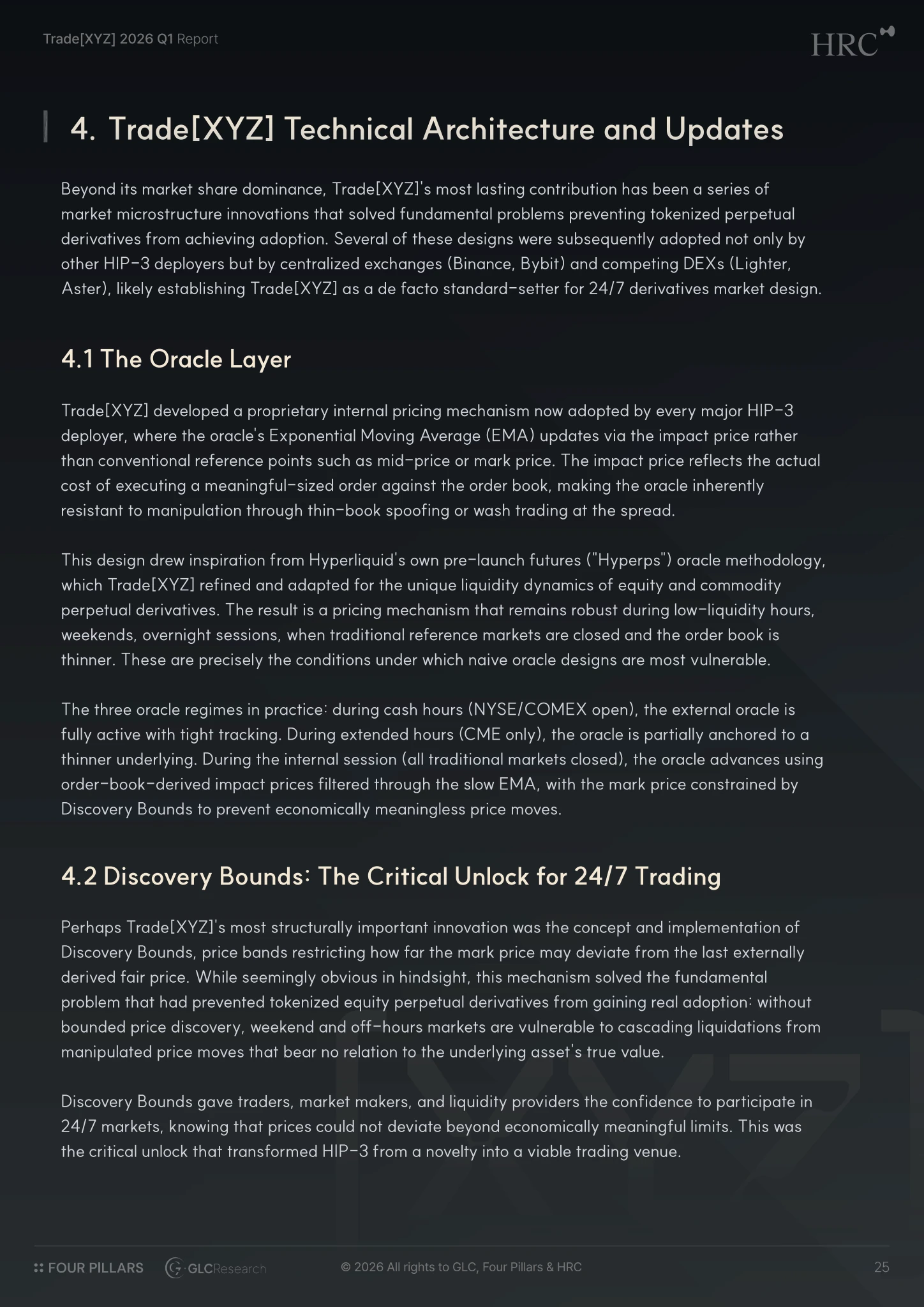
Section 4 text on Trade[XYZ]'s oracle layer and discovery bounds, which cap how far the mark price can drift so tokenized perps can trade 24/7.

Slide 26

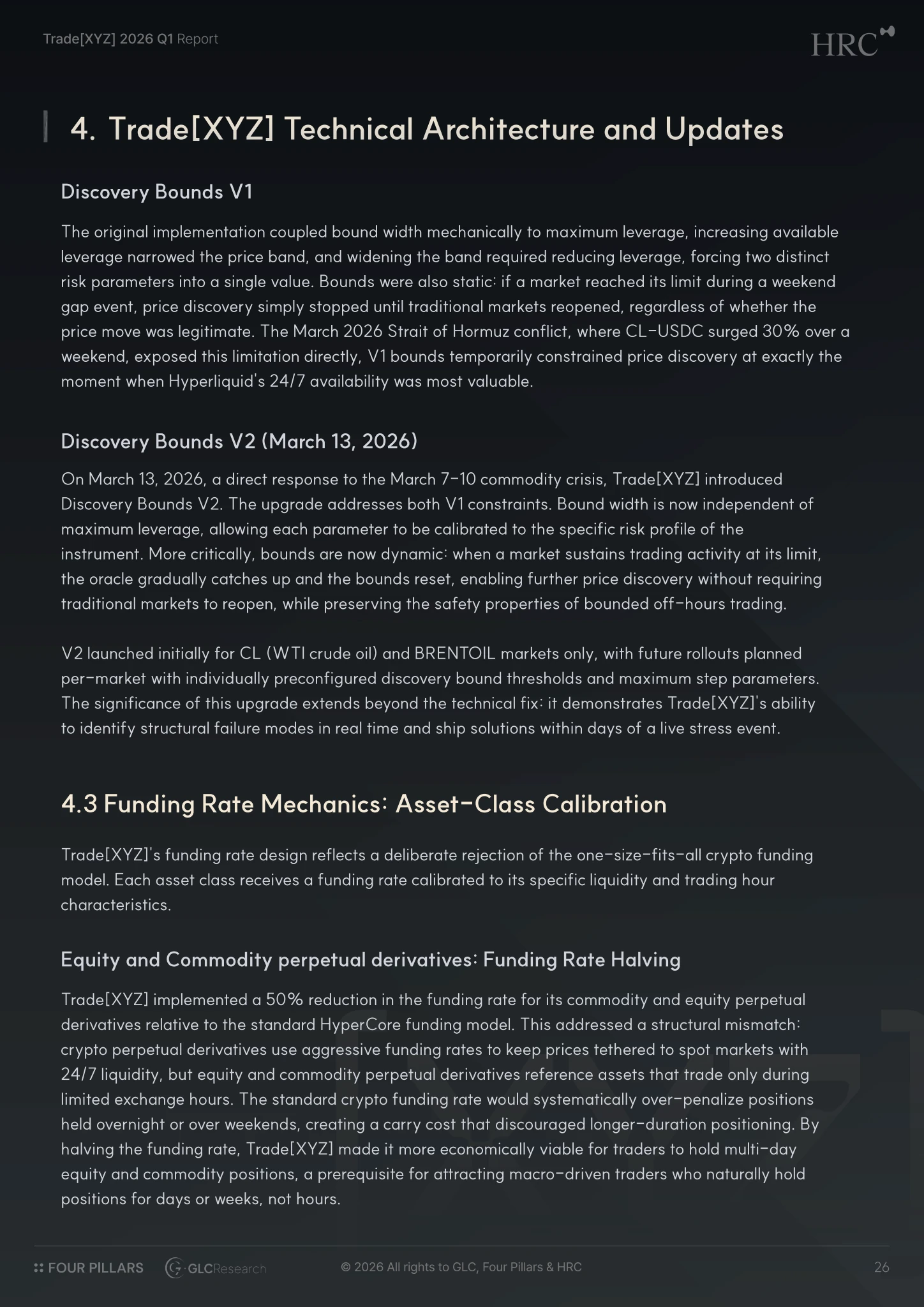
Text on Discovery Bounds V2 from March 13, 2026, which decoupled bound width from leverage, and on halving funding rates for equity and commodity perps.

Slide 27

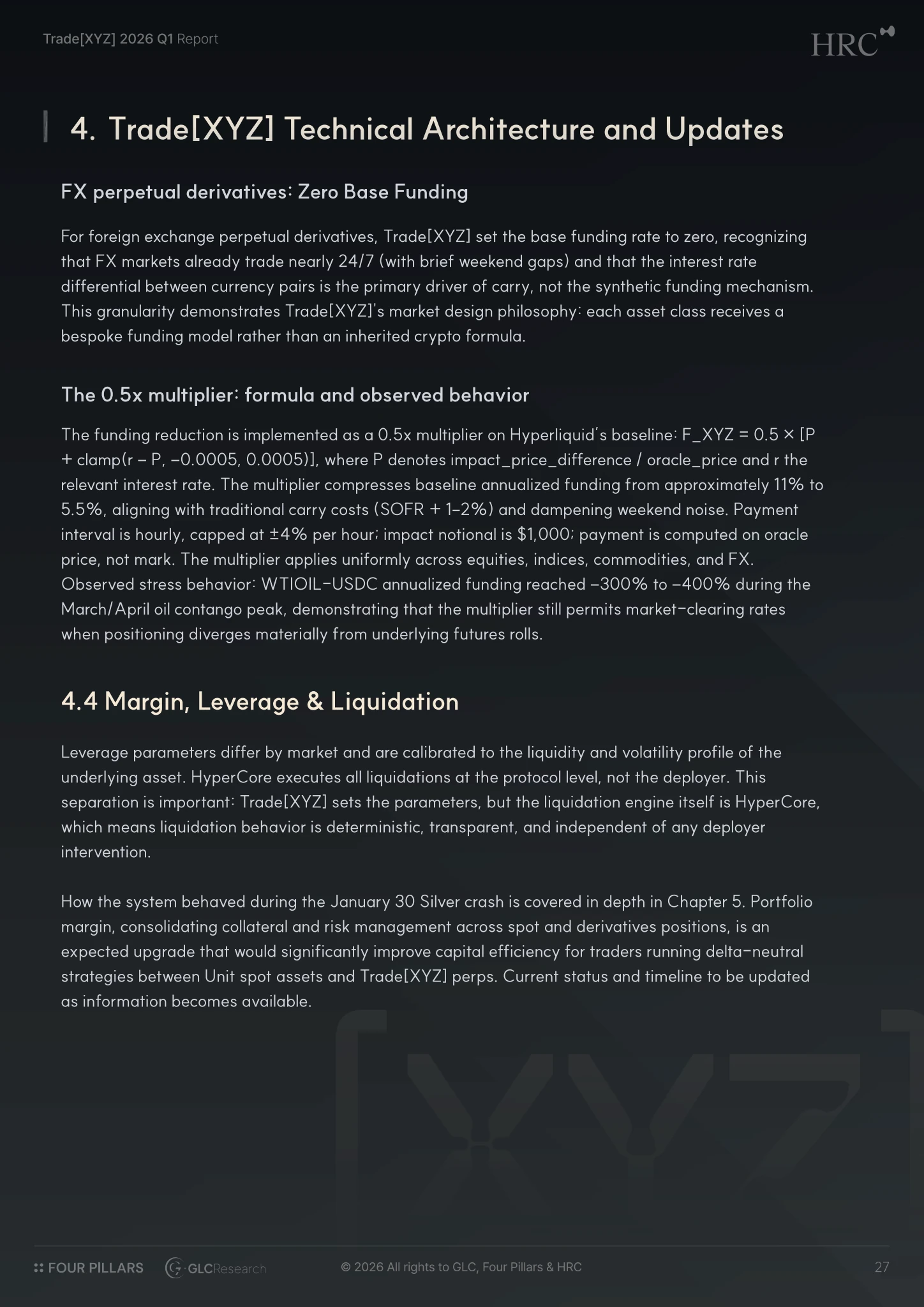
Text on zero base funding for FX perps, the 0.5x funding multiplier, and margin, leverage and liquidation handled by HyperCore.

Slide 28

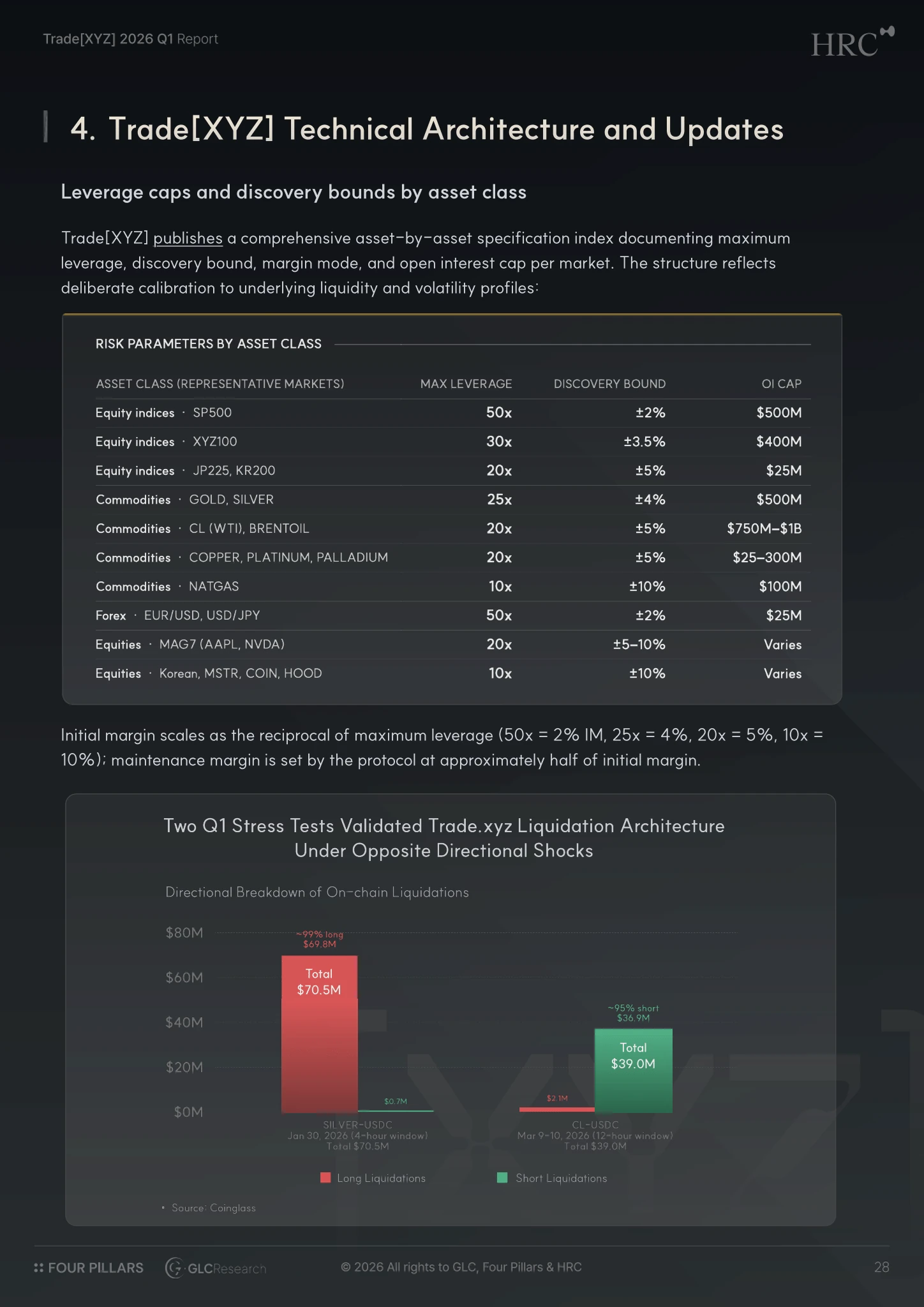
Risk parameter table with maximum leverage from 50x (SP500, EUR/USD, USD/JPY) down to 10x, and a liquidation chart: $70.5M of mostly long silver liquidations on January 30 and $39.0M of mostly short CL liquidations on March 9 to 10.

Slide 29 · Source: Coinglass

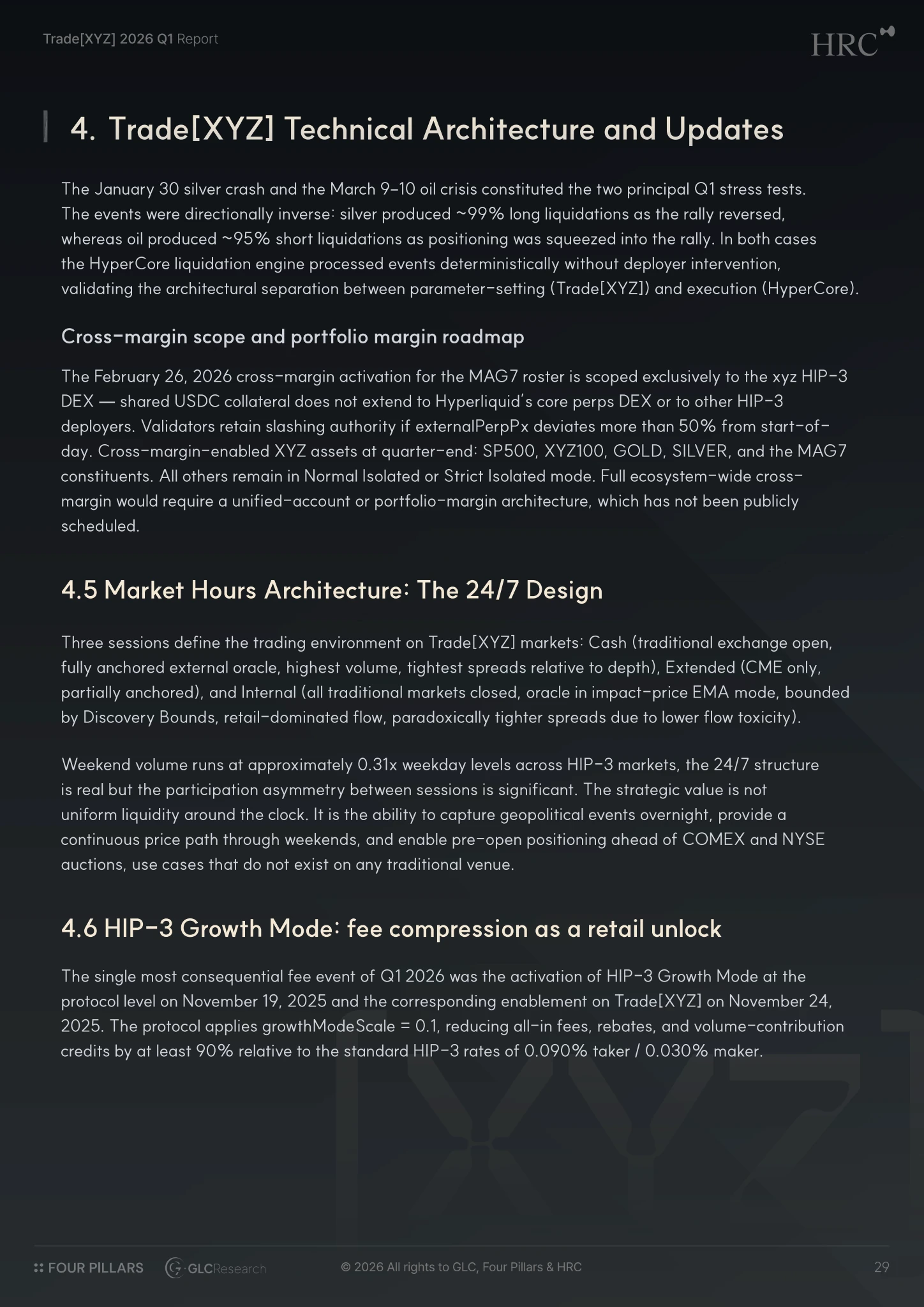
Text on the 24/7 market hours design, cross margin, weekend versus weekday volume, and HIP-3 Growth Mode cutting fees by at least 90%.

Slide 30

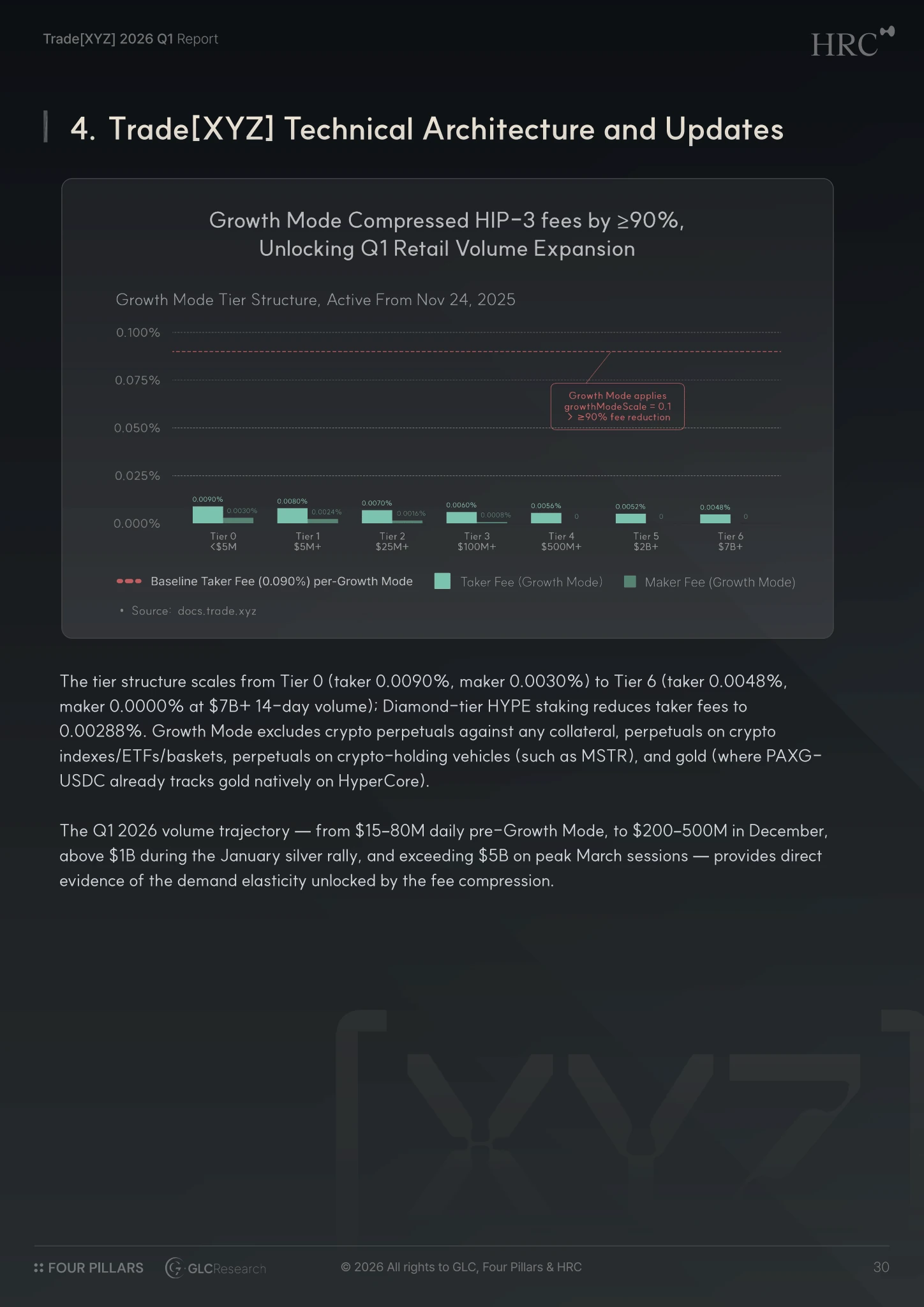
Bar chart of Growth Mode fee tiers active from November 24, 2025: taker fees from 0.0090% at tier 0 down to 0.0048% at tier 6, against a 0.090% baseline.

Slide 31 · Source: docs.trade.xyz

5. Price Discovery & Market Efficiency Analysis
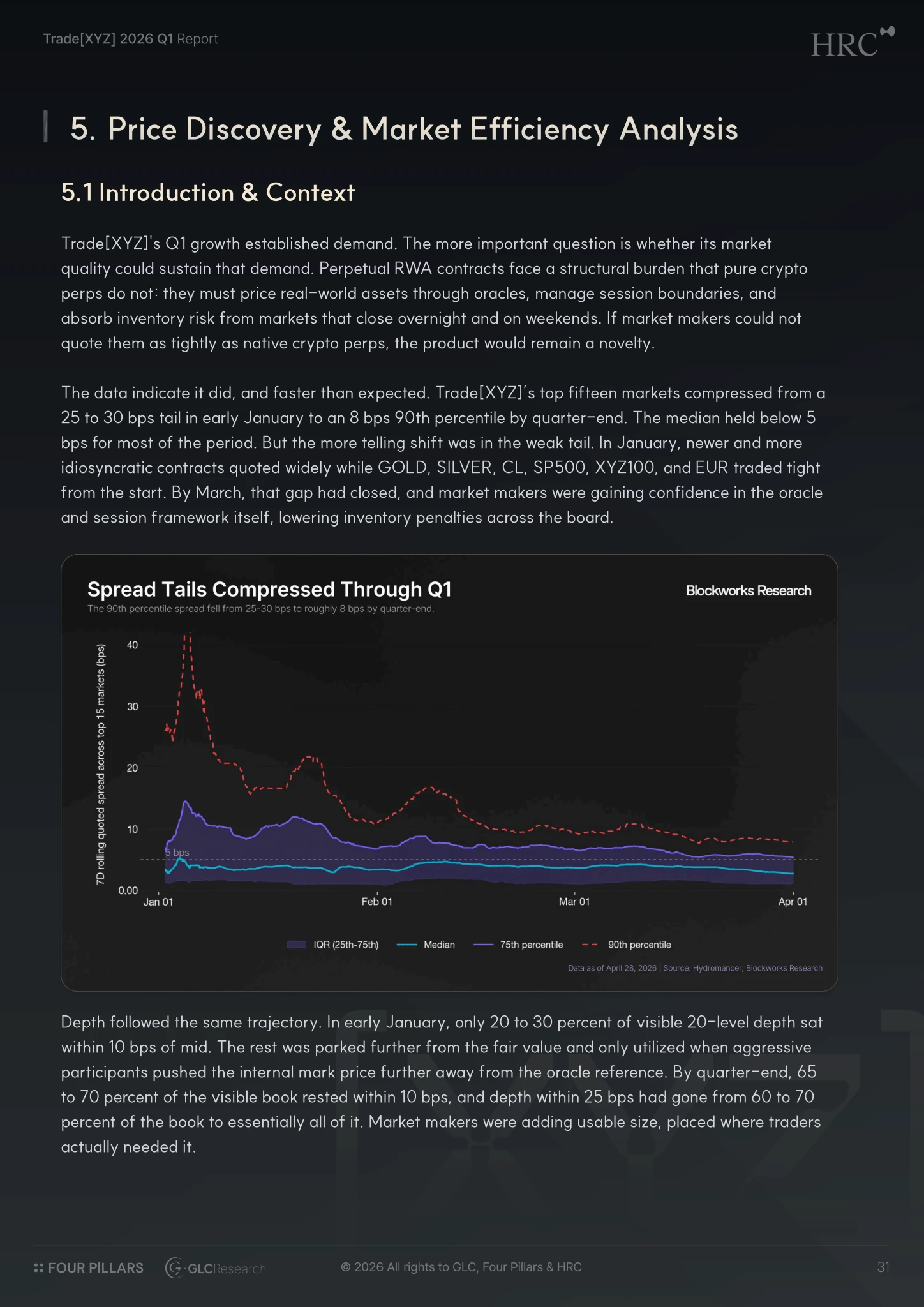
Spread chart for Trade[XYZ]'s top markets: the 90th percentile quoted spread fell from 25 to 30 bps in early January to roughly 8 bps by the end of Q1 2026.

Slide 32 · Data as of April 28, 2026 | Source: Hydromancer, Blockworks Research
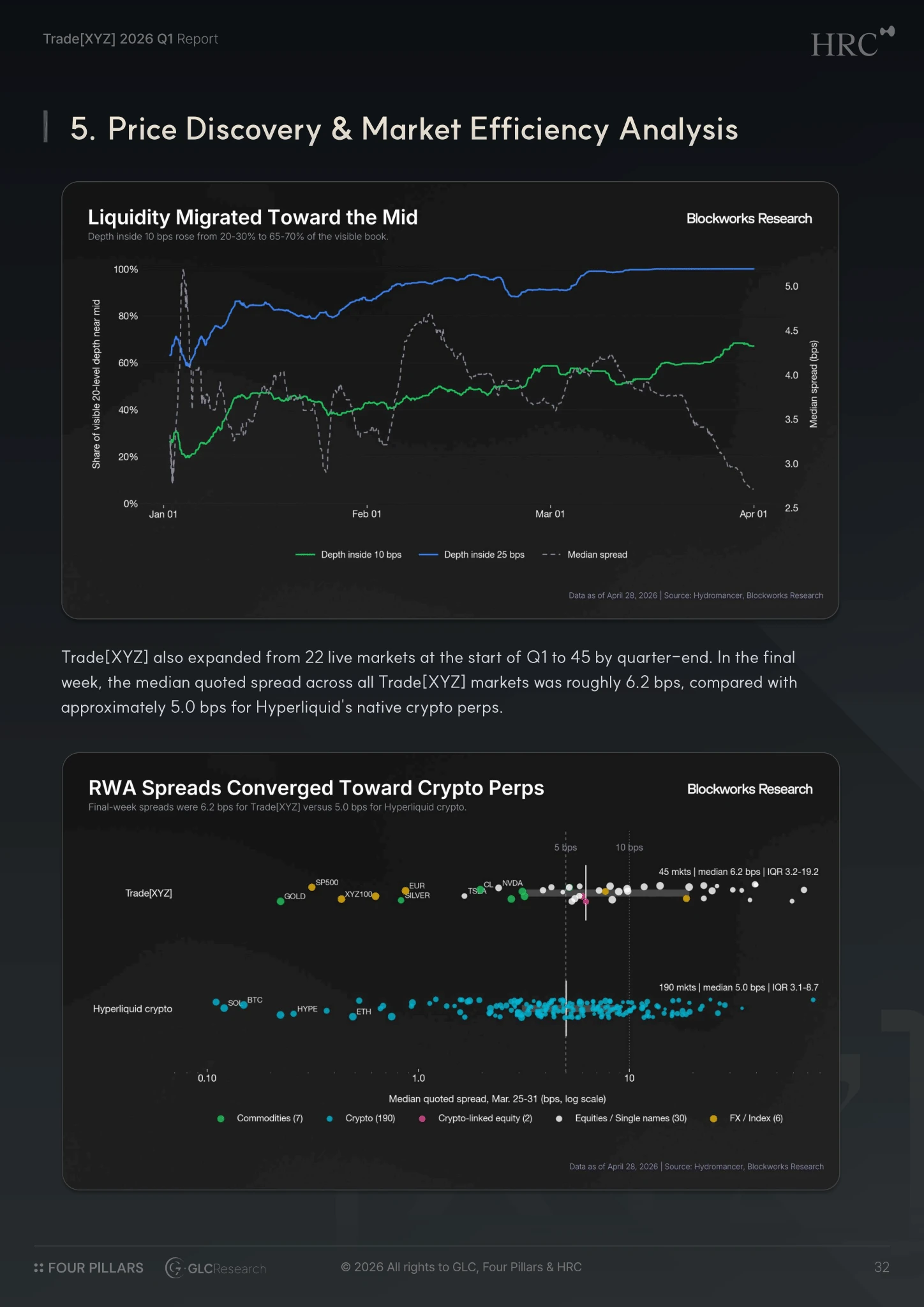
Two charts: depth inside 10 bps rose to 65 to 70% of the visible book during Q1, and Trade[XYZ]'s final-week median spread of 6.2 bps approached Hyperliquid crypto perps at 5.0 bps.

Slide 33 · Data as of April 28, 2026 | Source: Hydromancer, Blockworks Research
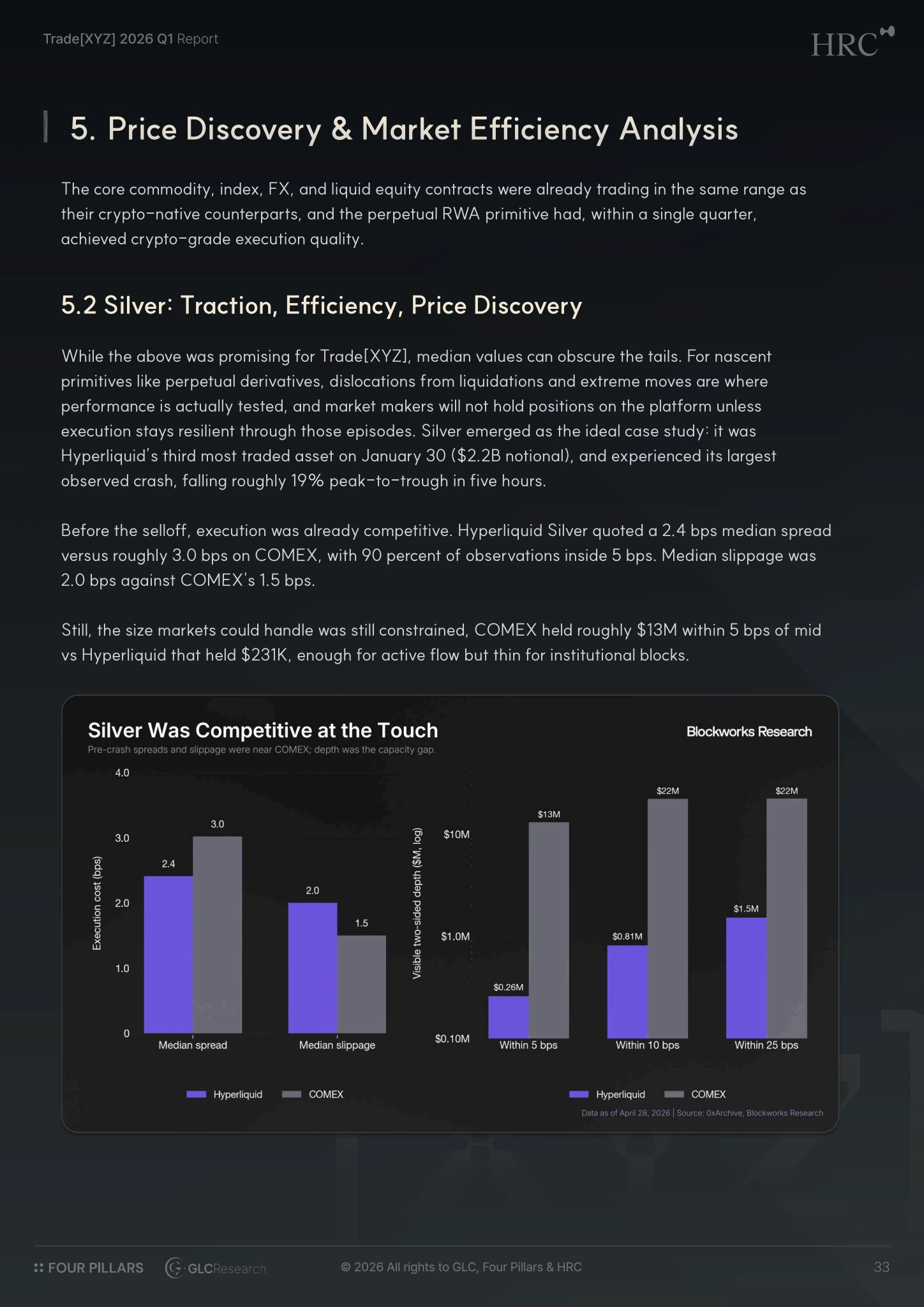
Silver chart, Hyperliquid vs COMEX before the January 30 crash: median spread 2.4 vs 3.0 bps and slippage 2.0 vs 1.5 bps, but depth within 5 bps of $0.26M vs $13M.

Slide 34 · Data as of April 28, 2026 | Source: 0xArchive, Blockworks Research
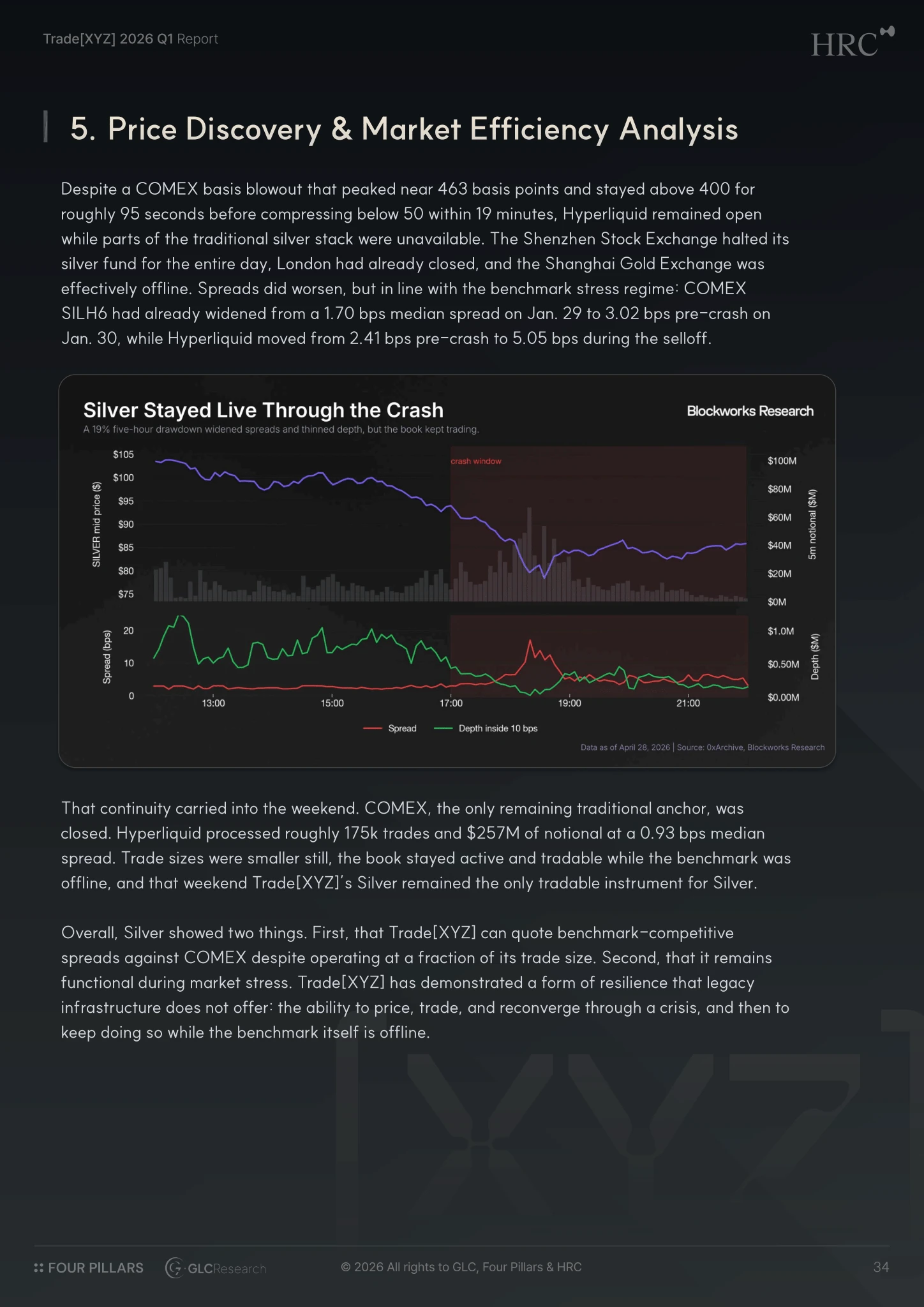
Intraday chart of silver spread and depth through the January 30 crash: spreads widened and depth thinned during the 19% five-hour drawdown, but the Hyperliquid book kept trading.

Slide 35 · Data as of April 28, 2026 | Source: 0xArchive, Blockworks Research
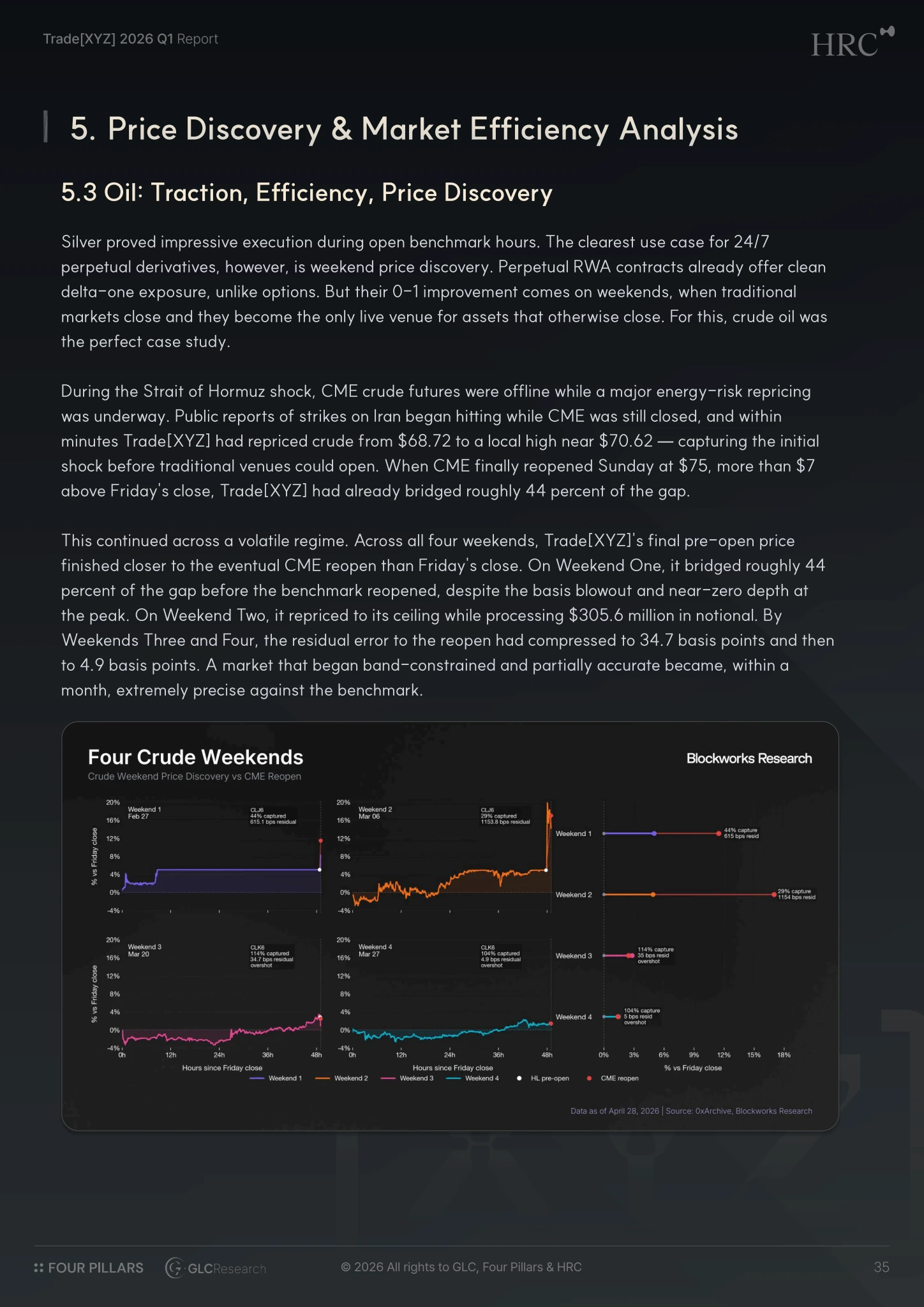
Chart of four crude weekends from February 27 to March 27 comparing Trade[XYZ] weekend prices with the CME reopen: the residual error fell from 615 bps on the first weekend to 5 bps on the fourth.

Slide 36 · Data as of April 28, 2026 | Source: 0xArchive, Blockworks Research
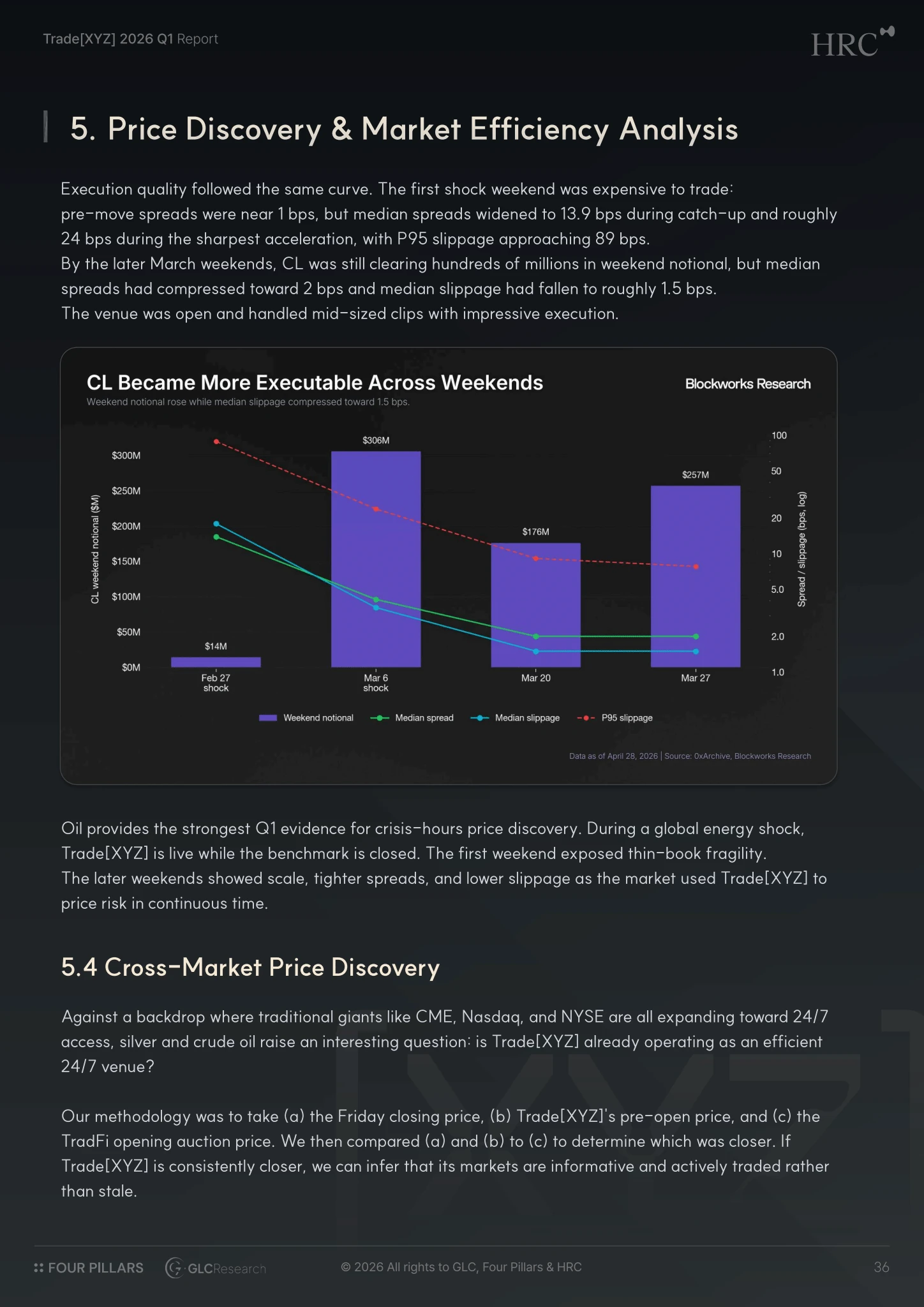
Chart of CL weekend notional rising from $14M to as much as $306M while median slippage compressed toward 1.5 bps.

Slide 37 · Data as of April 28, 2026 | Source: 0xArchive, Blockworks Research
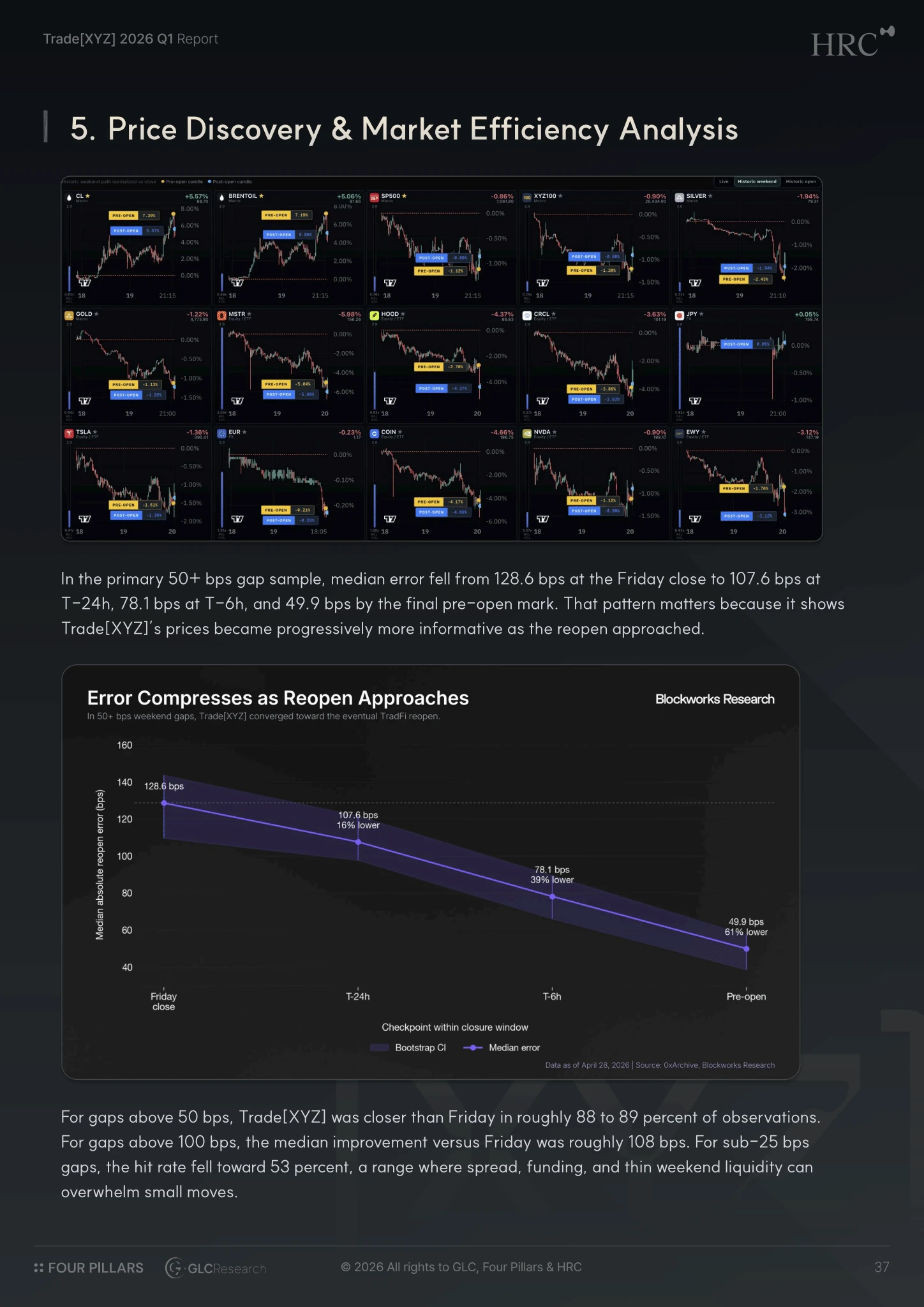
Grid of weekend price paths for 15 markets, and a chart of median reopen error in 50+ bps gaps falling from 128.6 bps at the Friday close to 49.9 bps before the open.

Slide 38 · Data as of April 28, 2026 | Source: 0xArchive, Blockworks Research
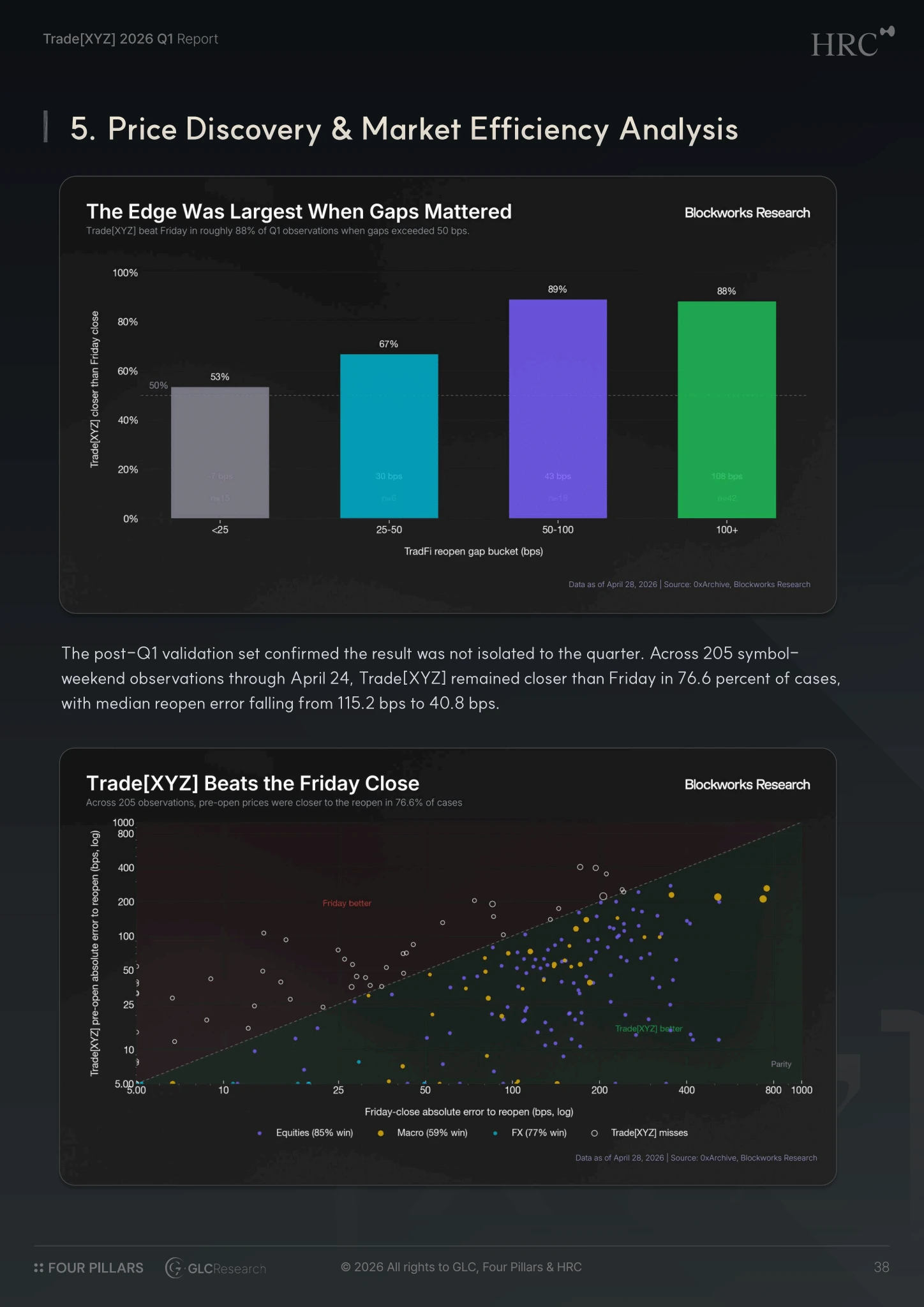
Two charts: Trade[XYZ] beat the Friday close in roughly 88% of observations when gaps exceeded 50 bps, and in 76.6% of 205 observations overall.

Slide 39 · Data as of April 28, 2026 | Source: 0xArchive, Blockworks Research
Text concluding the price discovery analysis: weekend prices on Trade[XYZ]'s largest real-world asset markets usually sat closer to the eventual reopen than the Friday close.

Slide 40

6. Regulatory Risks

Section 6 text on regulatory risks, including the lack of a clear lawful US path to Hyperliquid perps and how SEC and CFTC jurisdiction may split across commodity and securities-linked perps.

Slide 41

Text on four regulatory risks for Trade[XYZ], including SEC treatment of equity perps and the futures versus swaps question, written by Salah Ghazzal from HPC.

Slide 42

Closing Thoughts

Closing thoughts from GLC Research and Four Pillars for HRC: Q1 2026 showed real-world asset perps working as serious infrastructure, with fee, regulatory and competition risks ahead.

Slide 43

Back cover with HRC, Four Pillars and GLC Research logos and contact links for the Hyperliquid Research Collective.

Slide 44

One email when we publish new Hyperliquid or Lighter research.