
0xArchive keeps the order-level record for every HIP-3 market: the order book reconstructed to L4, plus every add, cancel, and fill, attributed by wallet, across 182 builder-perp markets. When Arrakis Finance set out to count who actually trades HIP-3, the answer took that record: 175,703 wallets across 21 days, $161.4B in volume, with 0xArchive credited for the data (April 2026). A candle cannot name a single one of those wallets. The order-level record can.
| HIP-3 markets | 182 live, six established builders plus a growing long tail |
| Order-level depth | L4 book reconstructed, plus the order lifecycle (adds, cancels, fills, TP and SL) from order-flow, order-history, and tpsl |
| Attribution | per wallet, via the L4 user_address |
| History by type | trades 2025-10-13; order book, funding, OI 2026-02-16; L4 2026-03-10 |
| Access | full depth and history on every plan, including Free |
Most HIP-3 data stops at the chart. This is what the order record holds, and how to query it.
What candles hide
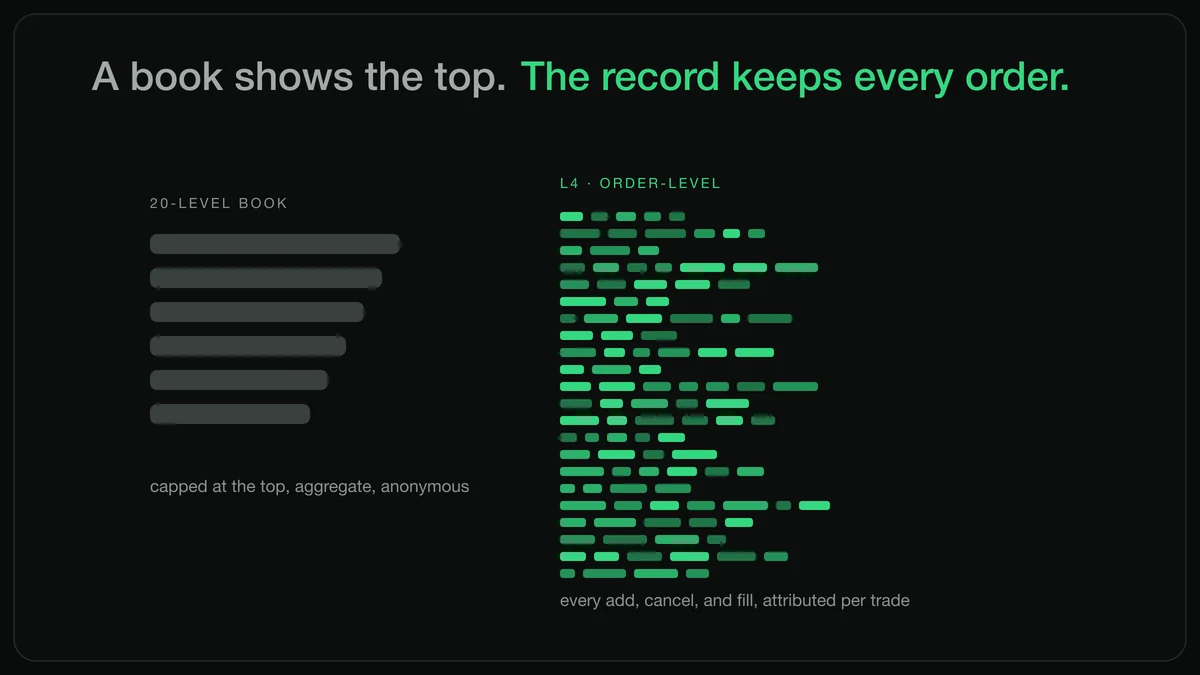
A candle is four prices and a volume. It tells you the interval closed green. It does not tell you who was in the book, where your order would have queued, or which fills moved the price. A native 20-level L2 snapshot is better and still blind: aggregate depth, capped at 20 levels per side, with no identity. On a thin builder market the orders that move price often sit past level 20, or arrive and cancel between snapshots.
| What you can see | Candle (OHLCV) | L2 (native, 20-level) | Order-level (L4 + flow) |
|---|---|---|---|
| Aggregate depth | — | top 20 levels | full book |
| Depth past level 20 | — | — | ✓ (reconstructed) |
| Individual resting orders | — | — | ✓ |
| Cancels between prints | — | — | ✓ |
| Wallet behind each fill | — | — | ✓ |
| Queue position | — | — | ✓ |
| Backtest fill model | mid-price guess | approximate | reconstructed: partial, slipped, or missed |
Sample once a second and you miss the order that set the high. The L4 book keeps those orders, and full depth past 20 levels is reconstructed from it.
L4, defined
L4 is the order book rebuilt order by order: every resting order, with its order id and the wallet that placed it. Alongside it, the order lifecycle (adds, cancels, fills, TP and SL) comes from the order-flow, order-history, and tpsl endpoints. Together that is queue position and per-wallet attribution a candle never carries.
The difference shows up the moment you backtest. With candles you assume you filled at the mid. With L4 you reconstruct queue position and model the fill you would actually have gotten: partial, slipped, or missed. One is a guess. The other is the tape. It is the difference between "the price touched 1.2040" and "your 1.2040 bid sat behind 38 contracts, and 12 of them cancelled before the print."
The HIP-3 landscape
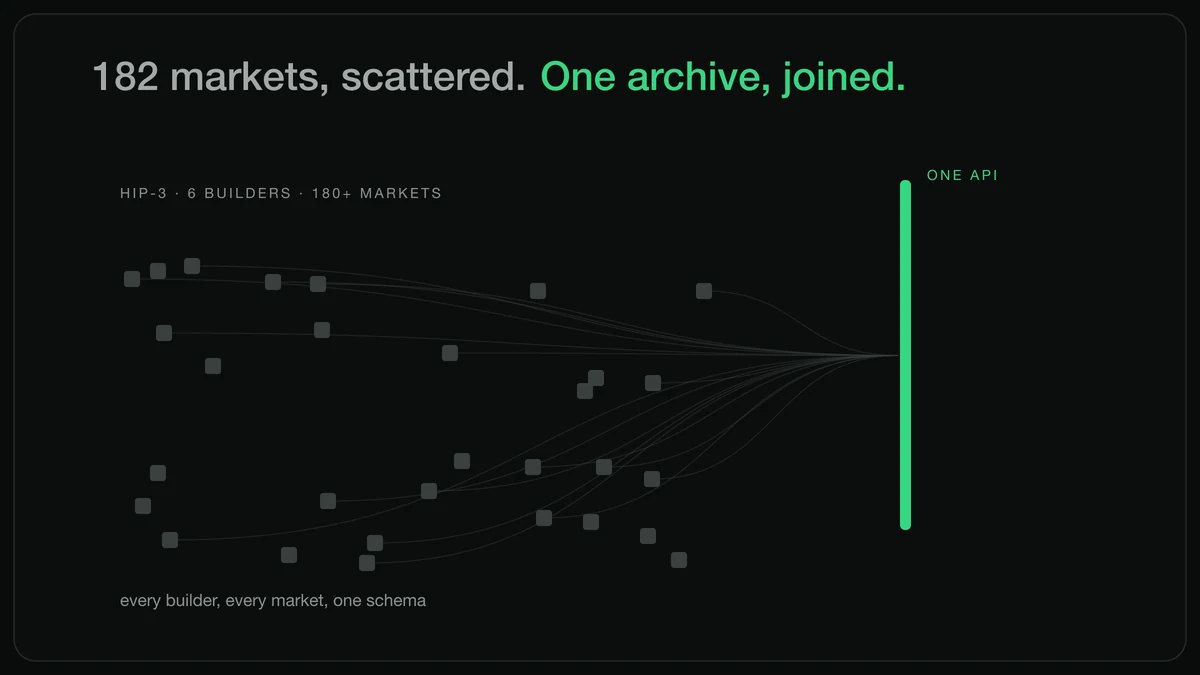
HIP-3 lets builders deploy their own perps on Hyperliquid. The result is wide and fragmented: 182 markets live today across eight namespaces, six established builders plus a growing long tail, each running its own roster and its own liquidity, each its own book and its own order flow.
| Builder | Namespace | Live markets |
|---|---|---|
| xyz | xyz | 87 |
| HyENA | hyna | 23 |
| Kinetiq | km | 22 |
| Felix | flx | 15 |
| Ventuals | vntl | 15 |
| dreamcash | cash | 15 |
| emerging | para | 4 |
| emerging | mkts | 1 |
| Total | 182 |
Six established builders account for 177 of 182 markets; para (4) and mkts (1) are an emerging namespace tail. Live snapshot, 2026-06-30; read /v1/hyperliquid/hip3/instruments for the current roster.
That fragmentation is why HIP-3 history is hard to assemble by hand. One builder's market is live for a week, another for months, each with its own coverage window. Read the live roster and per-market count at /v1/hyperliquid/hip3/instruments.
How far it goes
HIP-3 history runs back by data type, not as one cliff: trades from 2025-10-13, the order book and funding and open interest from 2026-02-16, and the L4 order-level book from 2026-03-10.
| Data type | HIP-3 history from |
|---|---|
Trades (with is_liquidation flags) | 2025-10-13 |
| Order book (native L2), funding, open interest | 2026-02-16 |
| L4 order-level book | 2026-03-10 |
Liquidations arrive as a fill row with is_liquidation: true, inside the trade record; candles derive from those trades. If you have read "Hyperliquid since 2023," that is core perps native L2 and trades, not HIP-3. HIP-3 is a newer family with its own start. Quote the start for the datatype you query, and confirm per-market windows at /v1/data-quality/coverage.
What the record reveals
The order record answers questions at the wallet and order level:
- Participation. Arrakis classified all 175,703 wallets from 21 days of attributed fills. Segment them by builder, by market, or by size.
- Concentration. A young builder market often runs on a handful of wallets. The L4 record shows exactly which, and how the rest of the book reacts when they pull.
- Liquidation cascades. Tie each
is_liquidationfill to the order book state that triggered it. Reconstruct the cascade, not just the wick. - Order flow. Aggregate adds and cancels to see how a market fills, where TP and SL cluster, and how maker and taker behavior splits builder by builder.
175,703 wallets. 21 days. $161.4B in volume. One order-by-order record, and 0xArchive credited for the data.
OHLCV keeps none of this. It survives only if someone keeps every order.
What you build
- Reproducible backtests. Replay the exact market window with original timing, so the same test run twice returns the same result. No re-derivation, no drift.
- Microstructure research. Queue position, fill realism, maker and taker dynamics across every HIP-3 market from one schema.
- Liquidation and risk studies. Every liquidation against the book that caused it.
This is the work teams approximate today by stitching node dumps and exchange snapshots: fragile, slow to reproduce, and silent on the order itself. One archive replaces the stitching.
How to query it
Every plan, including Free, reaches all HIP-3 markets at full depth and full history. Free runs a 90-day query window. Paid plans raise limits, not access.
| Surface | Path | What you get |
|---|---|---|
| REST | /v1/hyperliquid/hip3/... | order book (native L2 and full-depth L2), L4, trades, candles, funding, open interest, plus order-flow, order-history, and tpsl for the lifecycle |
| WebSocket replay | same connection as live | stream HIP-3 history back with original timing, at configurable speed |
| Parquet export | /data | HIP-3 history at dataset scale for offline work, from $1/GB |
Create a key at 0xarchive.io/signup, or browse coverage at 0xarchive.io/data.