
TreadFi routed $1.19B through 555 wallets, about $2.1M a wallet: a small number of large, coordinated accounts. Phantom routed $867M through 6,569 wallets, about $132K a wallet: the widest retail reach in Arrakis's HIP-3 study. Same rail, opposite crowd. The only way to tell them apart after the fact is order-level history with a wallet on every line, not a volume chart.
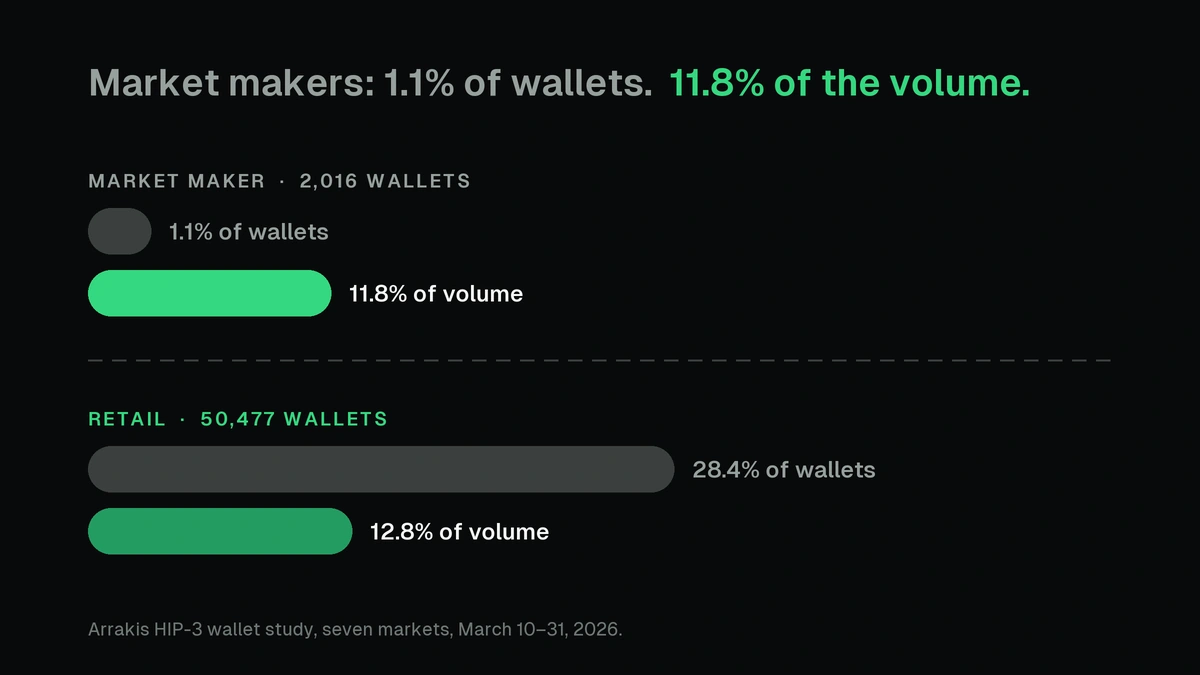
That distinction runs through the whole study. Market makers are 1.1% of wallets and 11.8% of the volume. Retail showed up as wallet breadth, not volume concentration: 28.4% of wallets, 12.8% of volume. Neither number comes from counting fills. Both come from tying every order to a wallet across three weeks and seven markets.
A pattern that only shows up over time
The sharpest finding in the study came from watching a market do nothing. Stat arb bots largely disappeared on weekends. Their edge depended on cross-venue price dislocations against CME, and once CME closed, there was nothing left to arb against. A live snapshot can't show a strategy vanishing; it just shows whatever's trading right now. A three-week order-level record shows the absence, because the bots are still in the schema, just missing from the fills on Saturday.
What Arrakis built this on, and what we supplied
Arrakis published the study April 8, 2026, and credited 0xArchive and HyperTracker (by CoinMarketMan) for the data behind it. The window: seven builder markets, March 10 to 31, 2026, 808 million order lifecycle events. xyz_SILVER alone did $78.6B, more than the other three silver deployers combined. 209 wallets traded all four silver markets, a cohort that only exists in the data if the classification looks across markets on purpose.
Arrakis owns the labels and the interpretation. What came from 0xArchive is narrower and specific: every fill and every order, wallet-attributed, for the full three weeks, before the paper was written. The benchmark tests whether that record holds up on a rerun.
/wallets/classify precomputes the same behavioral fields a taxonomy like this depends on: cancel rate, maker ratio, order-to-trade ratio, one row per wallet per day. Pull it twice for the same date and the wallet metrics match exactly; only the request_id in the response changes. The benchmark covers the full method.
Pull the same shape of record
# fills for xyz:TSLA, 2026-06-30 to 07-01 UTC, wallet on every row
curl "https://api.0xarchive.io/v1/hyperliquid/hip3/trades/xyz:TSLA?start=1782777600000&end=1782864000000" \
  -H "X-API-Key: $OXARCHIVE_API_KEY"
Every row carries user_address. Pair it with /orders/{symbol}/history for order-level state (placed, open, canceled) on the same wallet. Full history is on every plan, including Free; a query's time span is capped at 90 days, and the Arrakis window is 21 days, well inside that limit. Pulling this fill-level slice needs nothing beyond a free key and cursor pagination through the trades route; the order-state and wallet-classification steps above are the rest of the reconstruction.
What the native API leaves out
None of this comes from Hyperliquid's own API at market scale. Its own docs cap userFillsByTime at the 10,000 most recent fills and historicalOrders at 2,000 most recent per user: enough for a live check on one wallet, not enough for a market-wide study. There's a raw S3 archive too, but it's L2 book snapshots only, updated roughly once a month with no guarantee of completeness, no order-level detail, and no wallet attribution at all. A study like this means reconstructing three weeks of market state by hand before the wallet work even starts. The comparison walks through where that gap actually costs a team time.
Pull the same slice of history yourself: create a free account, or go deeper with the HIP-3 REST reference.