
0xArchive Research · The Midnight Reset
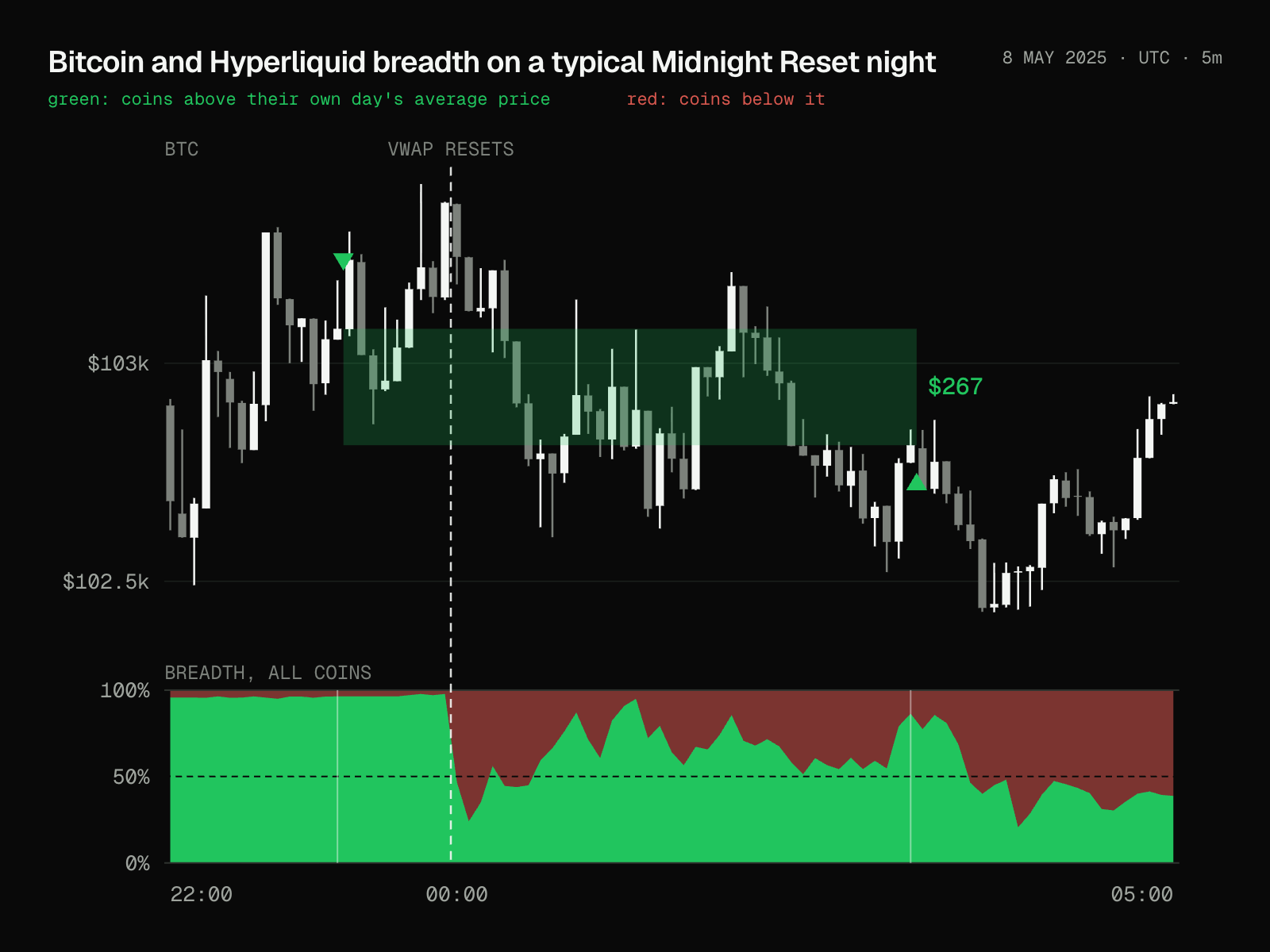
Some nights the whole Hyperliquid board is green going into midnight UTC, with 85% or more of the coins trading above their own average price for the day. Then midnight hits, every average resets, and the scoring starts over.
On those nights, shorting bitcoin at 23:15 UTC and holding through the reset won 62% of the time since March 2025. The signal is market breadth, the count of coins winning against their day's average, and 0xArchive publishes it every minute.
Short bitcoin at 23:15 UTC when 85% of coins are winning
One trade a night, at most. At 23:15 UTC, check the count. If it has averaged 85% or more over the last four hours, short bitcoin. Close at 03:15 UTC, four hours later, after the reset.
| Result | Value |
|---|---|
| Typical night | +$15.90 per $10,000 |
| Winning nights | 50 of 81 (62%) |
| Total made | +$721 per $10,000 |
| Deepest drawdown | -$294 per $10,000 |
| Nights it fires | 15% of nights |
After $10 of round trip cost per $10,000: Hyperliquid's base taker fee of 0.045% on the way in and again on the way out, plus 0.01% of slippage. 178 coins across 538 sessions, 2025-03-22 to 2026-09-10. Median 15.9 basis points, t 1.48.
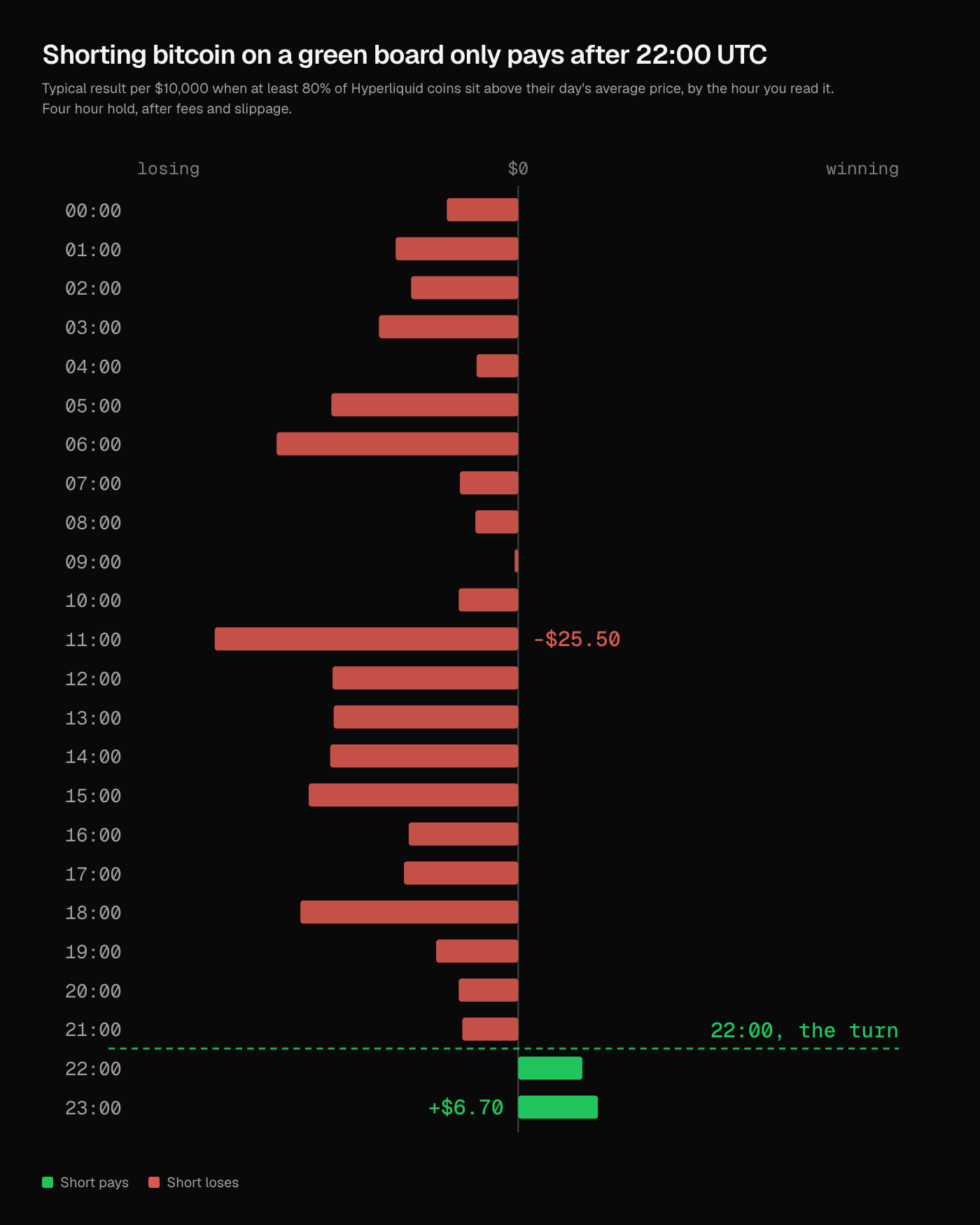
The edge only exists after 22:00 UTC
Run the same idea at every hour of the day: short bitcoin whenever at least 80% of the board is green, and hold four hours. Before 22:00 UTC it loses, every hour. From 22:00 on it makes money, right up to the reset.
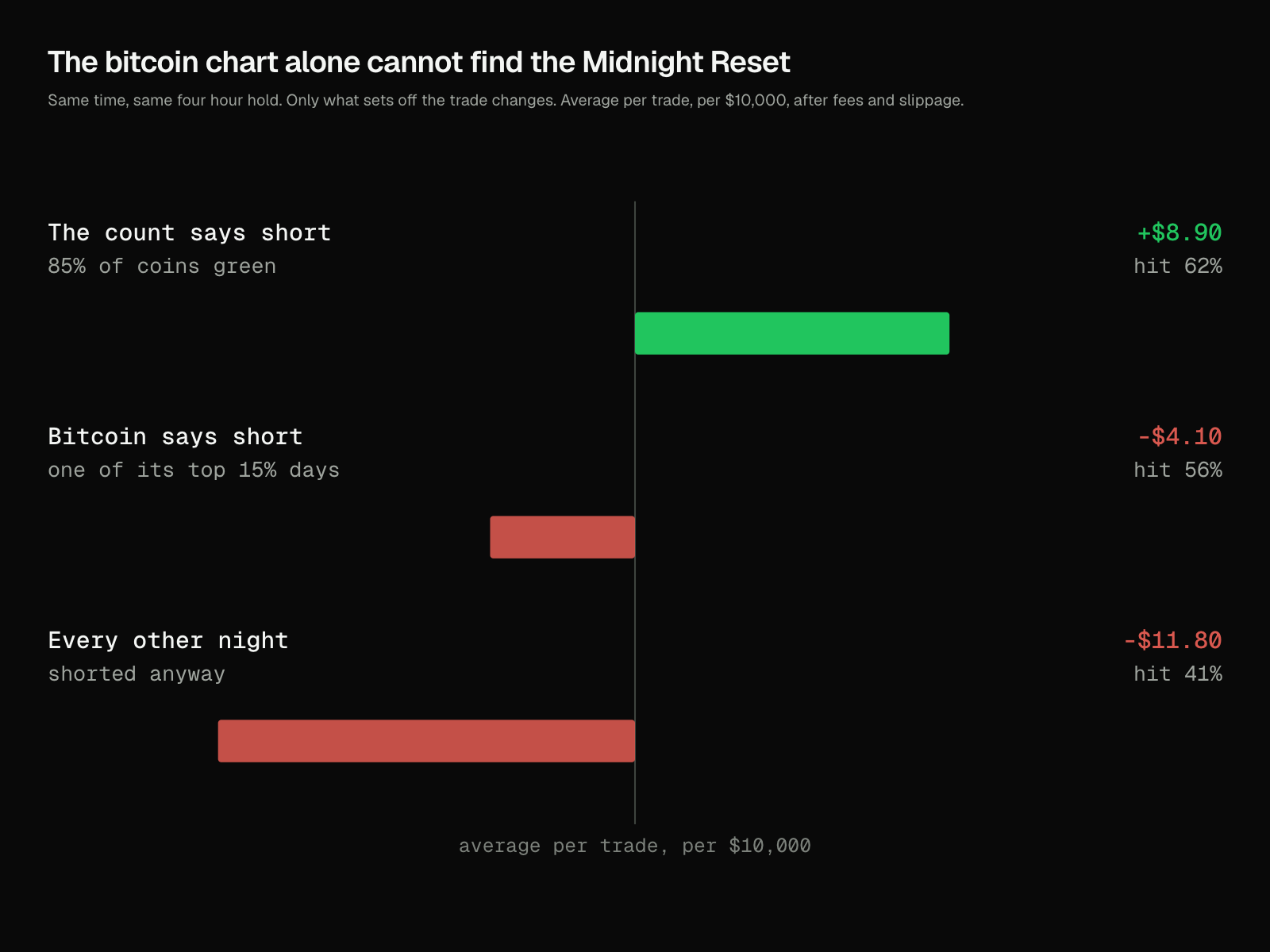
The bitcoin chart alone cannot find this setup
Swap the count for bitcoin's own chart: same time, same hold, but the short only goes on after one of bitcoin's best days.
That loses $4.10 per $10,000 a trade. Shorting 23:15 on every other night loses too.
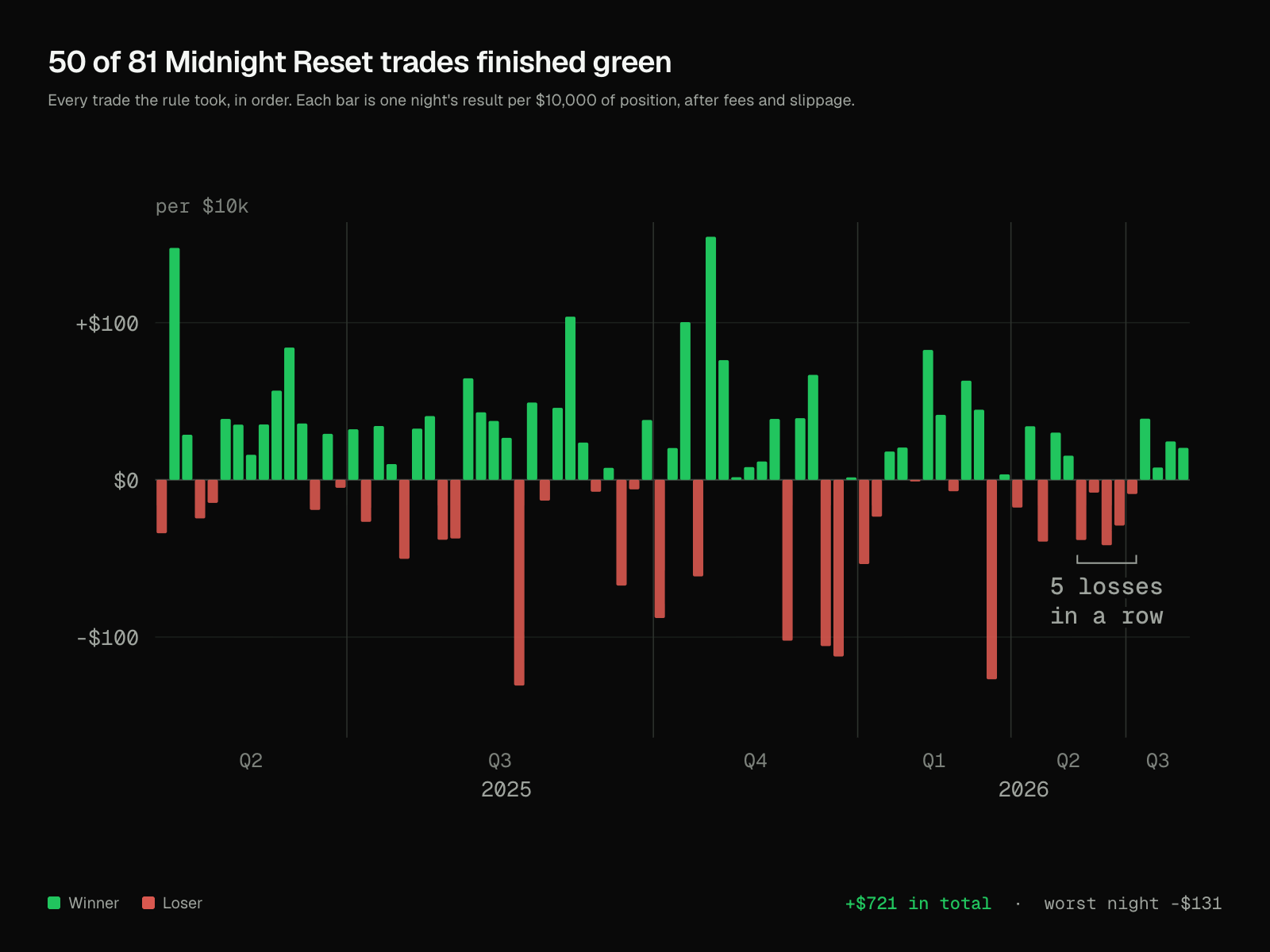
81 trades, 62% winners, one losing quarter
Every trade the rule took, in order. Flat $10,000 each time, no leverage, nothing compounded. Fifty won.
The red patch from May to July 2026 is five losses in a row. The worst night lost $131, more than eight typical nights make.
| Quarter (trades) | Hit rate | Total per $10,000 |
|---|---|---|
| 2025 Q2 (15) | 67% | +$410 |
| 2025 Q3 (24) | 63% | +$212 |
| 2025 Q4 (16) | 69% | +$49 |
| 2026 Q1 (12) | 58% | +$62 |
| 2026 Q2 (9) | 33% | -$95 |
| 2026 Q3 to 10 Sep (5) | 80% | +$82 |
Four hours is the best hold, and costs eat over half the average trade
Every hold from one hour to twelve got tested, and four hours came out on top. Ask for more of the board to be green and each trade gets better, but you get fewer of them.
| Hold | Typical per $10,000 | Hit rate |
|---|---|---|
| 1 hour | -$3.30 | 43% |
| 2 hours | +$0.40 | 52% |
| 3 hours | +$4.10 | 54% |
| 4 hours | +$15.90 | 62% |
| 6 hours | +$11.10 | 57% |
| 8 hours | +$1.40 | 51% |
| 12 hours | +$7.30 | 53% |
Hyperliquid's base taker fee is 0.045%, and you pay it going in and again coming out. That is $9 per $10,000 before slippage. Every other number here assumes $10.
| Round trip cost per $10,000 | Typical night | Average night |
|---|---|---|
| $0, before costs | +$25.90 | +$18.90 |
| $5, discounted fees | +$20.90 | +$13.90 |
| $10, base taker fees | +$15.90 | +$8.90 |
| $15 | +$10.90 | +$3.90 |
Halve the cost to $5 and the average night rises to $13.90. At $15 it drops to $3.90.
The long side and the alt version both lost money
Three more ideas got tested. None of them paid.
1. Buying when the board is red. Same time, flipped around. It makes nothing after costs, so this only works as a short.
2. Shorting the alts instead. The count is mostly alts, so shorting all of them looks like the natural trade. It is weaker than just shorting bitcoin. Shorting alts with a bitcoin long against them made nothing.
3. Trading bitcoin against the board. Nights when bitcoin goes one way and the rest of the board goes the other. Every version was too weak to trade.
The sample is small and the last six months are flat
81 trades do not prove it. The rule fires on 15% of nights, and it came out of a search across every hour of the day with several holds and triggers. After fees, its average is not statistically proven.
The last six months are flat. Fourteen trades since March 2026, half of them winners. Together they lost $12 per $10,000. Every quarter before that made money.
The count is junk right after midnight. The day's average has barely any trading behind it yet, so coins flip between winning and losing on noise. It settles once the day has traded.
Run this analysis from an agent
The count is one market wide number covering every eligible Hyperliquid coin, published every minute with the tallies behind it so you can audit what was in the universe. Start with the current breadth reading for the live snapshot and the breadth history to replay it. The backtest behind this page rebuilds the count from OHLCV candles. Agents connect through the hosted MCP server, which uses client managed OAuth and needs no API key. For direct REST work, use the quickstart and take a free key at signup. Bulk history ships as Parquet from the data catalog.
Route references
Use the breadth history reference for the minute cadence series and its tallies, the current breadth reference for the live snapshot, the candles reference for the OHLCV history every number here derives from, and the instruments reference for the tradeable universe.
For current API availability and plan details, use the Hyperliquid data API, data catalog, pricing, and status.
Research output, not investment advice. Session VWAP is cumulative quote volume over base volume since 00:00 UTC. Breadth before 2026-08-24 is rebuilt from settled candles and tracks the published series at correlation 0.92. Past behaviour of a market does not oblige it to repeat.