
Originally published by Blockworks Research and written by Shaunda Devens. Republished with permission. The report cites 0xArchive among its data sources. Read the original article.
Key Takeaways
The crypto perpetual is an efficient construction for synthetic delta-one exposure on any asset with a reliable reference price. TradeXYZ, deploying through HIP-3's market deployment model on Hyperliquid's settlement layer, has brought the instrument to traditional underlyings, opening 24/7 access to markets historically closed through crucial weekend hours. Within months of launch it has listed more than one hundred markets across equities, commodities, FX, and pre-IPO names, with combined daily volume averaging $3.7 billion over the trailing month, 52% of all Hyperliquid perpetual volume. Each market operates under two pricing regimes, an external session anchored to the underlying's official prices while it trades, and an internal session forming its own while it is closed.
Using Hyperliquid data through July 2026, we find these RWA markets in their external sessions indistinguishable from liquid crypto perpetuals, anchoring at a median market-day basis of 4.31 bps against 5.08 for native crypto, quoting 1.67 against 1.88 bps at the median spread, and filling 0.95 bps from the prior midpoint against 1.38. The weekend sessions, quoting at main-hours tightness (1.43 bps at the median) and filling typical orders at main-hours cost (1.58 against 1.89 bps to the prior mark), prove the internal pricing mechanism performant enough for genuine price discovery, providing both a public reference and a vehicle for hedging weekend exposure.
And empirically, these weekend prices were consistently strong indicators of the eventual open, with direction correct in 94.9% of events where the weekend move exceeded 100 bps, median reopening error cut by 53% across 614 market-weekends, and implied moves carrying into realized moves at a ratio of roughly 0.83 to one, evidence that real economic activity and information flow through Hyperliquid in the hours when traditional venues are closed.
Perpetual Futures
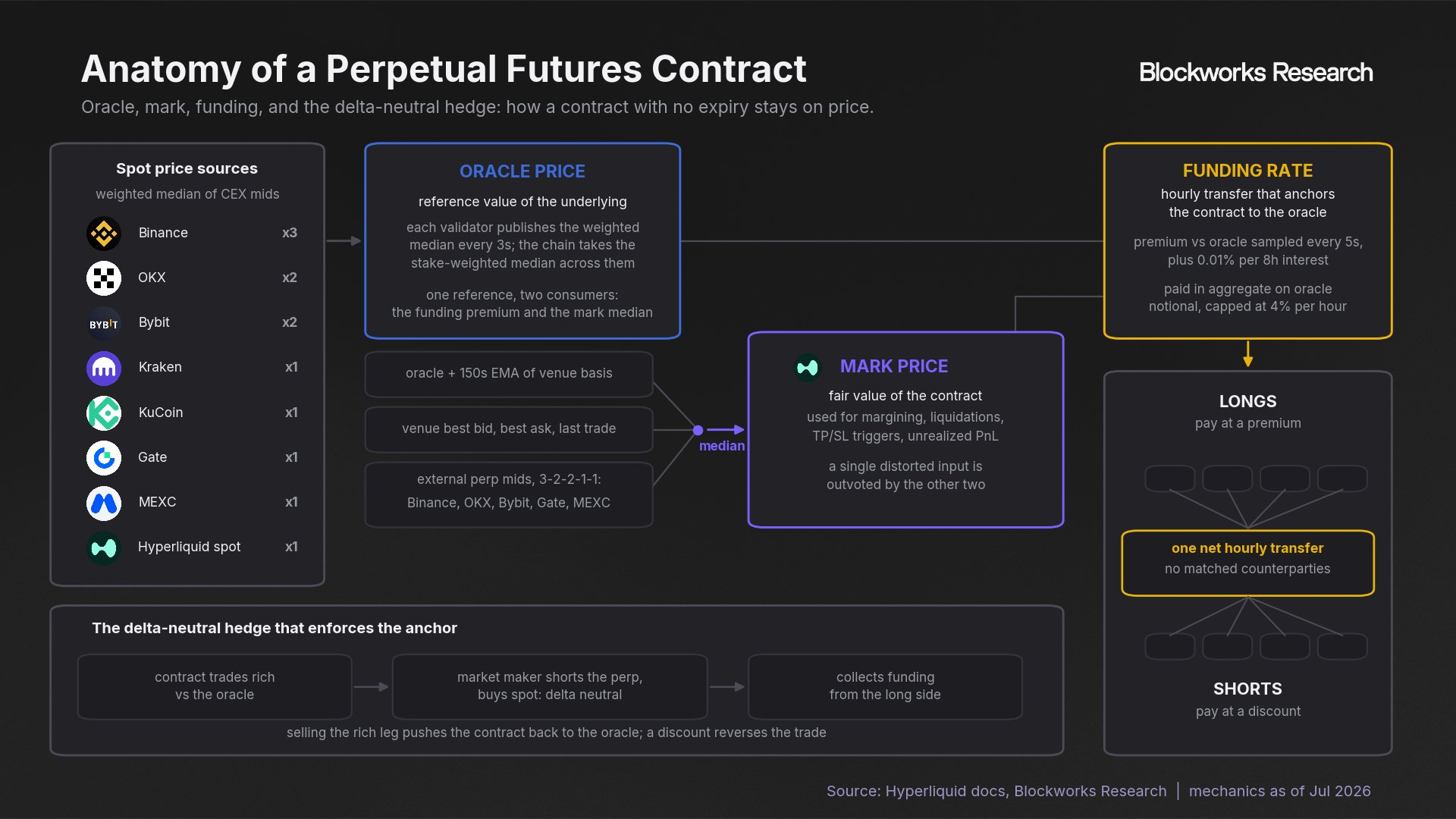
A perpetual futures contract is a derivative providing continuous, margined exposure to the price of an underlying asset. It carries no expiration or delivery; instead, the contract anchors to a reference price through a funding mechanism, periodic payments exchanged between long and short positions according to its premium or discount. At a premium, funding is debited hourly from the margin of long positions and credited pro rata to shorts; at a discount, the flow reverses.
Because that premium or discount (the contract's basis) can be captured through a delta-neutral position in the contract and spot, any deviation creates an arbitrage incentive that draws the two prices back together, making the perpetual an efficient vehicle for synthetic exposure without delivery or contract rolls.
- Oracle price. The reference value of the underlying asset that the contract seeks to replicate. For Hyperliquid's crypto perpetuals, each validator publishes a weighted median of the leading spot venues' prices, and the chain adopts the stake-weighted median across them.
- Mark price. A robust estimate of the contract's fair value, used to margin and liquidate positions and evaluate order triggers. Hyperliquid takes the median of three estimates: oracle-linked, local order-book, and external perpetual mids, limiting the influence of any single price source.
- Funding rate. The anchoring mechanism that incentivizes the traded price to remain close to the oracle: payments exchanged in aggregate between position holders, calculated from the contract's premium together with a fixed interest component.
The design makes perpetuals unusually flexible. A venue can list a market without custody, delivery, or wallet support for the underlying, provided it can supply a reliable oracle and risk controls, since funding delegates price alignment to arbitrage. Traders gain continuous delta-one exposure in a single contract, avoiding fragmentation across expiries and strikes while using collateral more efficiently. Accordingly, perpetuals account for approximately 93% of crypto derivatives trading (Ruan and Streltsov, 2025), with the ten largest centralized perpetual exchanges turning over $86.2 trillion in notional volume in 2025 and the ten largest decentralized venues adding another $6.7 trillion (CoinGecko, 2026).
Real-World-Asset Perpetual Futures
The perpetual's success has so far been confined to crypto underlyings, while traditional access to delta-one exposure remains uneven across asset classes.
For single-name equities, the US currently lacks a broadly available listed instrument: delta-one exposure is restricted to over-the-counter swaps, reserved by statute for "eligible contract participants," a status that, for individuals, requires more than $10 million in discretionary investments (CEA Section 1a(18)). Volume concentrates instead in short-dated options, with same-day expiries carrying 59% of SPX options volume in 2025, roughly half of it retail (Cboe). And while commodities carry standardized, accessible futures, even these do not trade around the clock: outside listed hours, no instrument in the stack is available at all.
Crucial periods of benchmark price discovery therefore go untraded. During the Strait of Hormuz closures, crude reopened 11.5% and 17.0% higher on consecutive weekends, and this year the mean absolute weekend gap across major commodities is 1.8% against a 1.1% median, with WTI's 90th-percentile gap reaching 6%. The same concentration holds in equities, where 90% of earnings releases land outside regular hours and most post-announcement discovery completes within minutes (Pan, Sul, and Wang, 2026; Christensen, Timmermann, and Veliyev, 2025). Institutions can source weekend cover through bespoke swaps, negotiated dealer by dealer behind the same statutory gate; everyone else is locked out of the hours where price discovery concentrates.
Extending perpetual futures to traditional assets addresses both constraints. First, and most broadly, it opens standardized delta-one exposure to any asset and any collateralized participant, including exposures currently reserved for ultra-high-net-worth individuals. Second, because the contract trades continuously, participants can hedge and manage risk through the closures where price discovery concentrates.
The Architectural Design of RWA Perpetuals
Delivering on both, in practice, divides into two roles: an exchange layer, responsible for matching, margining, and settlement, and a contract specification layer, responsible for parameterizing the instrument itself, from its oracle and mark to its leverage and price bounds.
Hyperliquid: Open Exchange Infrastructure
The first requirement is an exchange layer capable of 24/7 operation. While traditional derivatives exchanges (i.e., “designated contract markets” or “DCMs”) and clearinghouses (i.e., “derivatives clearing organizations” or “DCOs”) could in theory support around-the-clock trading, clearing, and settlement, they are bottlenecked by post-trade infrastructure: variation margin moves through settlement banks on the banking calendar, weekend collateral calls would raise liquidity demands weekday banking processes are not built to meet, and continuous operation requires surveillance and system resilience without maintenance windows (CFTC Letter 26-16, 2026).
Hyperliquid solves these constraints by unifying execution and post-trade within a single protocol. HyperCore, the chain's state machine, provides matching, margining, and collateral control infrastructure as protocol logic, ordered by HyperBFT, a consensus algorithm run by a stake-weighted validator set. Three properties make the architecture suitable for 24/7 perpetual trading:
- Instant settlement. Execution and settlement are one event: every order, trade, and liquidation finalizes at consensus against prefunded USDC collateral, at 200ms of median end-to-end latency.
- Continuous risk management. Hyperliquid’s margin logic marks positions to settlement prices; HyperCore marks against a validator oracle refreshed every few seconds, accrues funding hourly, and liquidates through a deterministic waterfall that includes automatic order book liquidations, backstop liquidators, and, as a last resort, auto-deleveraging. It has margined continuously since early 2023, “clearing” over $4.7 trillion in volume through June 2026.
- Disintermediated access. Traditional derivatives access runs through layers of intermediaries, under terms negotiated per relationship. Hyperliquid users can access HyperCore on a disintermediated, non-custodial basis, on identical margin and terms.
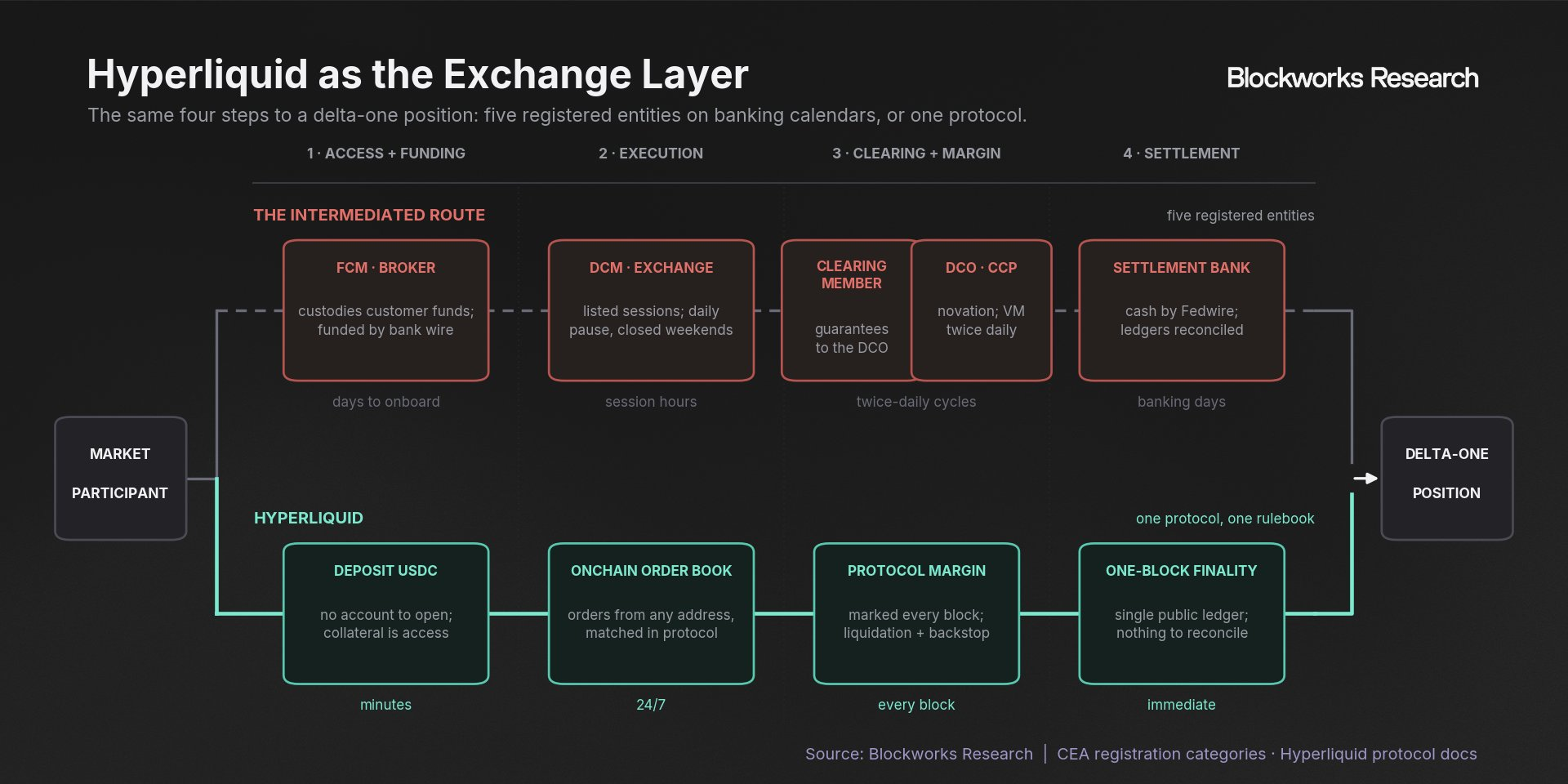
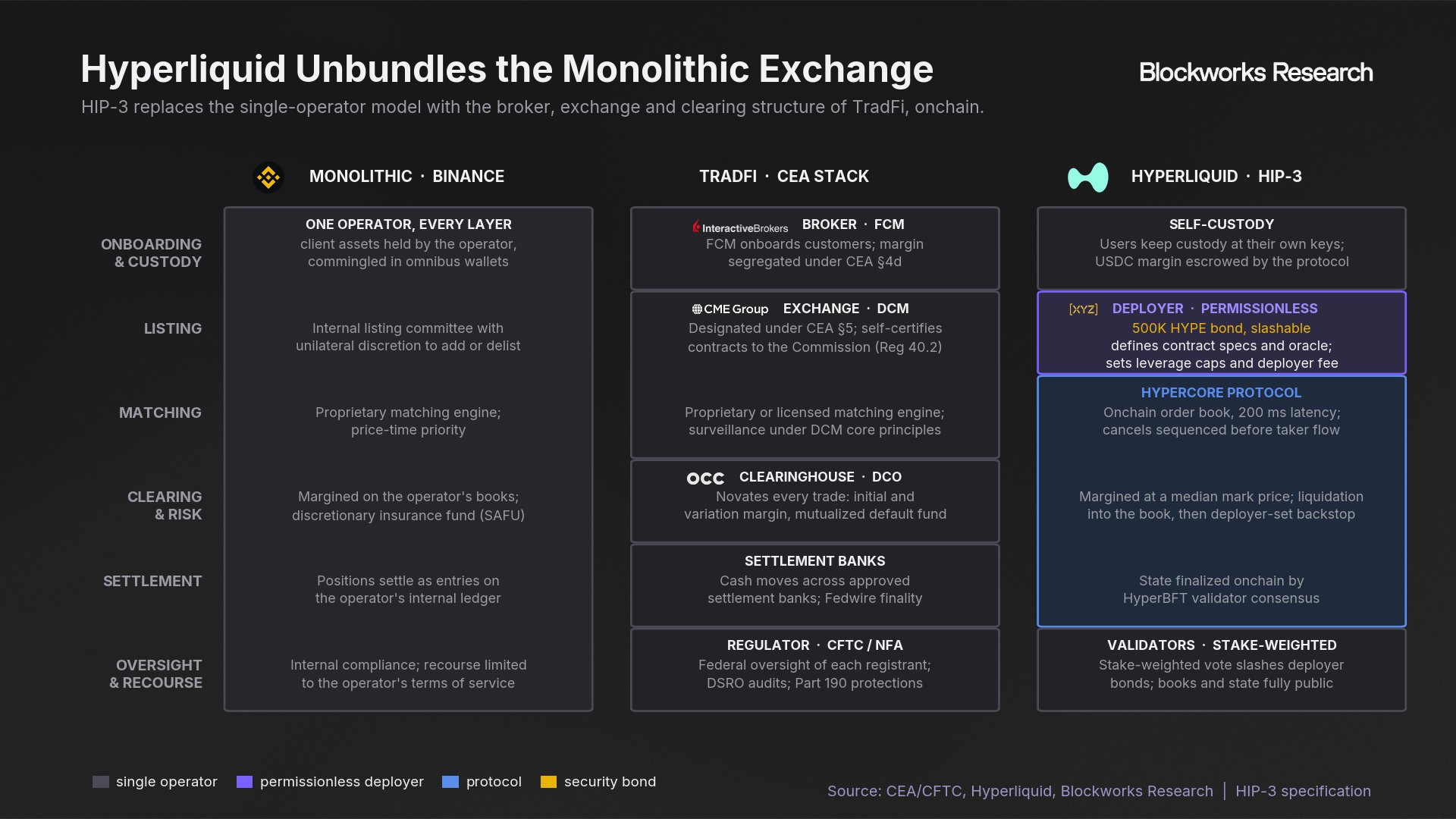
Market deployment inherits Hyperliquid’s trade execution, clearing, and settlement infrastructure, sharing the same set of programmatically enforced rules. Under HIP-3, listing is delegated to third-party deployers, incentivized to provide secure and technically sound markets via a staking-and-slashing mechanism. HIP-3 deployers list markets against a bond of 500K HYPE, slashable by stake-weighted validator vote for faulty operation of their markets. The deployer then bids for listing capacity in recurring Dutch auctions, sets contract specifications and leverage limits, publishes oracles, controls listings and delistings, and may retain up to half of the fees its markets generate.
TradeXYZ: The Deployer Layer
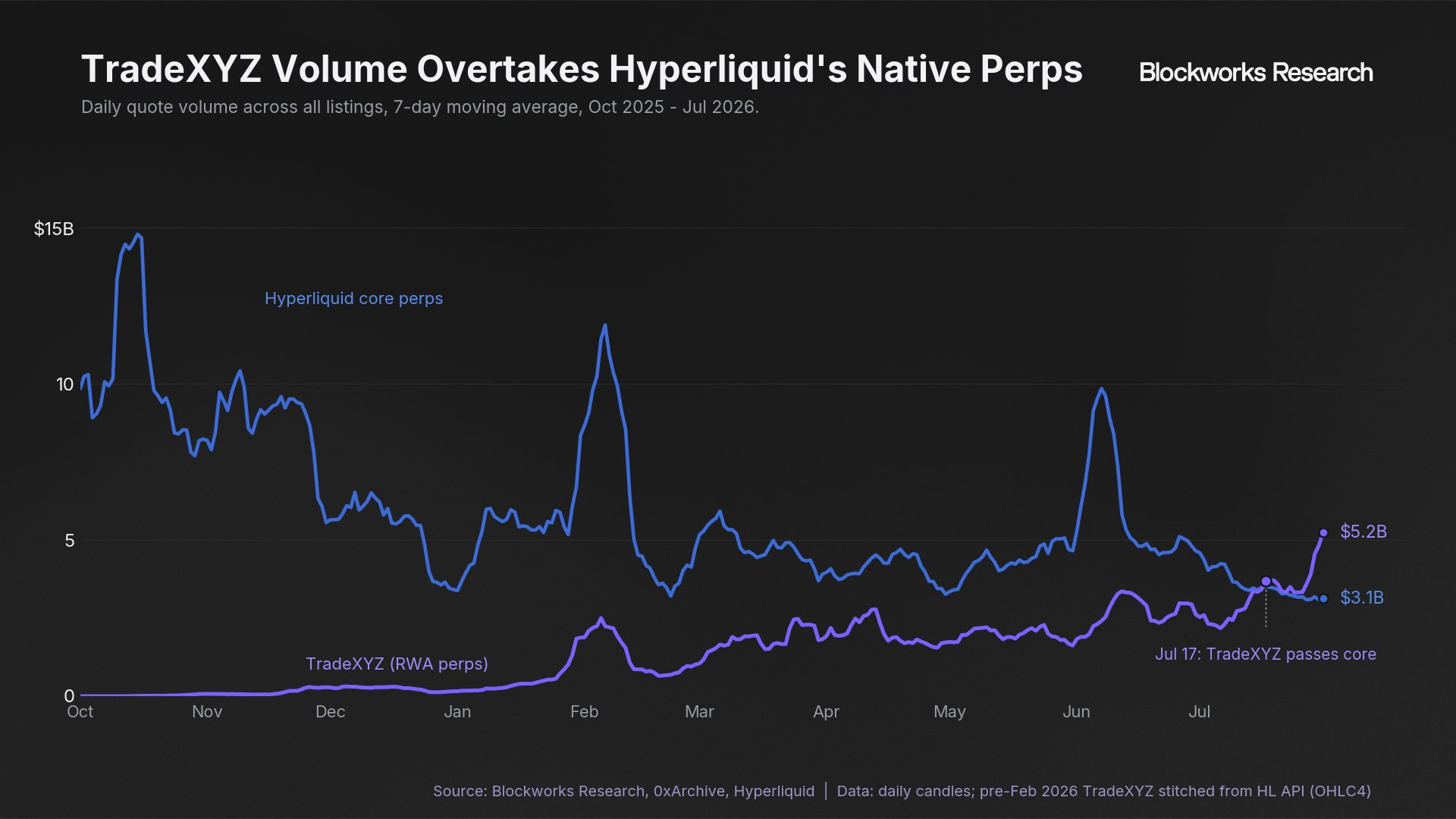
TradeXYZ carries this mechanism to real-world assets. Launched in October 2025, it deploys HIP-3 perpetuals referencing offchain assets, with no tokenization or custody of the underlying. As of August 2026, the universe spans 103 deployed markets, 88 actively traded, across commodities, foreign exchange, US and Asian equities and indices, and pre-IPO products, including Cerebras (CBRS) and SpaceX (SPCX), both listed before their Nasdaq debuts, and ChangXin Memory (CXMT). Thirty-day daily volume averages $3.7 billion, cumulative volume exceeds $440 billion, and open interest stands at $3.5 billion; since July 17, TradeXYZ's seven-day volume has run above Hyperliquid's native crypto perpetuals, making the deployer's markets the largest on the exchange within ten months of launch.
As deployer, TradeXYZ defines the markets it lists, each deployment carrying an auction cost, and establishes risk parameters across that universe. Its most consequential function is adapting the crypto perpetual itself, an adaptation that reworks the three components defined above: i) the oracle, which carries the underlying's price, must remain continuous for assets that do not trade 24/7; ii) the mark, which carries the contract's fair value, must stay robust through temporary dislocations, so liquidations execute only against representative prices; and iii) funding must sustain the arbitrage incentive that anchors the contract while pricing each asset's cost of carry, keeping positions economical to hold.
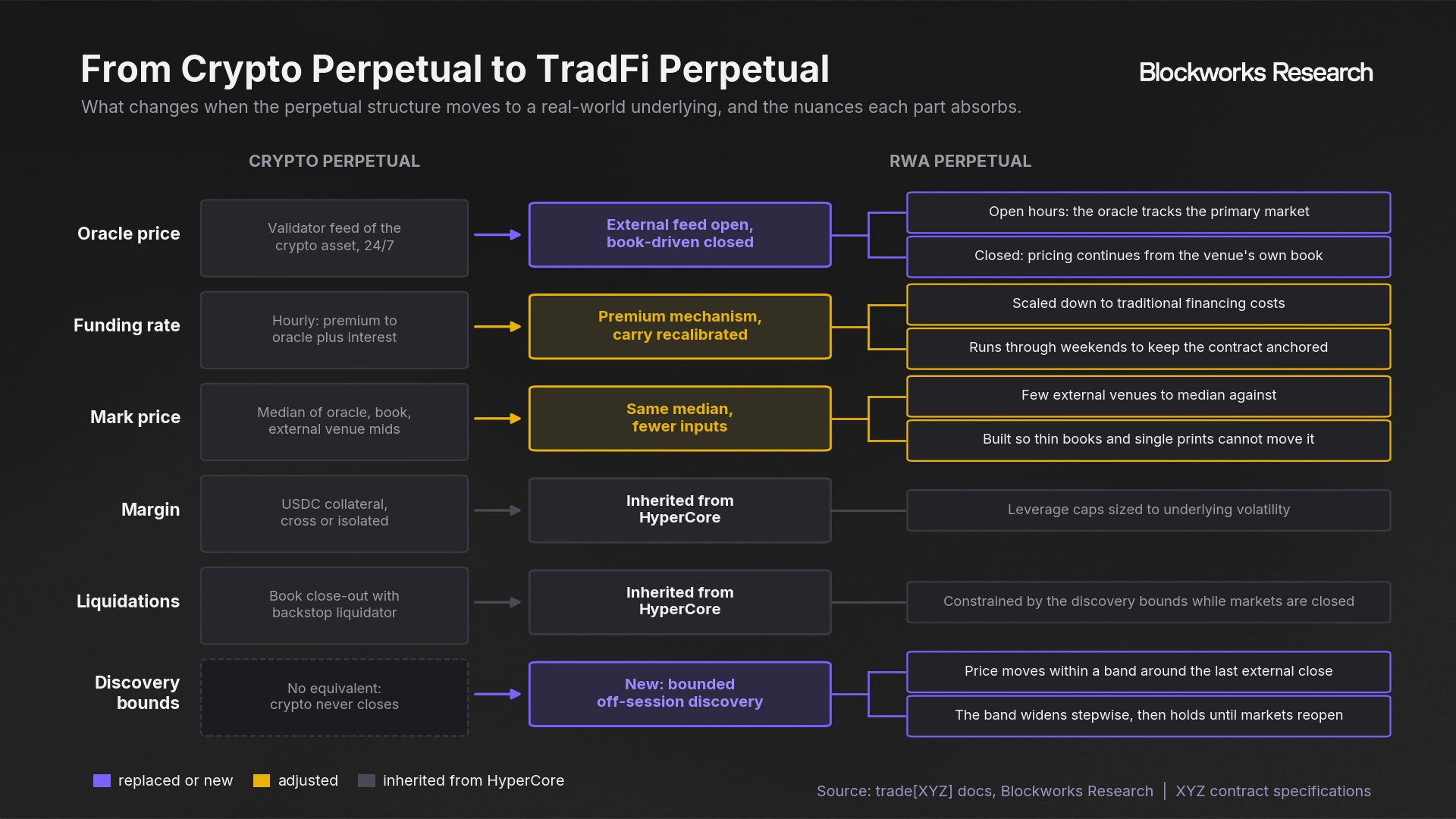
TradeXYZ solves all three by splitting the contract's pricing mechanics into two sessions: external, while the underlying trades, and internal, while it is closed.
RWA Perpetuals: External Sessions
During the external session, when the underlying's venues are open, a TradeXYZ market functions as a crypto perpetual does.
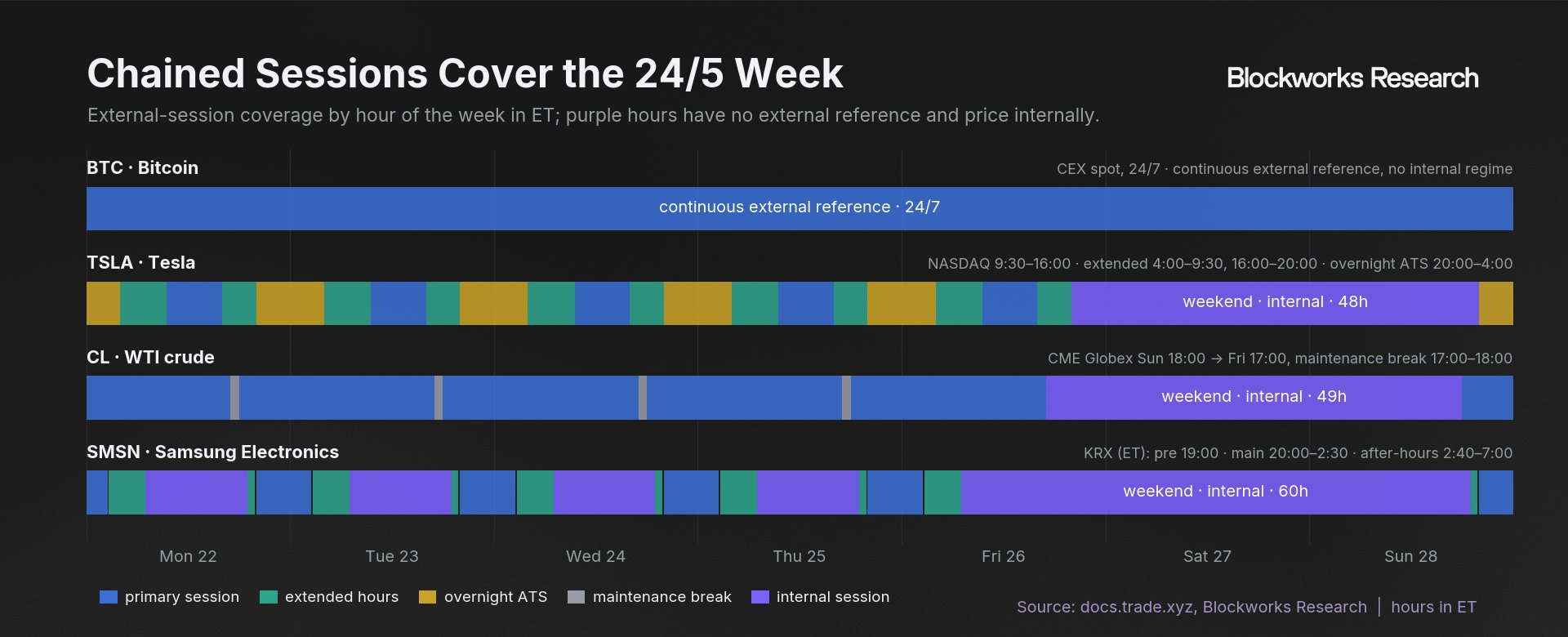
In place of a crypto index, TradeXYZ's relayers publish the underlying's reference price feed, derived from its most liquid venues and chained across sessions for continuity: a US equity reference tracks Nasdaq through the regular day, extended hours after the close, and Blue Ocean (BOATS) overnight; index references combine cash indices with futures stripped of financing and expected dividends; commodity references smooth rolls between expiring contracts; and Korean equities convert through USD/KRW. To align carry with traditional assets, TradeXYZ halves the crypto perpetual's fixed interest component to roughly 5.5% annualized.
Market makers carry one added burden, hedging offchain through a broker, which duplicates collateral and introduces basis and transfer-latency risk. The process is otherwise identical: the contract, tethered to its underlying through funding, should create sufficient incentive to sustain performant, liquid markets.
To test how these markets perform empirically, we benchmark them against Hyperliquid's most liquid native-crypto perpetuals while external markets are open. The RWA perpetuals anchored tightly to the references they synthetically replicate, with a median mark-oracle basis of 4.31 bps against 5.08 for native crypto; 57.8% of minutes fell within 5 bps of the oracle against 49.1%; and even the tails staying close, 12.59 against 13.25 bps at the median market's p99 deviation from the underlying.
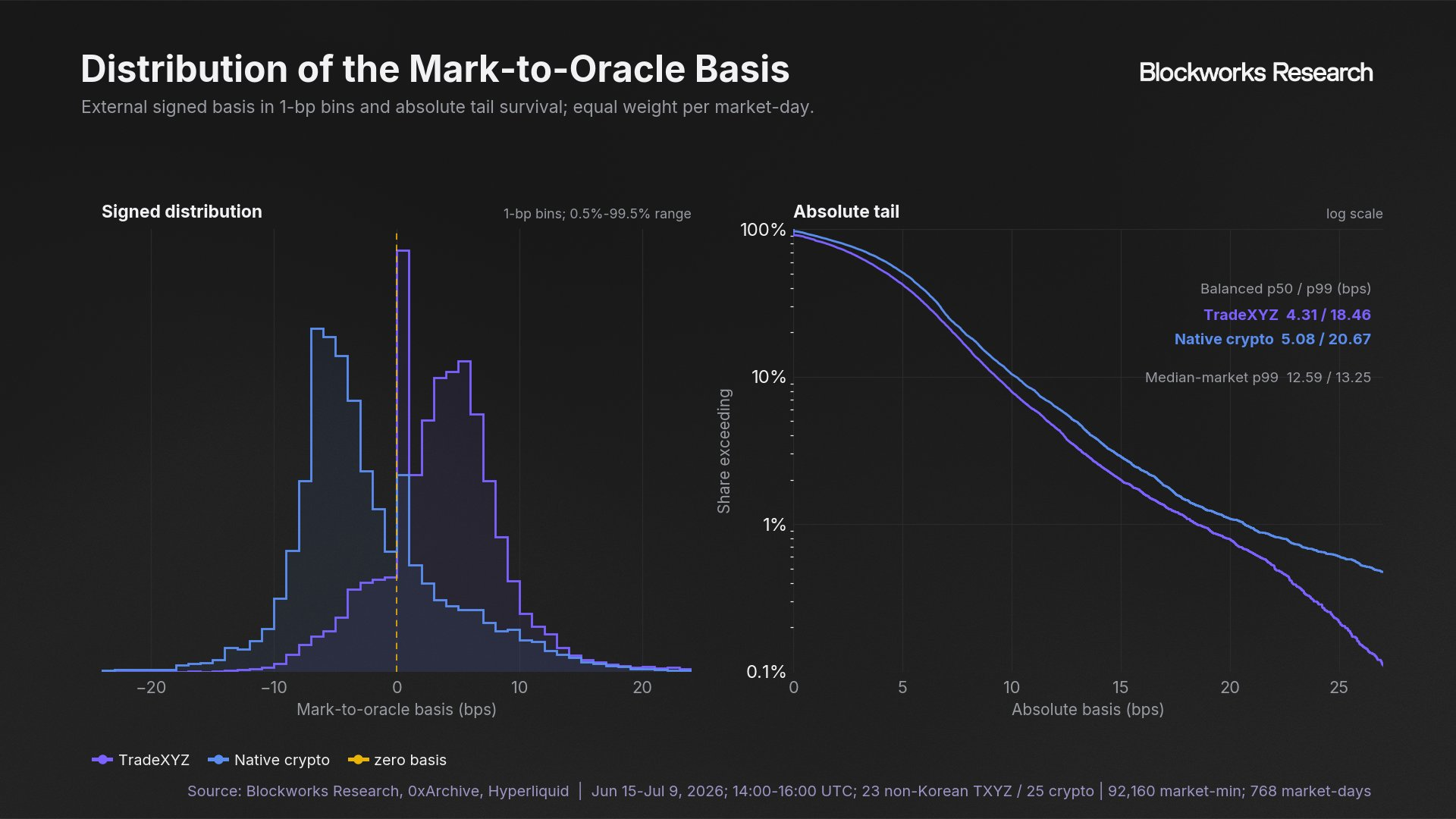
Similarly, despite the added overhead and nascent listings, quoted spreads ran tighter on the RWA markets, 1.67 against 1.88 bps at the median, and, like the basis, the tails stayed contained, 10.71 against 13.11 bps at p99. The tightness was matched in size, with the median RWA market-day displaying $211,000 of two-sided depth within 10 bps against $33,000 for the median crypto market, though BTC and ETH remain the venue's deepest books. As a result, RWA trades execute as liquid crypto does: the signed median fill lands 0.95 bps from the prior midpoint against 1.38, with 21.6% of orders price-improving against 15.8%.
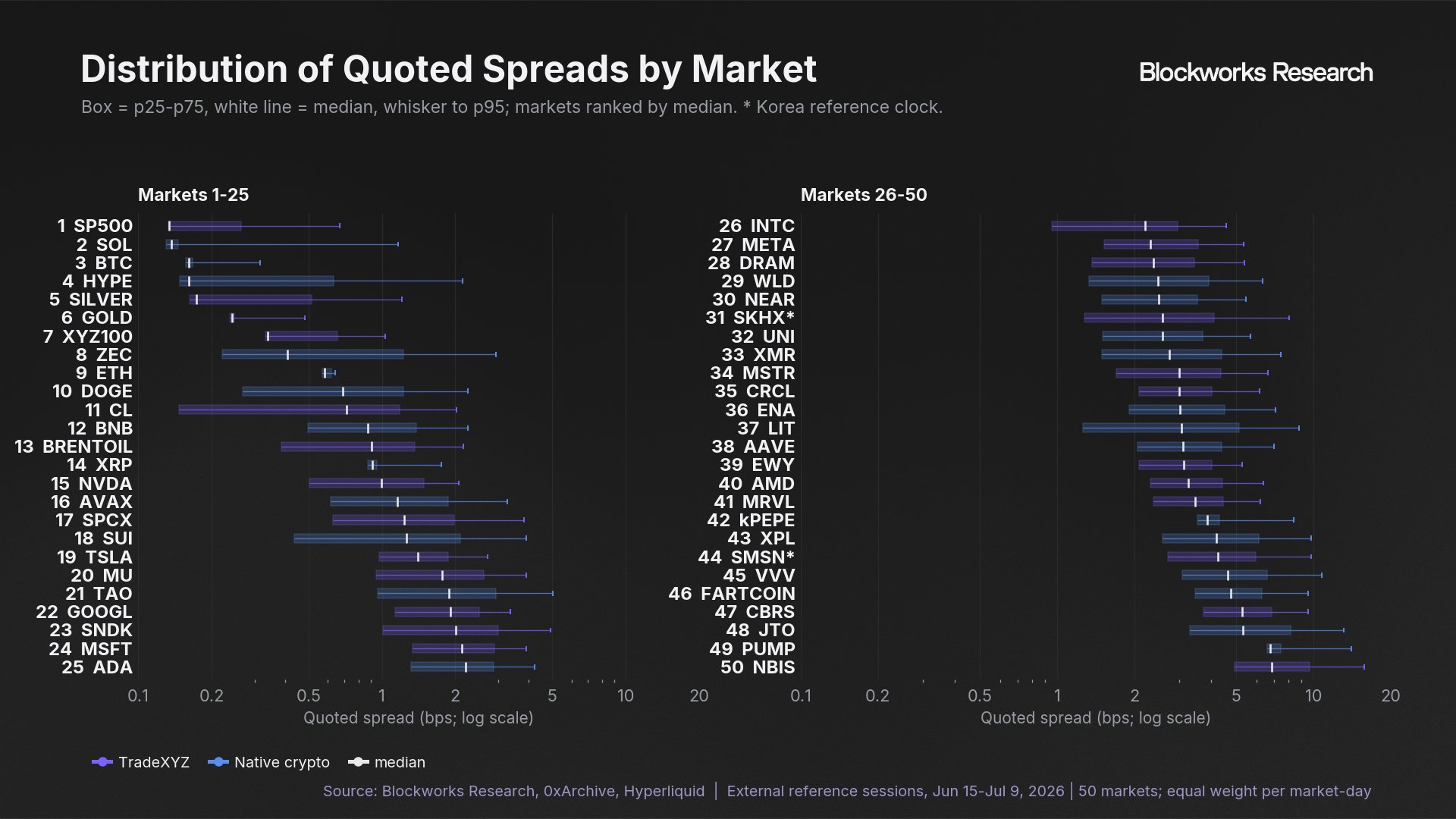
Volume has followed that quality, and TradeXYZ's HIP-3 markets now carry a dominant share of Hyperliquid's perpetual volume, including eighteen of its twenty-five largest markets.
RWA Perpetuals: Internal Sessions
During internal sessions, when no external venue is live, TradeXYZ transitions the contract to an internal reference: the oracle and mark start from Friday's closing print and thereafter track Hyperliquid's own order flow. In open hours, funding computed against a live external price ties the perpetual to its underlying; through the closure, no such price exists, and the anchor becomes a scheduled event as the oracle reverts to external pricing at the reopen.
The contract therefore spends the weekend like a dated future, "settling" at the reopen to the recovered oracle print, as a future does at expiry. And because the market trades continuously, traders price that settlement in advance: WTI closes Friday at $100; the perpetual trades at $104 on Saturday evening; a trader expecting a $102 open shorts the contract and realizes the difference when the oracle resettles.
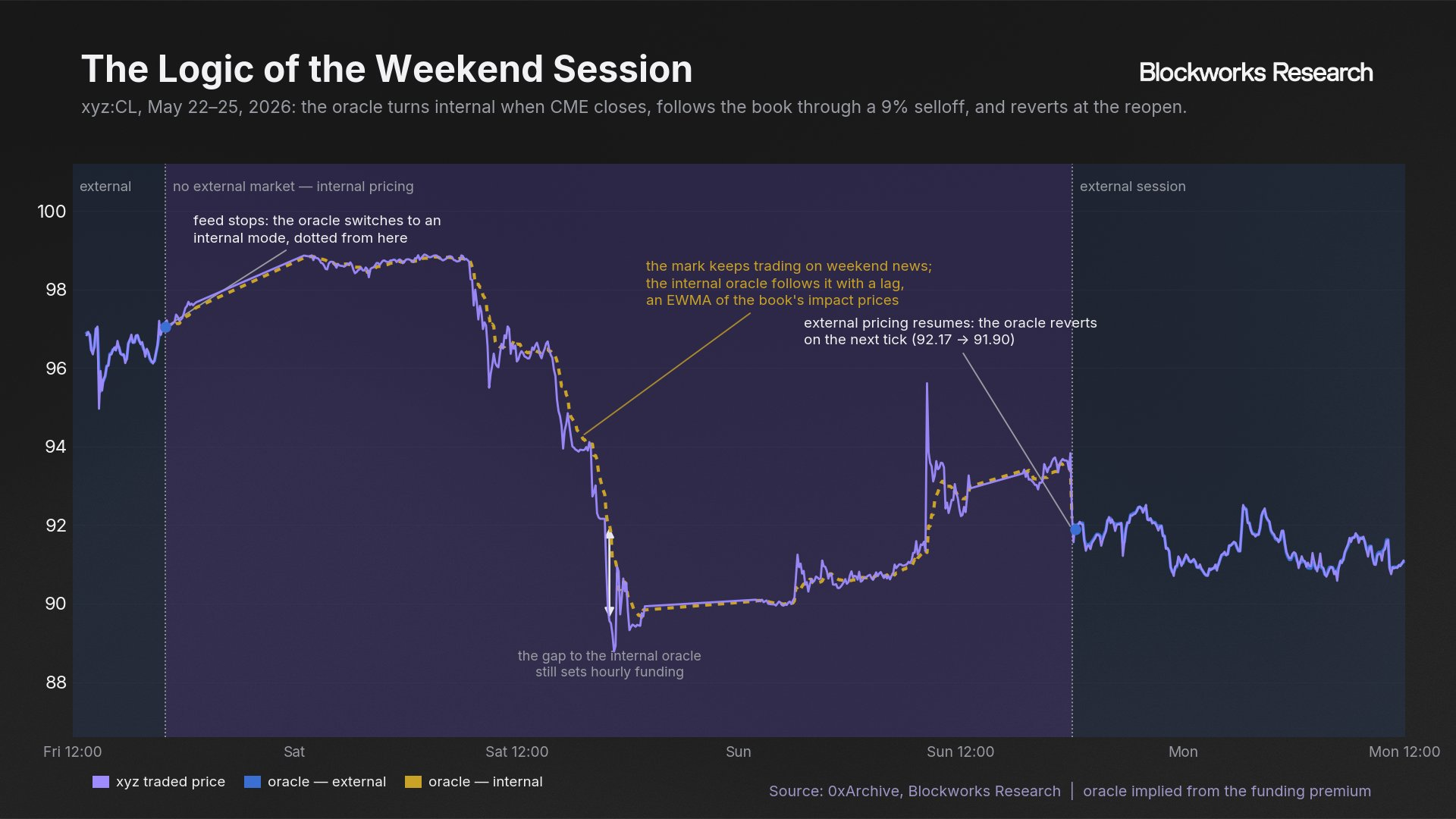
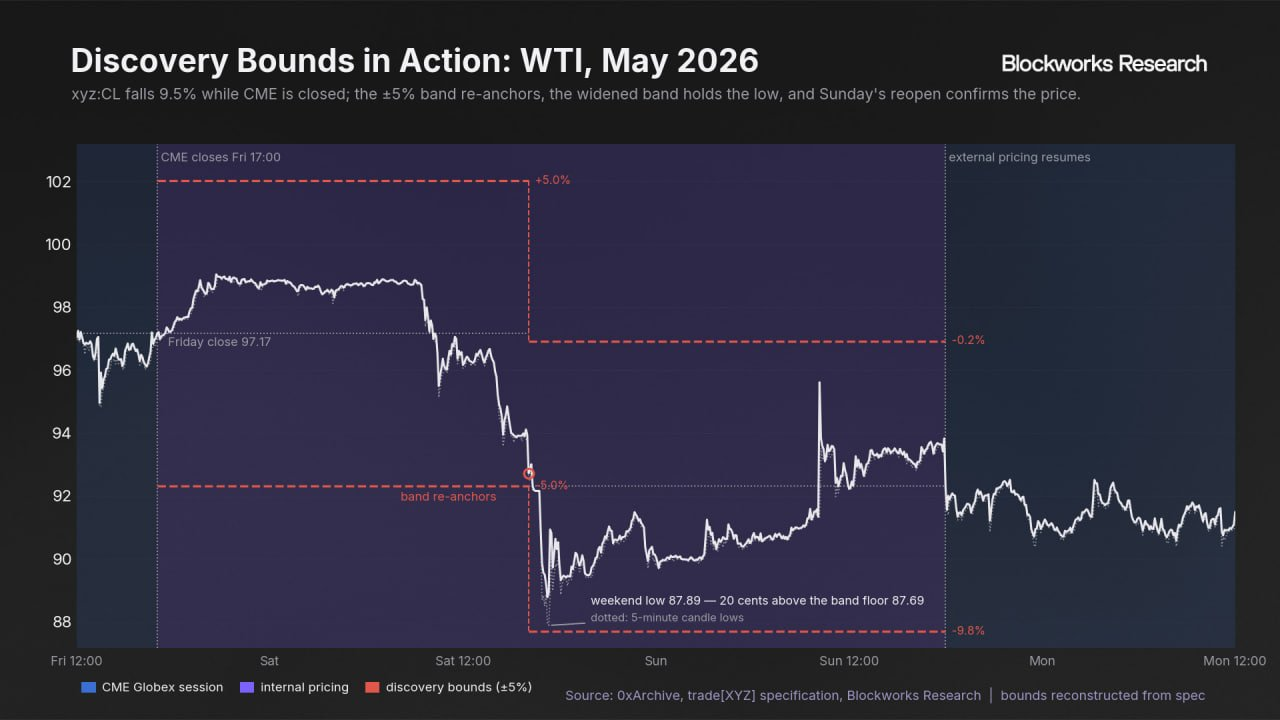
To balance the mark's flexibility against protection for positions carried across the closure, TradeXYZ introduced discovery bounds: a price range that limits how far an instrument can move within the internal period. The band is generally configured to 1/max-leverage, ±5% for WTI at 20x and ±2% for SP500 at 50x, ensuring that a position opened at the last external price cannot be driven past liquidation during weekend price discovery, even at maximum leverage. The band has since been adjusted for several markets, such as WTI, that reached their limits: under consistent pressure it may now re-anchor, up to twice for WTI, before hardening until the reopen, but the invariant remains a maximum deviation the mark cannot exceed.
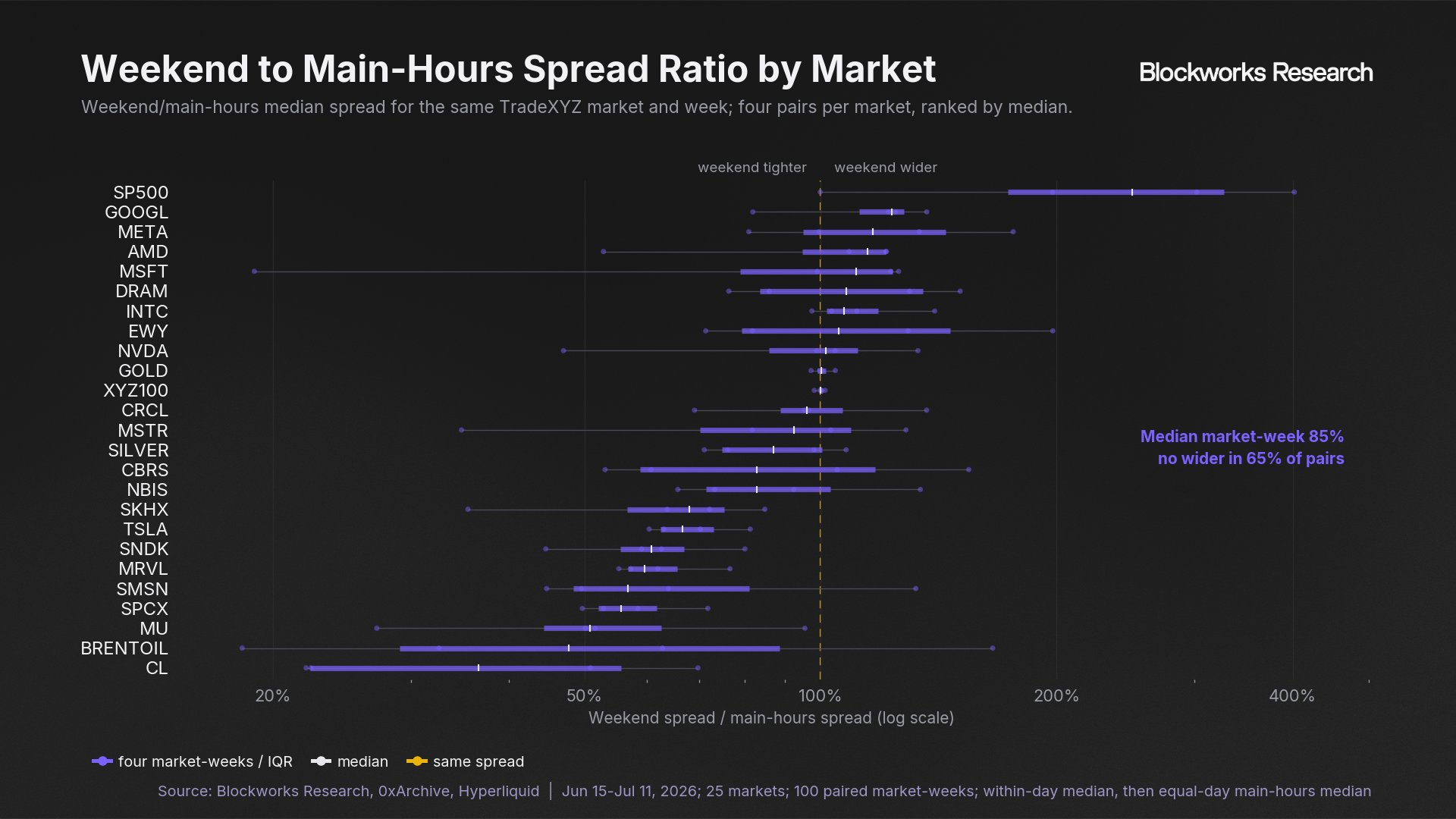
And just as the RWA perpetuals proved robust in their external sessions, the internal sessions delivered similar results. Compared with each market's own main-hours baseline, weekend spreads ran at 85% of that level, no wider in 65 of 100 market-weeks, and the pooled distributions tighter at every reported quantile, 1.43 against 1.77 bps at the median.
However, while spreads held, depth thinned, retaining 50%, 41%, and 31% of its external level within 5, 10, and 25 bps. The shallower book came with smaller flow, the median order falling from $471 to $106, roughly four times smaller, yet typical fills still matched external sessions against the prior mark, 1.58 bps against 1.89, with the upper tail widening to 41.2 against 23.7 bps at p99 as larger orders encountered the thinner book, the natural cost of being the only venue open.
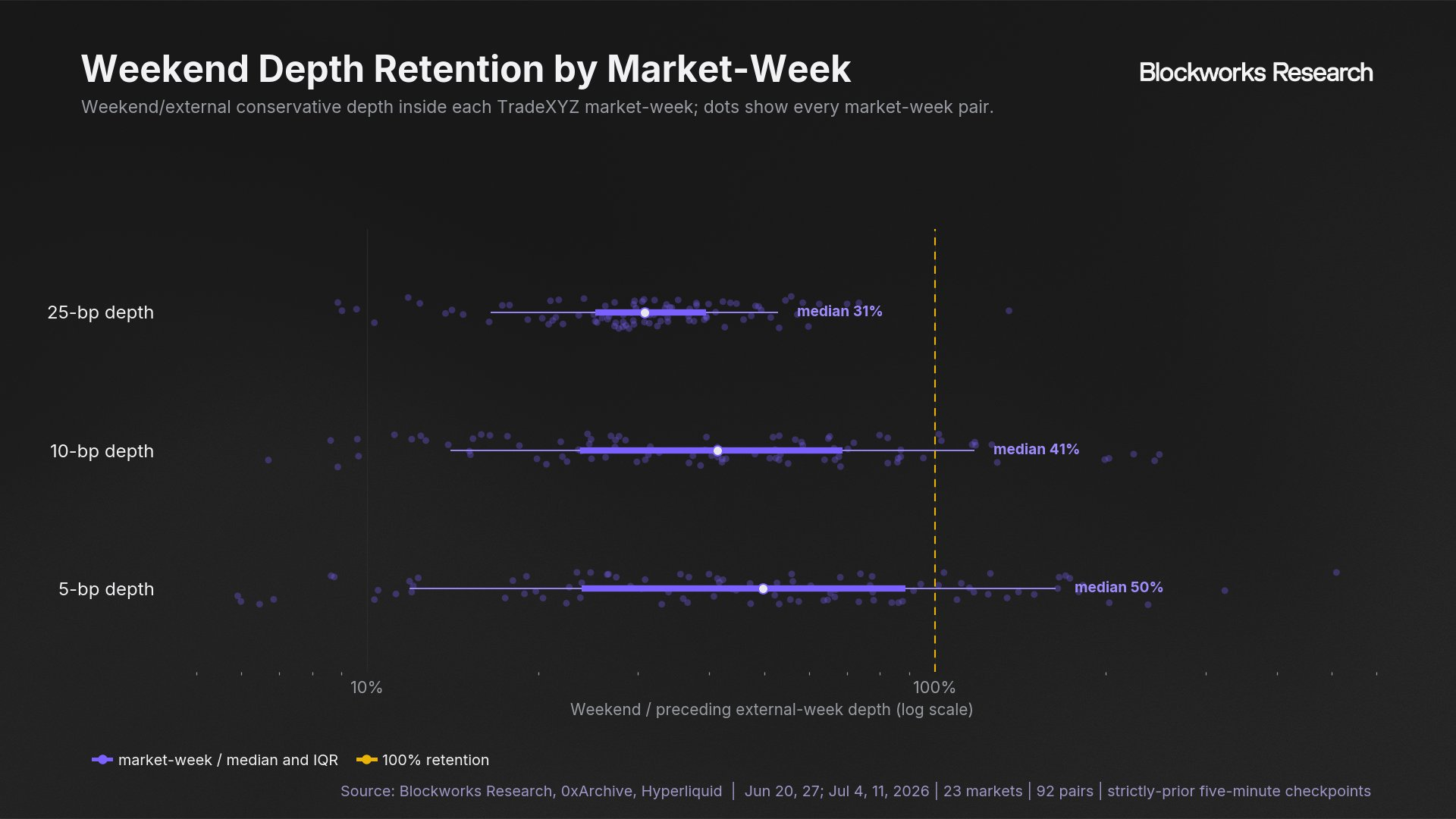
Still, for smaller trades and for traders willing to accept that wider tail, the sessions offer the first permissionless, order-driven weekend market in traditional assets.
Opening Auctions and the Value of Continuous Price Discovery
Having established the theoretical and empirical foundations of 24/7 perpetuals, we turn to what weekend trading does to the traditional markets it references. Weekend price discovery is strictly predictive: the internal price is a forecast of the opening print the market will settle toward, and once the underlying prints, the contract re-anchors to it, with 84% of reopenings back within 10 bps of the oracle inside five minutes and 89% inside fifteen. As a result, there is no channel through which the weekend price can directly disturb the open; the underlying's own prices govern the contract as soon as they exist.
For participants, the instrument replaces waiting for the reopen to absorb two days of information in one print, because the weekend tape prices it as it arrives: equities, with few weekend disclosures, realized 37% of their matched external-session volatility, while energy, moving on weather, outages, and geopolitics, held 64%. Any participant can put on delta-one exposure at a live price, and the convergence that protects the open completes the hedge, since a position carried into the reopen “settles” towards the underlying reference. A portfolio manager can cut equity risk on a Saturday, an options desk can manage delta while its listed hedges are closed, and a refiner can meet a supply shock at once instead of waiting to be marked.
For the wider market, the same price closes an information gap. The weekend is closed from Friday's close until CME's Sunday pre-open, whose indicative price arrives only in the hour before trading resumes, on exchange data feeds, and cannot be traded; Hyperliquid publishes the reference continuously, as a live, executable price anyone can read. This price feed, kept accurate by economic incentives, tells every market participant where the market is expected to open and gives them a basis for decisions, from risk marks to margins, ahead of the print.
Hyperliquid’s weekend market lets any participant express a view or adjust risk through the closure, in either direction and on margin, gives auction participants a continuously formed estimate of fair value before they commit orders to the uncross, and broadcasts that estimate publicly, carrying the closure's information beyond the venue's own participants.
Hyperliquid’s Weekend Prices against the Benchmark
With those functions established, Hyperliquid's weekend prices should be measurably better indicators of the open than the pre-closure boundary, as traders predicting the print pull the price toward it directly and hedgers positioning through the closure pull it indirectly. The prior sections showed the weekend market is orderly; improvement against the stale boundary would show it is informative, evidence that sophisticated participants trade these markets and that their prices carry signal.
To test this, we score two forecasts of the open against one target:
- Pre-closure boundary. The unchanged closing price. It uses no weekend information, so its error is the full move over the closure.
- Final weekend price. Hyperliquid's internal price, taken five minutes before the scheduled reopen.
- Opening reference. The target both forecasts are scored against: the median external-oracle print over the five to ten minutes after the reopen, past the oracle's handoff back to external pricing.
The panel takes one event per market per closure and requires $1 million of weekend volume, yielding 614 market-weekends across 68 markets and seventeen consecutive closures.
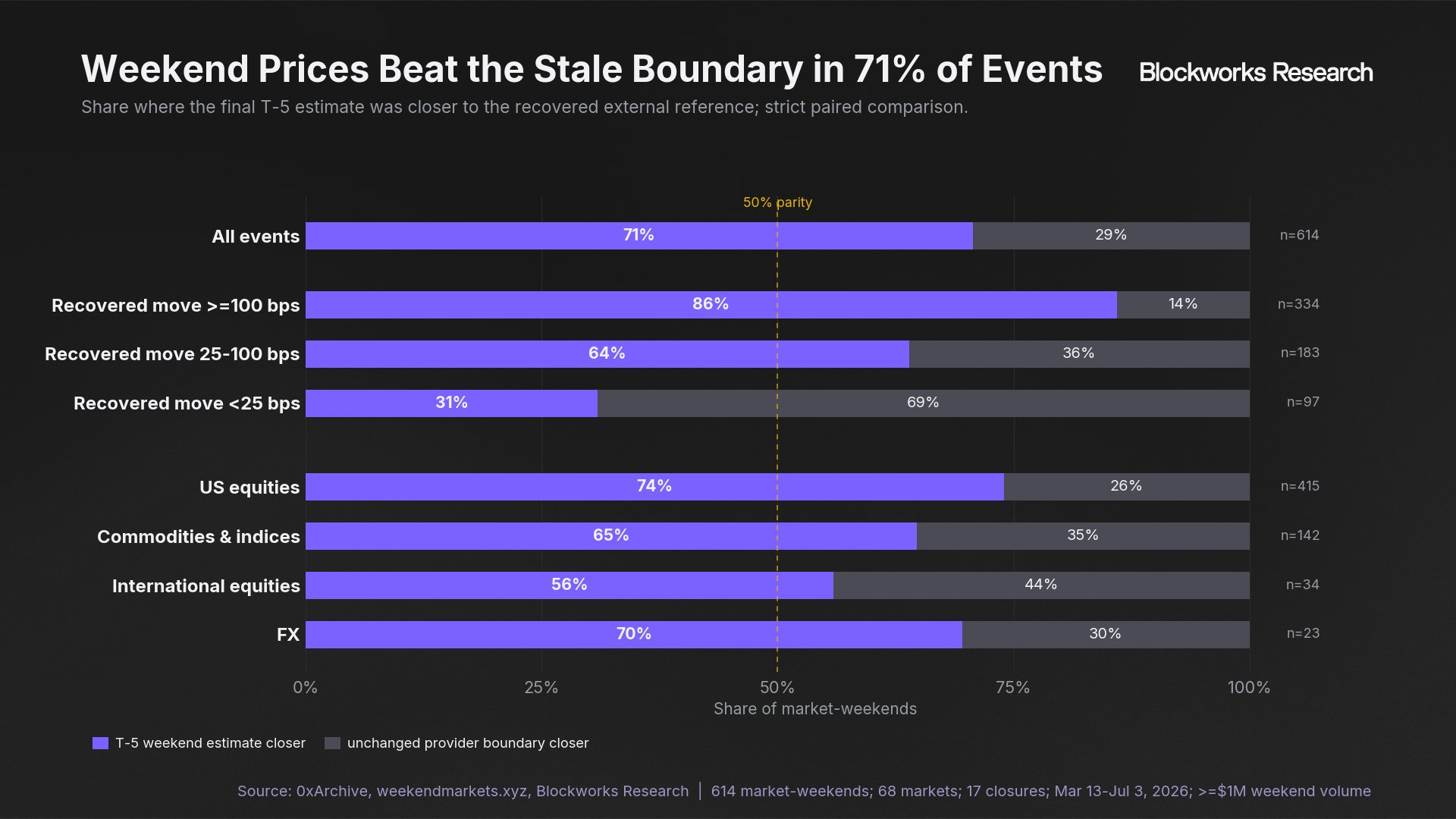
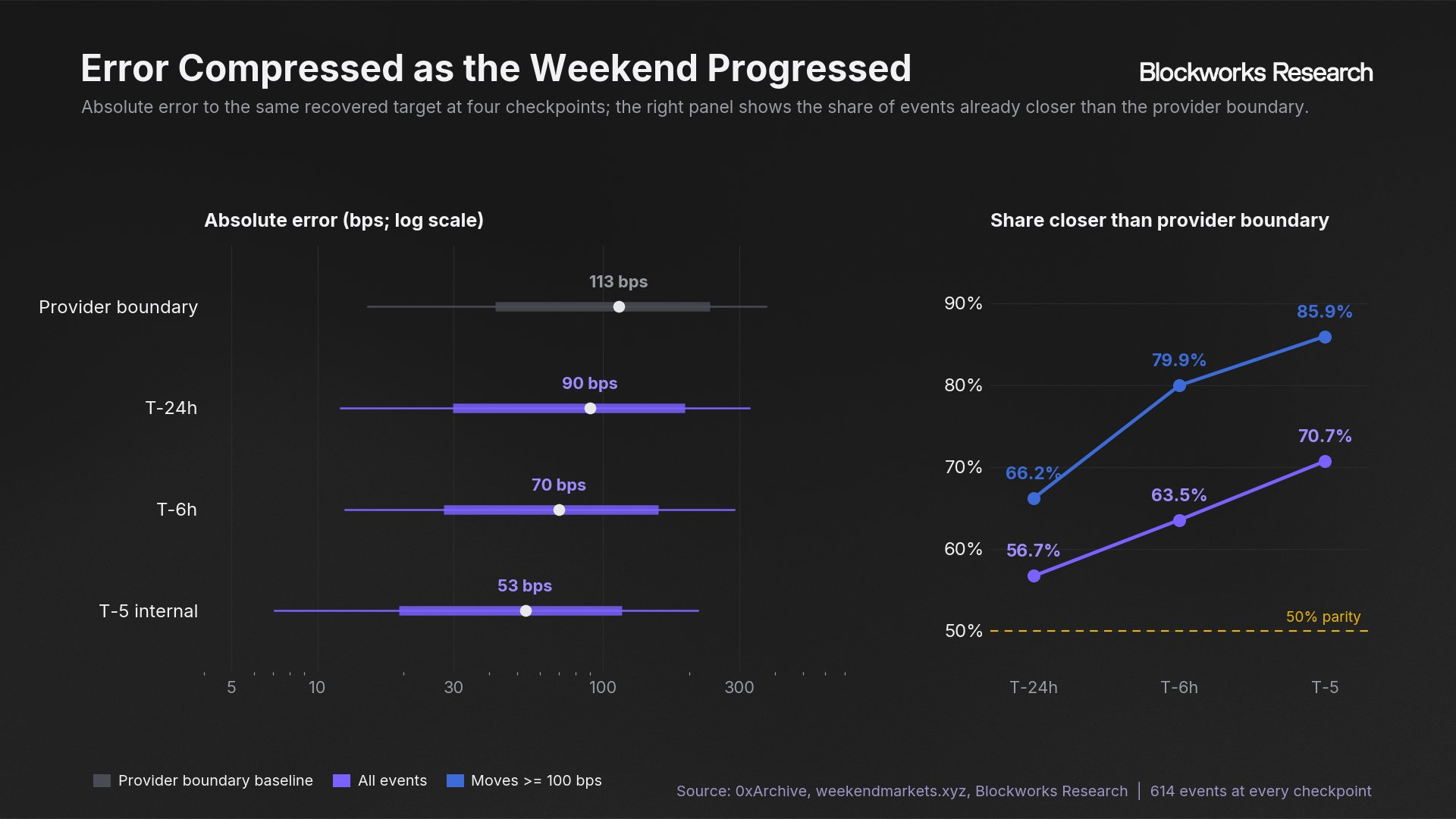
We find that Hyperliquid's weekend prices were generally accurate indicators of the open. The final weekend price finished closer to the reopening reference compared to the pre-closure boundary in 70.7% of the 614 market-weekends, and the share rose with the size of the move, 86% for reopening moves above 100 bps, 64% between 25 and 100, and 31% below 25. As expected, where weekend news opened a material gap against the pre-closure boundary the market priced it, while quiet weekends left little error to beat and no clear direction to call.
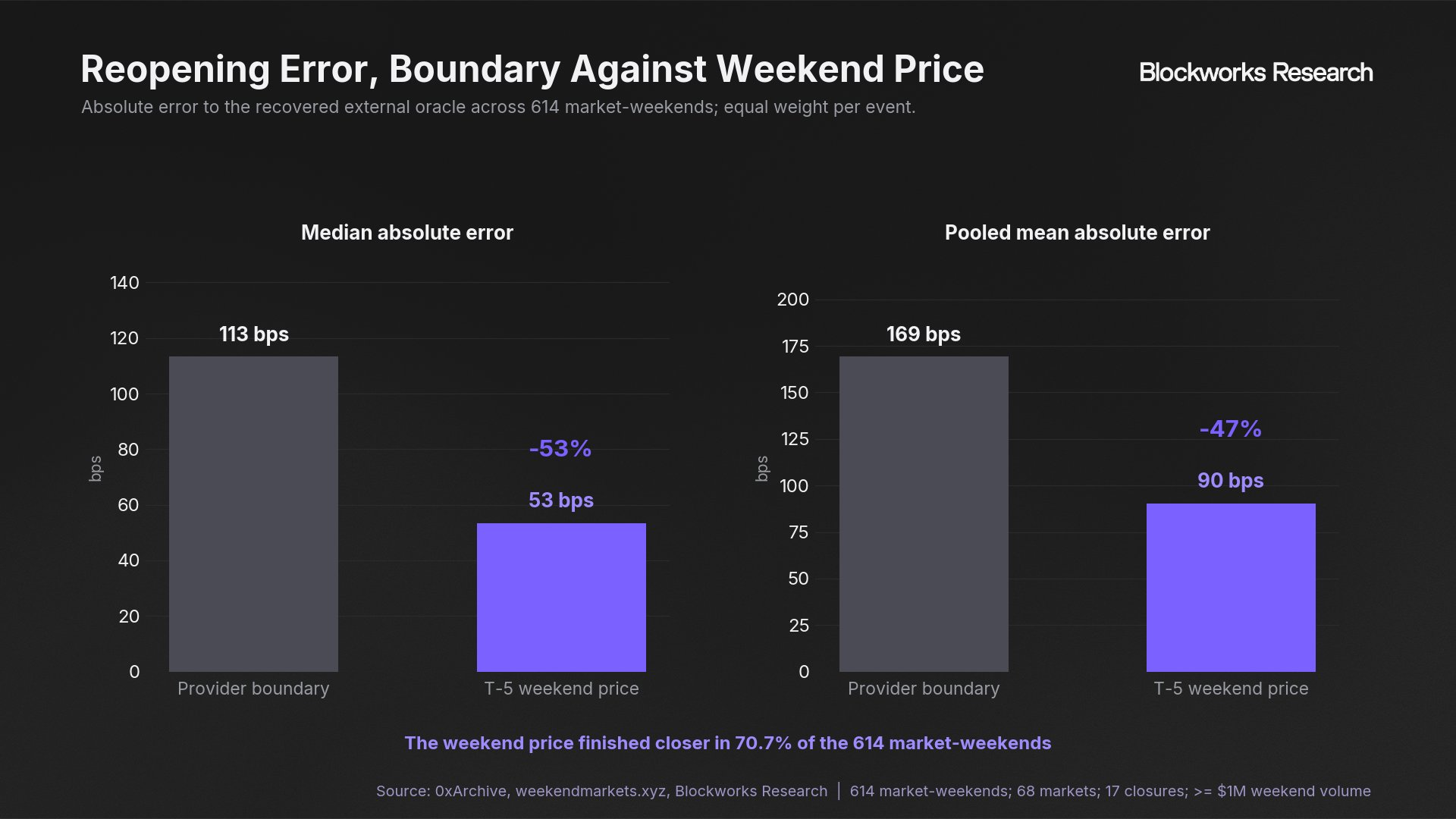
In addition to being directionally accurate, the weekend prices landed close in magnitude, measured by absolute error, the distance between each price and the reopening print. Median absolute error fell from 113.3 bps at the pre-closure boundary to 53.4 at the final weekend price, a 53% reduction; pooled mean absolute error fell 47%, from 169.2 to 90.4 bps; and the median event improved by 37.7 bps.
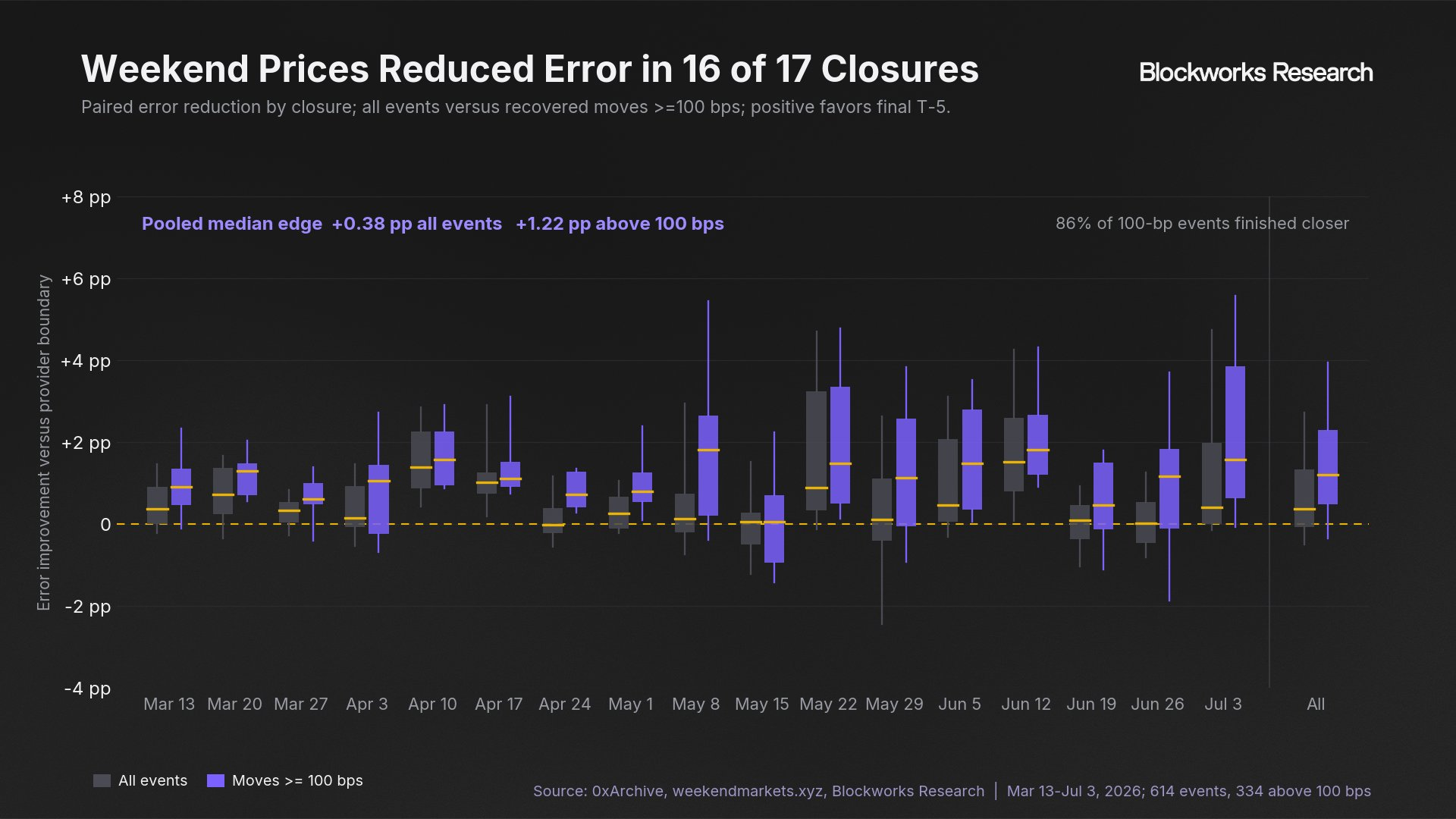
The margin also grew with the move, the pooled median edge running +0.38 percentage points across all events and +1.22 among the 334 reopening moves above 100 bps. And it held weekend by weekend, positive in sixteen of seventeen closures across all events, and in all seventeen among the moves above 100 bps.
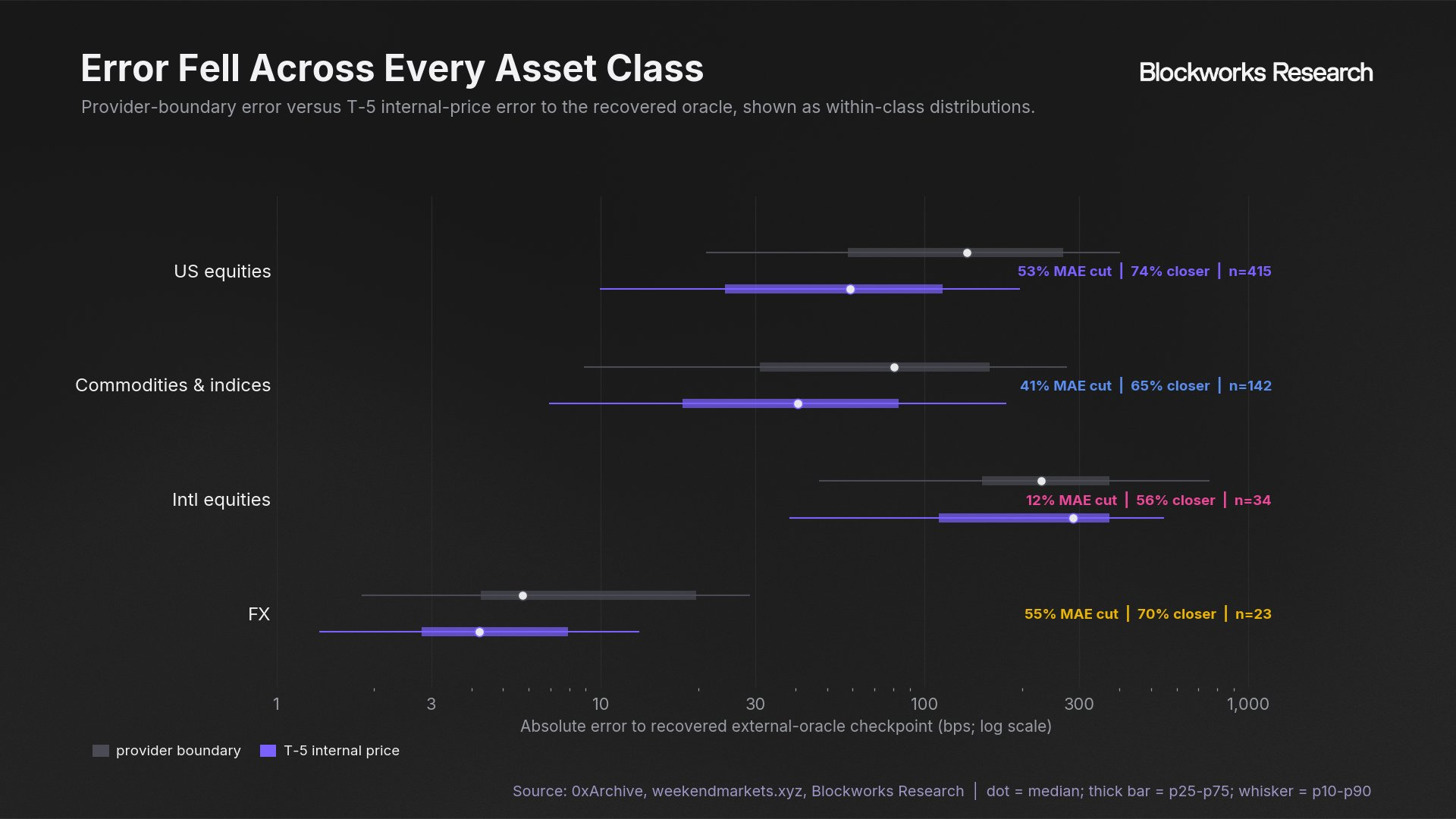
The reduction also held within every asset class, pooled MAE falling 12% in international equities, 55% in FX, 53% in US equities, and 41% in commodities and indices, although international-equity median error rose from 229.4 to 287.7 bps.
As trading was continuous and accumulated over the weekend, median error declined at every checkpoint, 113.3 bps at the boundary, 89.9 a day out, 70.1 six hours out, and 53.4 at the final five minutes, while the share of events closer than the boundary rose from 56.7% to 70.7%, and from 66.2% to 85.9% among moves above 100 bps.
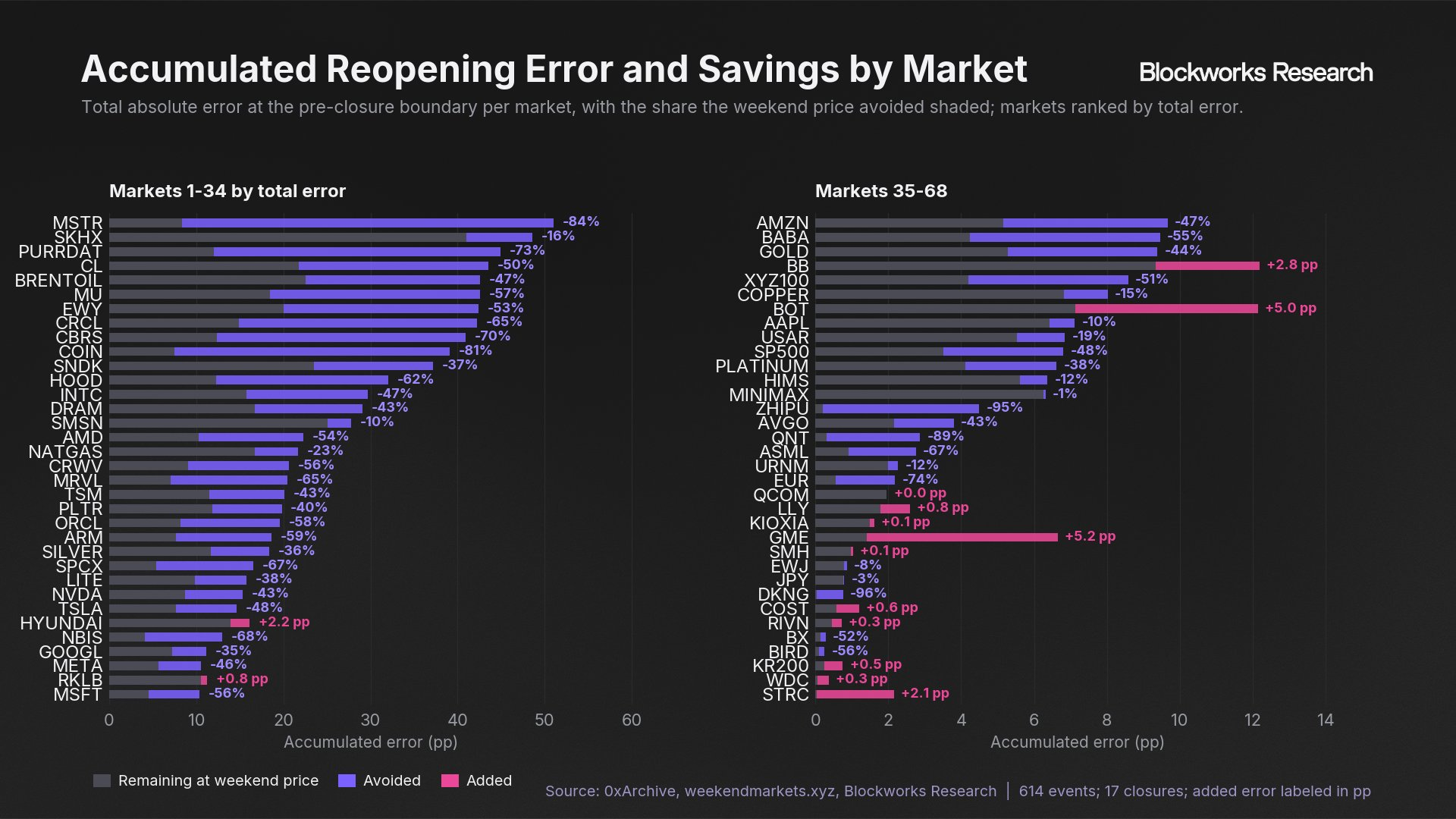
Hyperliquid's pre-reopening prices were, in sum, informative. Across the seventeen closures, they removed 484 of the 1,039 percentage points of reopening error the boundary accumulated, with 54 of 68 markets ending the sample ahead and the deepest error pools cut the hardest.
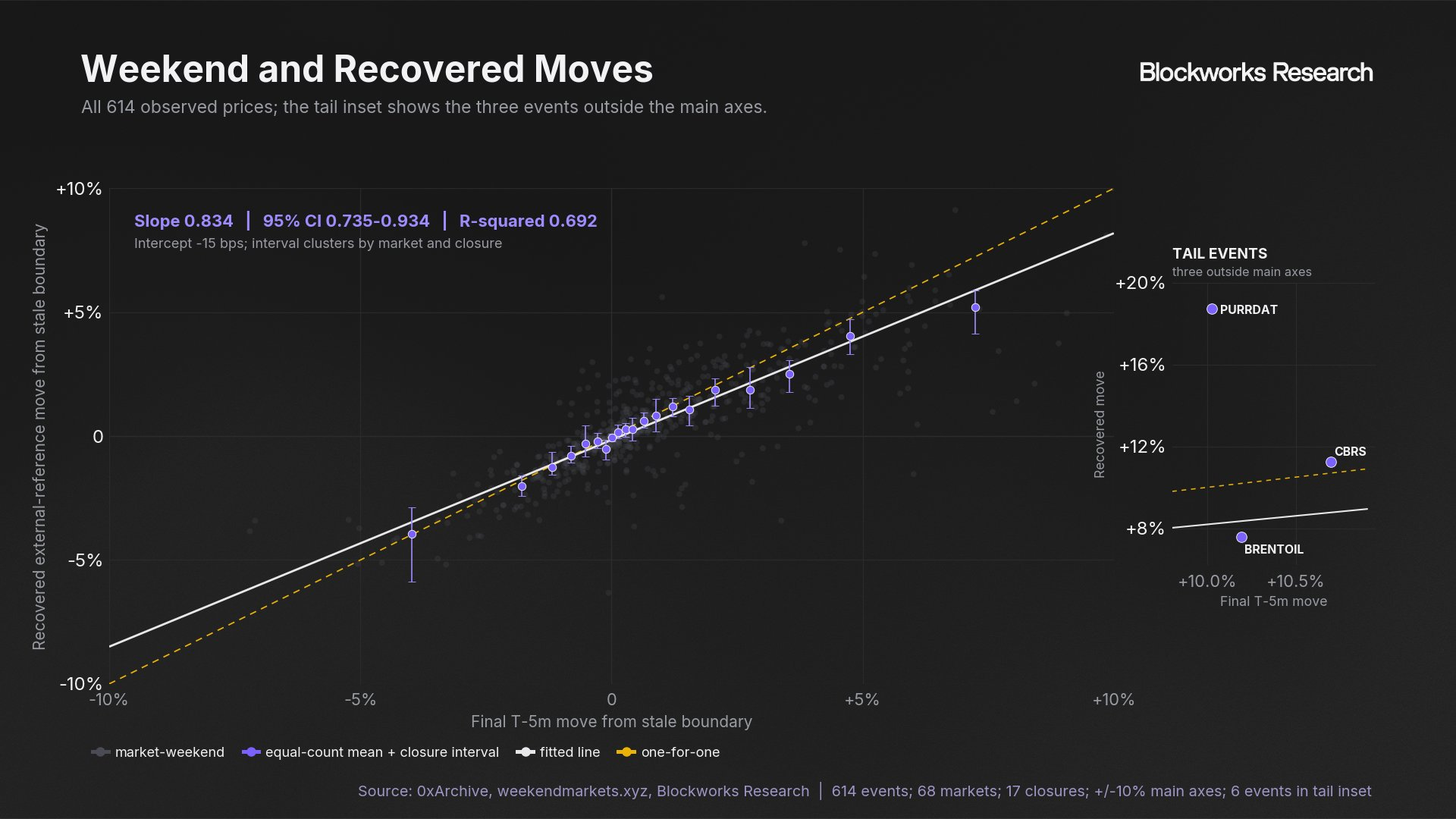
Regressing the opening move on the implied weekend move, to understand whether priced moves arrive at full size, we find that 100 bps priced over the weekend carried into about 83 bps at the reopen, with the implied move alone explaining 69% of the variation. The largest gaps were priced most completely, 49% of a 100–200 bp gap left unpriced against 19% above 500 bps, and the relationship held market by market, positive in all 31 established markets at a median slope of 0.87.
Finally, to make sure these results are not influenced by external factors, we ask which way information flowed in the hour before trading resumes, when CME's Sunday pre-open accepts orders and calculates an indicative opening price from pending interest. If market makers quoted Hyperliquid off that print, the final hour's accuracy would be inherited and a repricing would mark the indicative's arrival. Across the 74 futures-linked reopenings, median error was 57 bps at T-65, the last checkpoint before order entry begins, against 59 at T-5, and the median event moved 0.3 bps through the hour, with no repricing when the indicative posted.
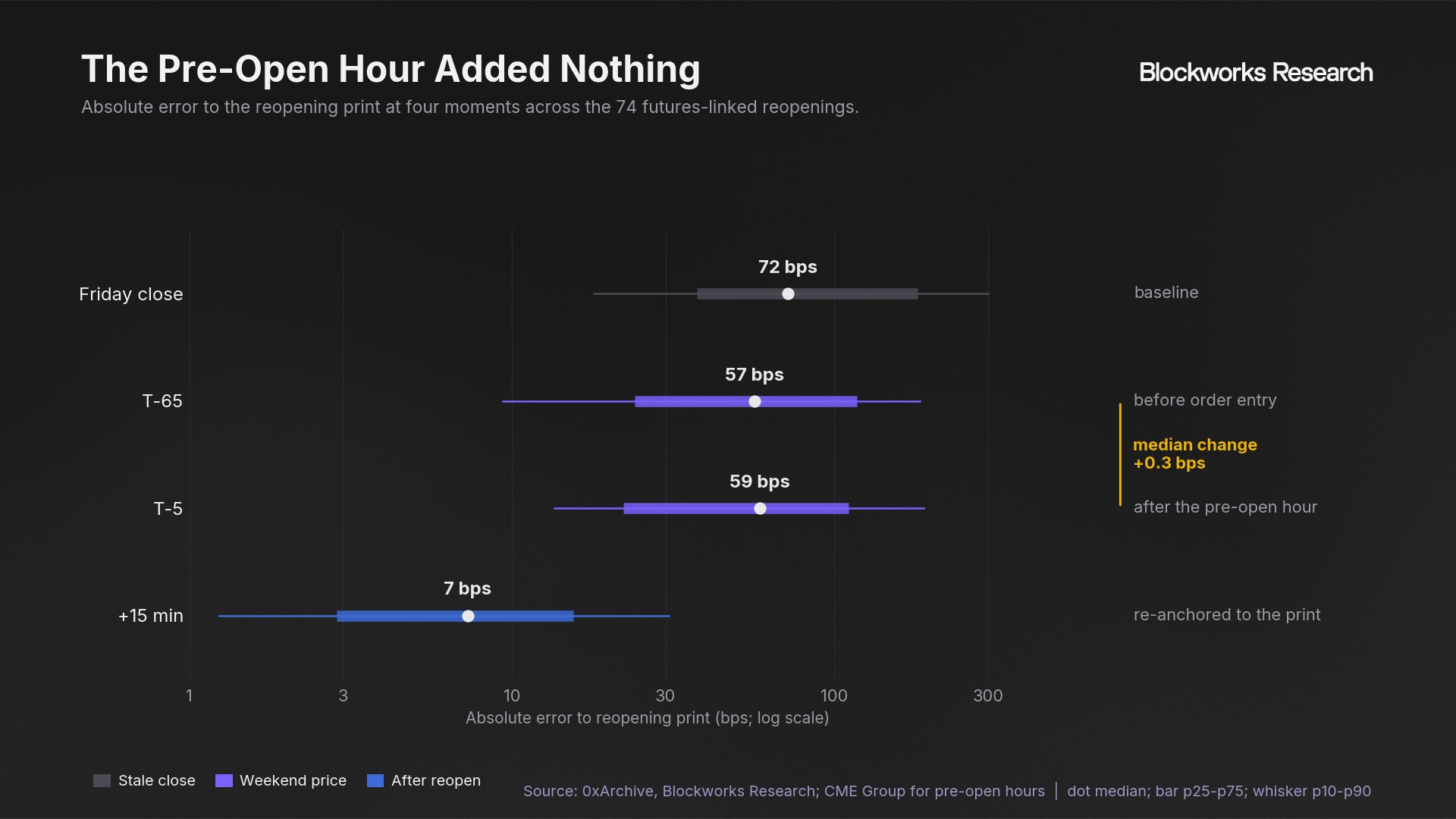
Hyperliquid's prices had, over the weekend, incorporated enough information that they held their level even once the exchange's indicative opening price appeared.
Conclusion
In our December 2025 report on equity perpetuals, we argued that equity perpetuals, and RWA perpetuals more broadly, would become a defining theme of 2026. Eight months later, TradeXYZ's trailing 30-day volume has risen from $6.9 billion to $110.6 billion, a sixteen-fold increase, and it now accounts for 52% of all Hyperliquid perpetual volume, up from 4.3%.
This growth, although substantial, was not unexpected; it was telegraphed by Hyperliquid's zero-to-one improvements in market infrastructure. Hyperliquid simplifies market creation by providing exchange, clearing, and settlement infrastructure that new markets inherit rather than rebuild. Market rules live in onchain logic and the protocol enforces them, so every deployment starts with the same institutional-grade foundation. Non-custodial frontends enable a disintermediated market structure: users control their own wallets, and no intermediary ever stands between a trader and the market.
Deployment separates along the same lines, splitting functions traditionally bundled inside a single exchange between HIP-3 deployers, who design and launch markets, and the Hyperliquid layer itself, which provides neutral execution, clearing, and settlement that no single party controls. Trading and settlement systems have traditionally been the province of specialized technology vendors, which build and license them to exchanges and clearinghouses at a premium. Hyperliquid makes that same infrastructure a public utility: deployers, interfaces, and even registered exchanges can plug into the protocol and inherit its matching, clearing, and settlement.
The results of the weekend markets and RWA perpetuals are therefore a reflection of broader dynamics, of what happens when global participants can provide, price, and manage risk on one layer with one set of rules rather than across fragmented systems. We believe the trend continues, from the pre-IPO listings of today to future HIP-4 markets, as permissionless, performant systems built for broad access keep extending, asset by asset, into the hours, markets, and products traditional structure has left unserved.
Appendix
Our research includes an appendix spanning methodology, data collection, and deeper dives into the microstructure across every part of the analysis. Due to X's limits on images per post, this version does not include it, but it is freely accessible on Blockworks Research.
Disclaimer
This research report has been funded by the Hyperliquid Policy Center. By providing this disclosure, we aim to ensure that the research reported in this document is conducted with objectivity and transparency. Blockworks Research makes the following disclosures: 1) Research Funding: The research reported in this document has been funded by the Hyperliquid Policy Center. The sponsor may have input on the content of the report, but Blockworks Research maintains editorial control over the final report to retain data accuracy and objectivity. All published reports by Blockworks Research are reviewed by internal independent parties to prevent bias. 2) Researchers submit financial conflict of interest (FCOI) disclosures on a monthly basis that are reviewed by appropriate internal parties. Readers are advised to conduct their own independent research and seek advice of qualified financial advisor before making investment decisions.
The information contained in this report and by Blockworks Inc. and related affiliates is for general informational purposes only and is not intended to provide legal, financial, or investment advice. The report should not be construed as an offer or solicitation to buy or sell any security, token, or financial instrument and does not represent any recommendation or endorsement of any investment or financial product or service. Blockworks Inc. and related affiliates are not registered as a securities broker-dealer or an investment advisor in any jurisdiction or country.