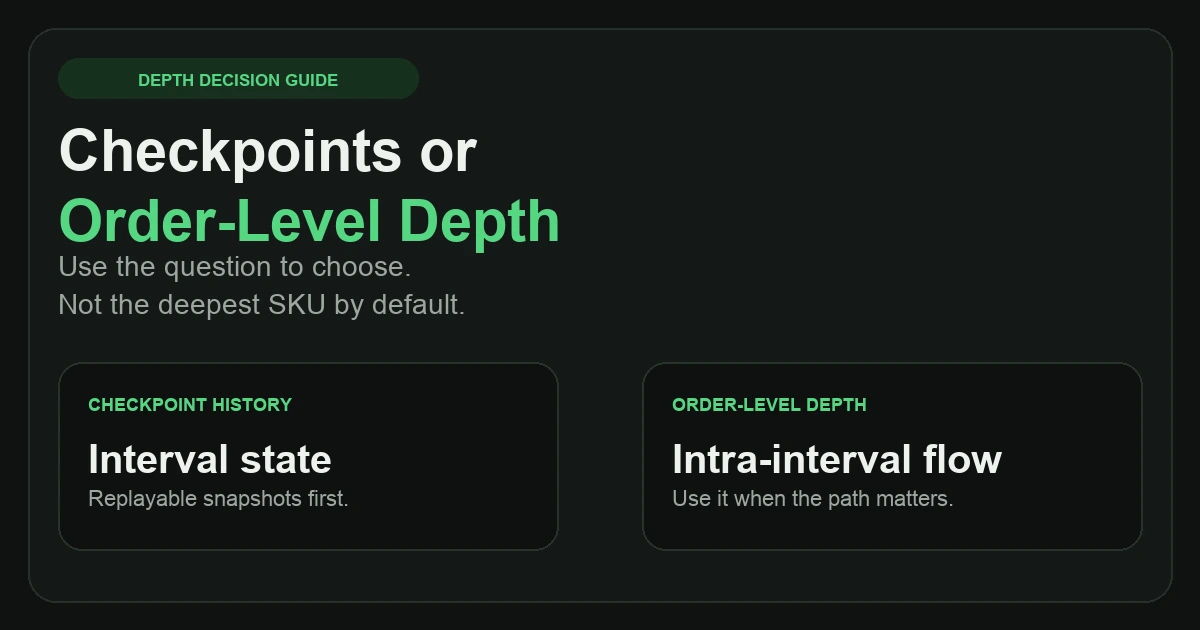
Depth decisions are expensive when the question is fuzzy. If interval snapshots already answer it, buying full order-level history is waste. If the answer changes inside the interval, checkpoint data will stop short. Start with the question, then pick your tooling shape.
This guide follows the broader native-versus-managed decision. The narrower decision here is whether checkpoint history is enough or whether you have crossed into order-level depth, L4, order flow, or TP/SL territory.
Short answer: checkpoint history is enough when you care about state at intervals and do not need to explain what happened inside them. Order-level depth becomes necessary when queue movement, trigger behavior, user attribution, or intra-interval order flow can change the answer.
In 30 Seconds
Start with checkpoint history when interval state already answers the question.
Order-level depth matters when the missing detail inside the interval changes the conclusion.
Build is positioned around replay and checkpoint history. Pro is positioned around order flow, TP/SL, and full L4 work.
Start at the shallowest surface that preserves the question, then move deeper only when the interval hides the answer.
Three practical layers of depth
Layer | Typical surface | How to decide |
|---|---|---|
Top-line market history | Trades, candles, funding, open interest, liquidations | Use it when you need regime context, timing, or broad filters, not state reconstruction. |
Checkpoint history | Replay state and | Use it when interval state is enough and you need reproducible reruns. |
Order-level depth |
| Use it when the answer changes because of what happened between checkpoints. |
Route-level guide
Question | Public route or surface to inspect first | Why |
|---|---|---|
Can replay alone explain the event window? | Start with replay lifecycle and state handling before you assume you need deeper depth. | |
Do I need checkpoint state at intervals? |
| Checkpoint history is the first test when interval snapshots may already preserve the answer. |
Do I need to study order placement and cancellation pressure? |
| Order flow helps when the path between checkpoints matters more than the checkpoint itself. |
Do triggers or TP/SL events matter? |
| Trigger history is the right proof surface when the trigger sequence is part of the answer. |
Do I need full order-level reconstruction? |
| Full L4 is for path-dependent questions where interval checkpoints are not enough. |
When checkpoint history is enough
You want replayable snapshots for backtests and incident reviews.
You are measuring changes at discrete intervals rather than queue behavior tick by tick.
You need something closer to state reconstruction than candles offer, but not user attribution or trigger history.
You care more about repeatable reruns than every intra-interval order mutation.
0xArchive's Build tier enables replay and checkpoint history, with detailed REST API docs to cover deeper order-level routes.
Do not buy depth for these cases
Broad regime filters, volatility context, and top-line event timing.
Discrete replay snapshots that already explain the incident window.
Offline studies where a checkpoint or export already preserves the state you need.
Cases where you are only reaching for depth because it feels safer, not because the answer changes between intervals.
When order-level depth is actually necessary
You are studying queue position, microstructure behavior, or what happened between checkpoints.
You need to inspect order flow, TP/SL triggers, or user-attributed order behavior.
You need full L4 reconstruction rather than interval checkpoints alone.
You are investigating path-dependent events where the order sequence matters as much as the resulting state.
One-symbol depth test
Run one event window twice. First, inspect the window through checkpoint history or replay. If checkpoint replay already explains the event, stay in Build territory. If the unresolved answer lives between checkpoints, test the matching Pro-level surface on the same symbol and the same window.
Pick one event window where the answer may depend on intra-interval behavior.
Review it first through checkpoint history or replay.
Write down what remains unresolved.
If the unresolved question lives inside the interval, inspect the matching order-level route.
Use the parity guide if you also need to compare native and managed rerun burden on that same window.
Build versus Pro as one decision rule
Use Build when the unanswered question is still about replay, checkpoint state, or interval-level reruns. Use Pro when the unanswered question depends on order-level behavior, trigger history, or full L4 reconstruction.
Final takeaway
Checkpoint history already answers a large share of rerunnable research and replay questions. Pay for order-level depth when the missing behavior inside the interval changes the conclusion.
Start the 14-day Build trial with no credit card, test one event window at checkpoint depth, and only move to Pro if the unanswered question lives inside the interval.
Related reads
Hyperliquid Historical Data API for Backtesting: Native API vs 0xArchive
How to Run a One-Symbol Parity Test Before You Migrate Historical Data
When Agent Workflows Need Replayable Market Data, Not Just Raw API Access